
The galette is supposed to be the forgiving pastry — no pie plate, no crimping. Until it isn’t: juice pooling where the bottom crust should be, fruit leaking through the folds, a crust cracking like dry earth. All three have mechanical causes and fixes — a galette is a pie without a pan, so every problem is moisture management and dough handling.
Quick diagnosis: Soggy bottoms mean the filling’s juice never got hot enough, fast enough — bake on a preheated steel at 400–425°F (200–220°C) with a thickener. Leaks mean the folds weren’t overlapped and sealed. Cracks mean the dough was too cold or too dry when folded.
Soggy bottom: the filling steamed the crust
A galette bottom goes soggy when fruit juice pools under the dough faster than heat drives it off — the dough boils in fruit syrup instead of crisping.
Why it happens: Oven not hot enough, galette launched onto a room-temperature sheet (which insulates the bottom), juicy fruit with no thickener, or the assembled galette sat before baking while fruit macerated into raw dough.
The fixes, in order of impact:
- Bake on a preheated steel or stone. The single biggest upgrade. A 45-minute preheat at 425°F (220°C) means the bottom hits screaming heat on landing — the crust sets before juice soaks in. A preheated dark heavy sheet is the budget version. Never launch onto a cool sheet.
- Thicken the filling. Toss fruit with 1–2 tablespoons cornstarch (or 2–3 of flour) plus sugar. The starch must actually boil to gel — another reason the hot oven matters. You want the filling visibly bubbling in the center, not just at the edges.
- Add a moisture barrier. A thin layer of frangipane, fine breadcrumbs, or semolina under the fruit absorbs juice from below while adding flavor. The French bakery trick is frangipane; the farmhouse trick is breadcrumbs.
- Assemble and bake immediately. Once fruit hits raw dough, juice migrates instantly. Have the oven fully preheated and the steel screaming hot before you roll out the dough.
Done looks like: the bottom is golden-brown and crisp when you lift an edge — not pale, floppy, or translucent.
Leaking: the folds weren’t a seal
Juice escaping through the folds and caramelizing into a bitter puddle is a construction failure. Galette folds look casual but do structural work — they’re all that stands between a pound of juicy fruit and your oven floor.
Why it happens: Folds too small or barely overlapping, no egg-wash seal, fruit piled too close to the edge, or the galette went in warm so the folds slumped open.
The fixes:
- Fold generously and overlap. Leave a full 2-inch border, fold up and over in pleats overlapping at least an inch, like shingles. Skimpy half-inch folds look rustic and leak like sieves.
- Egg-wash the folds into place. Brush the border with beaten egg, press each pleat to seal — the proteins glue layers as they bake — then egg-wash the whole border for color.
- Chill before baking. Fifteen to twenty minutes in the refrigerator firms the butter so folds hold instead of slumping in the oven’s first minutes. Cold dough, hot oven — the eternal pastry rule.
- Pile, don’t spread. Mound fruit tall in the center rather than flat toward the edges — less fruit pressing against the folds, gravity working with you.
Leaking mid-bake? Don’t open the oven — the temperature drop worsens sogginess. Let it finish; a leaked galette still tastes excellent.
Cracked crust: dough too cold, too dry, or both
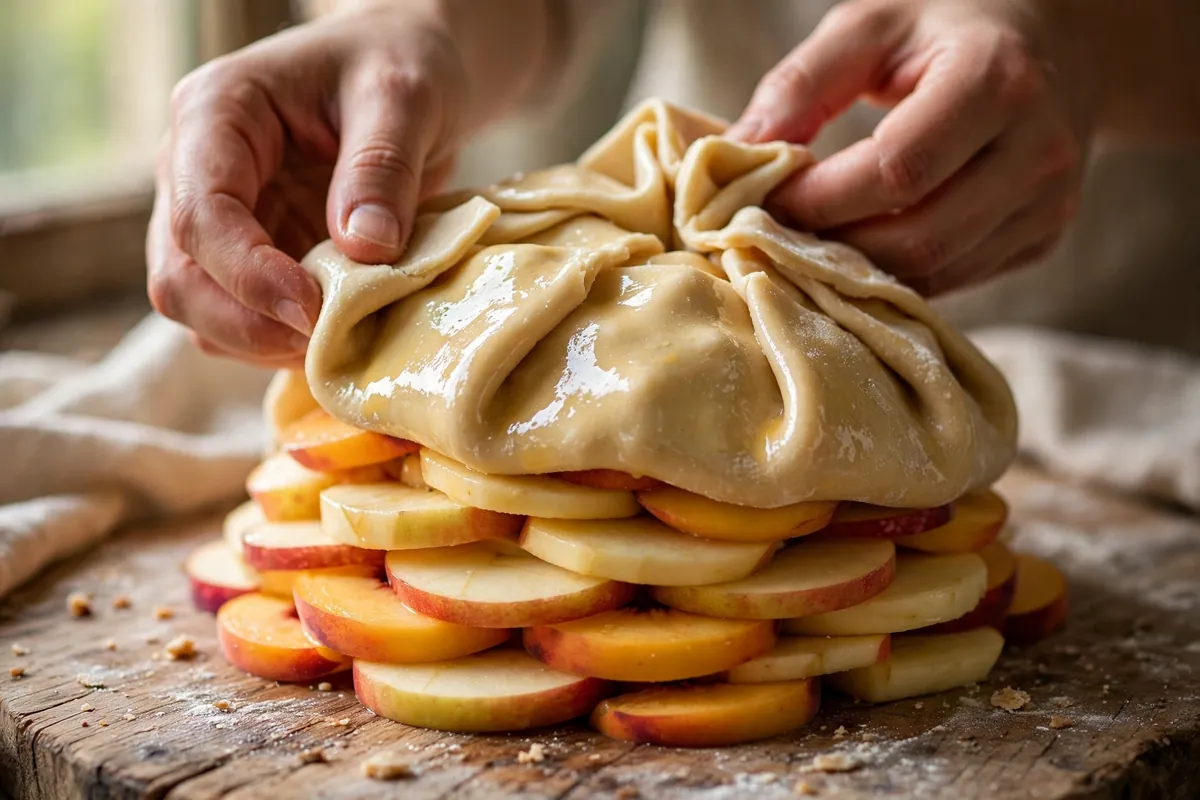
Cracks in the folded border are a dough-condition problem. Pastry cracks when bent cold (rigid butter, no pliability) or when too dry (too little water to hold flour together under stress). The fold is the highest-stress point, so weakness shows there.
Why it happens: Rolled and folded straight from the refrigerator, under-hydrated from the start, or dried out during rolling (too much bench flour, too long on the counter).
The fixes:
- Temper before folding. Let the rolled dough sit 5–10 minutes at cool room temperature until pliable — if edges crack when lifted, it’s still too cold. Don’t let it go warm and greasy; there’s a window, and you’ll feel it.
- Patch, don’t panic. Press a dough scrap over the crack with a dab of water as glue, smooth with a finger, egg-wash over it. After baking the patch is invisible — pros patch galettes constantly.
- Hydrate properly next time. Chronically cracking dough needs slightly more water — it should just hold together when squeezed, no dry crumbly bits. A teaspoon of vodka or vinegar replacing water also helps: less gluten forms, so the dough stays tender and pliable. Rest a full hour (or overnight) after mixing so flour fully hydrates.
The bake: hot, bottom-heavy, patient
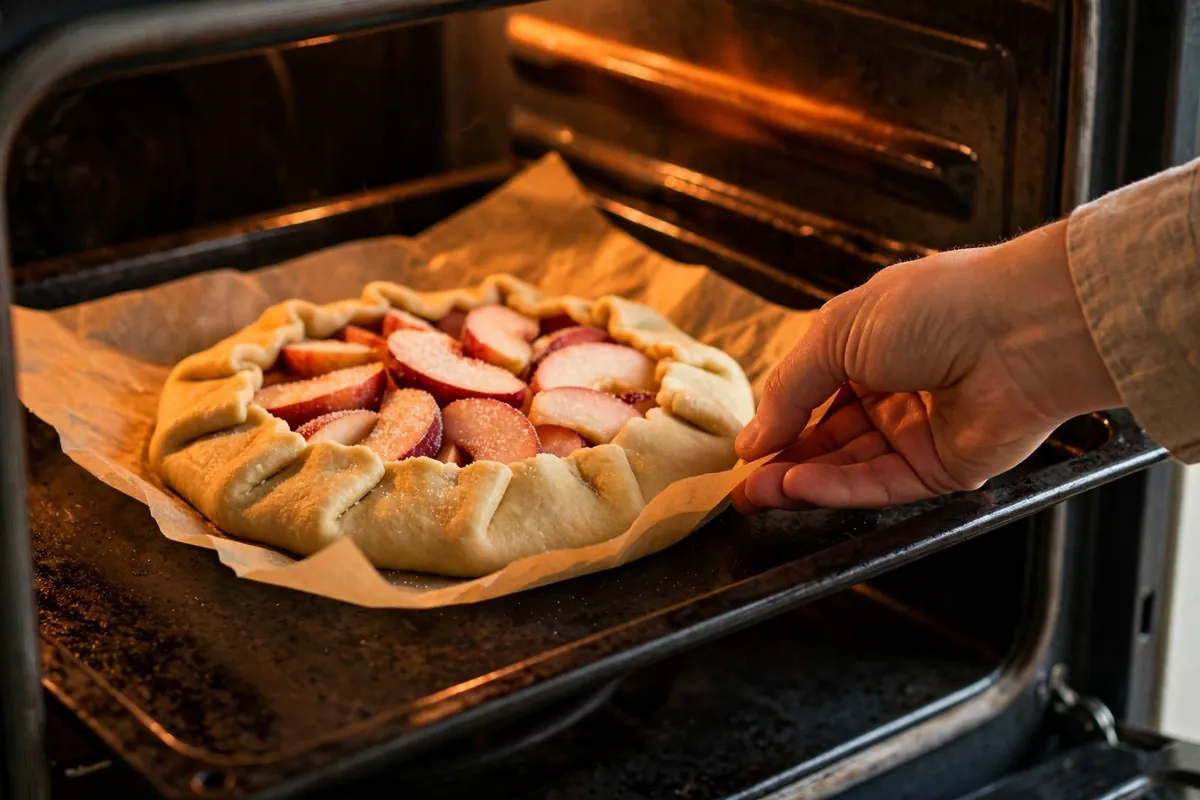
Oven at 400–425°F (200–220°C) — 425°F (220°C) for juicy fruit, 400°F (200°C) for delicate — steel preheated 45 minutes, galette assembled fast and chilled 15 minutes, baked 35–45 minutes until the filling bubbles visibly in the center and the crust is deeply golden. The bubbling center is your doneness signal, not the timer: starch-thickened juice must boil to set. Tent the edges with foil if they brown too fast.
What about the failed galette on your counter?
A soggy galette is still safe and delicious warm — serve in bowls with juices spooned over like a pandowdy. Trim bitter burnt-juice bits off a leaker; serve a cracked one with confidence, since cracks are cosmetic. Every failure reheats well: 10 minutes at 375°F (190°C) re-crisps the bottom noticeably.
FAQ
Is a soggy galette safe to eat?
Yes — sogginess is texture, not safety, as long as the filling cooked through. Serve warm in bowls with the juices, or re-crisp 10 minutes at 375°F (190°C).
Can I fix a galette that’s leaking in the oven?
Mostly no — opening the door drops the temperature and worsens the accompanying sogginess. Let it finish, then trim bitter burnt-juice bits before serving. Prevent it with generous overlapping folds sealed in egg wash and a 15-minute chill before baking.
Why did my galette dough crack when I folded it?
Too cold or too dry. Cold butter makes pastry rigid — temper the rolled dough 5–10 minutes until pliable. Chronically cracking dough needs slightly more water, or a spoonful of vodka/vinegar replacing water for tenderness. Patch cracks with scraps and water; they bake invisible.
How do I stop fruit making my galette soggy?
Four defenses: preheated steel or stone at 425°F (220°C), 1–2 tablespoons cornstarch tossed with the fruit, a frangipane or breadcrumb moisture barrier, and assembling right before baking. The preheated steel is the single biggest fix.
Can I make galette dough ahead?
Yes — up to 3 days refrigerated or 3 months frozen; the rest improves pliability as flour hydrates. Thaw overnight in the fridge, temper 10–15 minutes before rolling so it folds without cracking.
What temperature do I bake a galette at?
400–425°F (200–220°C): 425°F (220°C) for juicy berries and stone fruit, 400°F (200°C) for apple or pear. Bake 35–45 minutes until the filling bubbles in the center — that bubbling is the doneness signal, since the starch must boil to set.
Related troubleshooting: Soggy Bottom Pie? How to Get a Crisp Base Every Time · Pie Crust Shrinking in the Oven · Why Did My Éclairs Collapse? Choux Pastry Science