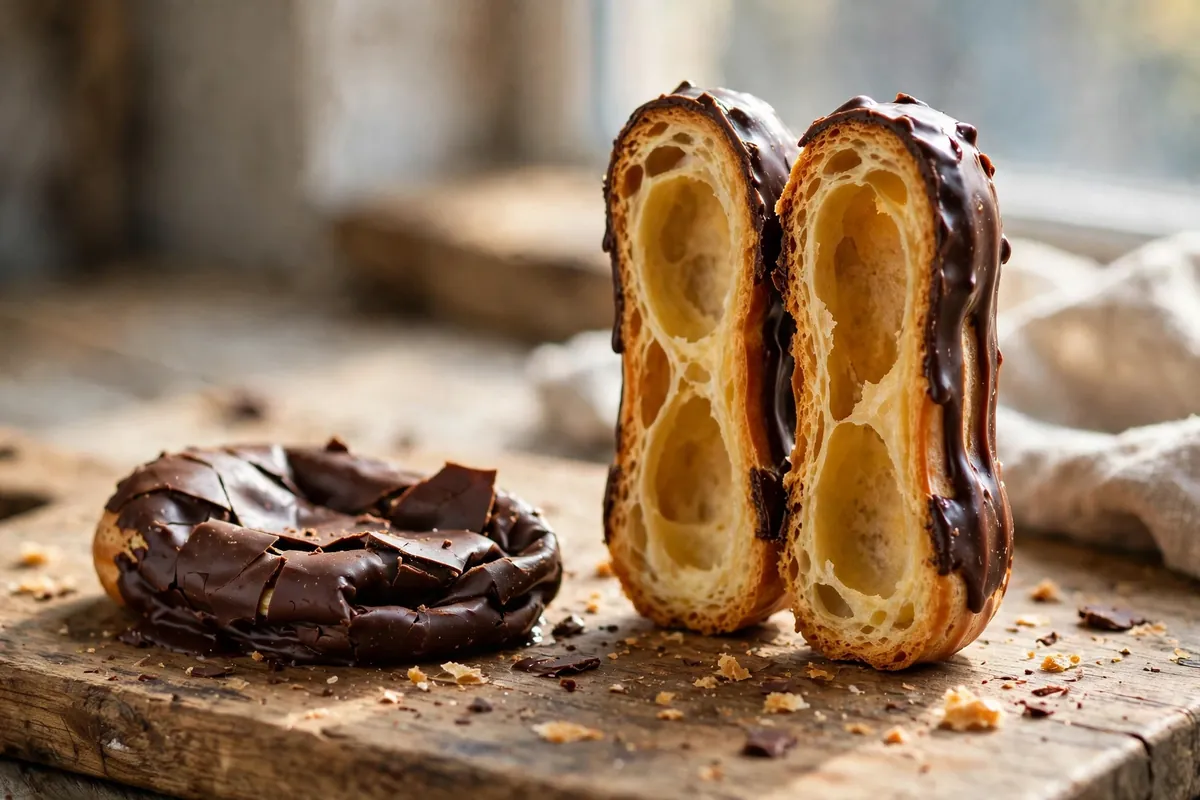
Choux pastry is the great heartbreaker of baking: it asks for nothing but water, butter, flour, and eggs, it puffs like a miracle in the oven — and then it collapses into a sad, flat strip if any single step was wrong. I’ve watched perfect-looking éclairs deflate on the cooling rack, and every collapse traces back to the same science. Understand how choux actually works and the failures become predictable — and preventable.
Quick diagnosis: Collapsed éclairs were underbaked 9 times out of 10. Choux must bake until fully dried and deeply golden — pull them when they “look done” and the steam trapped inside condenses as they cool, collapsing the shell. If your éclairs were pale gold and soft when you pulled them, start with cause #1.
Here’s the science in one paragraph: choux has no chemical leavener and no yeast. The rise is pure steam — water in the dough vaporizes in a hot oven and inflates the paste like a balloon, while egg proteins coagulate and starches gelatinize into a rigid shell. The shell must be FULLY set and dried before you take it out. Pull early and the steam condenses as it cools, the wet walls cave in, collapse.
1. Underbaked — pulled before the shell was dry
The number one cause, and it’s not close. Choux looks done before it is done: golden outside, puffed and proud — but inside, the walls are still moist and flexible. Out of the oven’s heat, the trapped steam cools and condenses, the wet walls can’t hold their shape, and down it comes. This is the collapse most bakers experience.
How to tell: The éclairs were pale-to-medium gold rather than deep golden brown, felt light but slightly soft (not crisp and firm), and may have deflated within minutes of leaving the oven. If you broke one open, the interior walls looked moist or eggy rather than dry.
The fix: Bake longer and hotter than feels safe. Full-size éclairs need 30–35 minutes at 400–425°F (200–220°C) — until deeply golden brown all over and firm to the touch. The color is your doneness signal: pale gold = wet inside; deep amber = dry and set. When you think they’re done, give them 5 more minutes. Then turn the oven OFF, crack the door, and let them dry 10 minutes in the cooling oven — this finishes the interior without over-browning. A properly baked éclair sounds hollow when tapped on the bottom, like a good loaf of bread (same principle: How to Tell When Bread Is Done).
2. Opened the oven door too early
Every peek costs you. Opening the door in the first 20 minutes drops the oven temperature by 25–50°F and — worse — releases the steam that’s actively inflating the shells. The structure sags mid-build and never recovers; even if it re-puffs slightly, the walls are compromised.
How to tell: You checked on them “just once” around the 15-minute mark and they looked slightly deflated afterward, or never reached full height.
The fix: Don’t open the door for the first 25 minutes, full stop. Use the oven light and the window. Choux is one of the few pastries where peeking genuinely ruins the result — the steam environment is structural, not incidental.
3. Too much egg — the batter was too wet
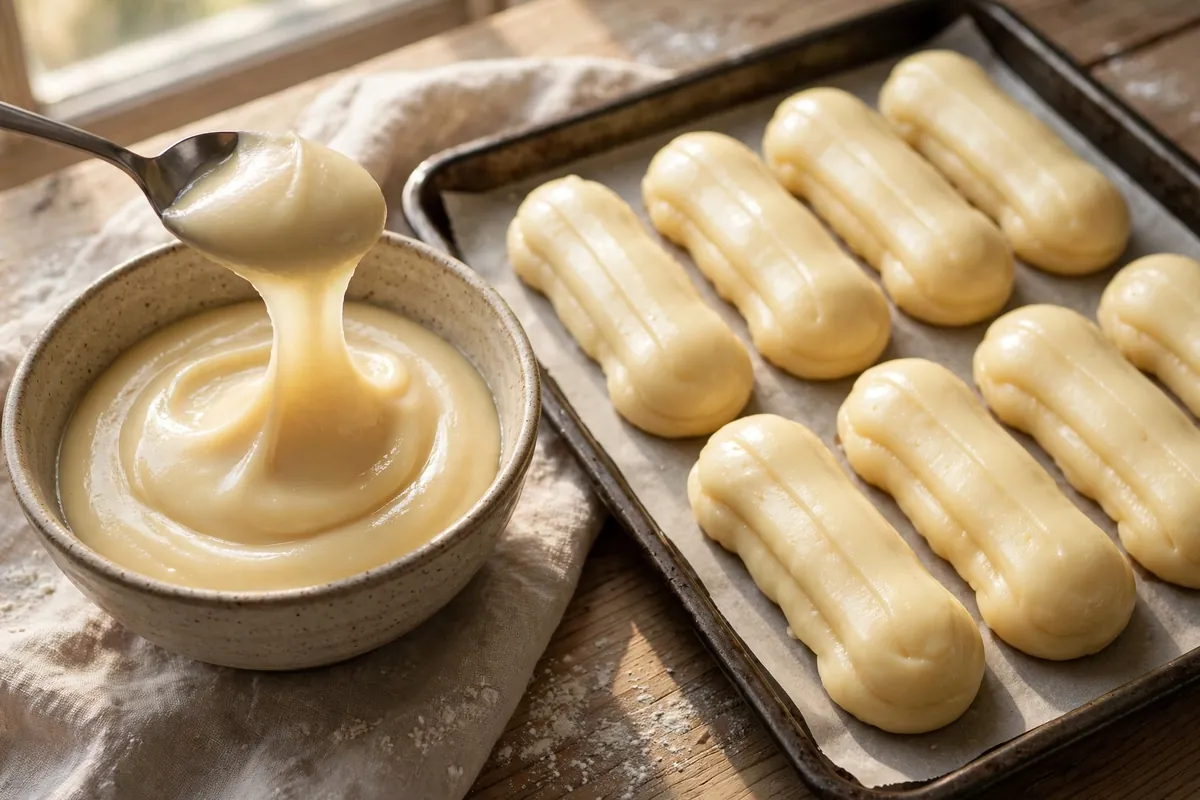
Choux paste should be smooth, glossy, and pipeable — it should hold a soft peak that slowly folds over (the classic “V” shape when you lift the spoon). Too much egg makes a slack, runny batter that spreads instead of piping tall, and the excess moisture means even more steam to drive off — extending the bake past what the structure can survive.
How to tell: The piped logs spread wide and flat on the tray instead of holding plump finger shapes. The batter looked more like thick pancake batter than paste.
The fix: Add the eggs gradually — beaten, in 3–4 additions — and stop when the paste reaches the right consistency, even if you have egg left over. Egg sizes vary and flour absorbs differently; the recipe’s “4 eggs” is approximate, but the V-shape test is exact. This is the single most important choux skill: judge the batter, not the egg count. (Eggs do four jobs in batter — structure, leavening, moisture, flavor — and choux leans on all of them: Eggless Cake That Actually Works explains the framework.)
4. Too little egg — not enough steam or structure
The mirror failure. Too little egg means too little water to convert to steam (weak puff) and too little protein to build strong walls (fragile shell). The result: éclairs that rise half-heartedly and collapse even when fully baked, because the walls were never strong enough.
How to tell: The batter was stiff, dry, and hard to pipe — it tore or held rigid peaks instead of flowing. The baked shells are thick-walled and dense rather than thin and crisp.
The fix: Same discipline as cause #3 from the other direction: add beaten egg gradually until the V-shape. If you’ve already piped a too-stiff batch, you can actually rescue it — scrape it back into the bowl, beat in more egg a tablespoon at a time until the consistency is right, and re-pipe. Choux is forgiving before it hits the oven.
5. Didn’t pierce to release steam
Even perfectly baked choux traps residual steam inside the hollow shell. As it cools, that steam condenses — and the resulting moisture softens the interior walls from the inside out. Crisp out of the oven, soggy and collapsed an hour later: that’s trapped steam.
How to tell: The éclairs looked magnificent coming out, then softened and sagged as they cooled. The interiors feel damp.
The fix: Pierce each shell as soon as it’s out of the oven — a small slit or hole in the side or bottom with a paring knife or skewer lets the steam escape. Then return them to the turned-off oven with the door cracked for 10 minutes to finish drying. This two-step (pierce + dry) is what professional bakeries do, and it’s the difference between éclairs that stay crisp for hours and ones that go limp.
6. The panade was undercooked — the flour never properly gelatinized
Before the eggs go in, choux starts as a panade: water/milk and butter brought to a boil, flour dumped in and stirred over heat until it forms a smooth ball that pulls away from the pan with a thin film on the bottom. That cooking step gelatinizes the starch — pre-swollen starch absorbs the eggs properly and builds stronger walls. An undercooked panade (pulled off heat the second it came together) makes a weaker paste.
How to tell: The paste looked slightly lumpy or the eggs seemed to “slide” rather than absorb when you beat them in. You cooked the flour mixture less than 2 minutes.
The fix: Cook the panade 2–3 minutes over medium heat, stirring constantly, until it forms a cohesive ball and leaves a distinct starchy film on the pan bottom. That film is your visual proof of gelatinization. Then — critical — let it cool 5 minutes before adding eggs, or the heat scrambles them (bits of cooked egg in choux = weak spots in the walls).

Frequently asked questions
Can I re-bake collapsed éclairs?
Sometimes. If you catch it within minutes, return them to a hot oven (400°F / 200°C) for 5–10 minutes — residual moisture may re-steam them. Once fully cooled and set flat, no: split them, fill anyway, and call them éclairs au plat.
Why are my éclairs hollow but soggy inside?
Under-dried, not under-risen. Pierce + oven-dry (cause #5), bake to deep golden, and fill within a few hours of serving — not the night before.
Can I make choux ahead of time?
The baked shells: yes — freeze unfilled shells up to a month, re-crisp 5 minutes at 350°F (175°C) from frozen. The raw paste: pipe and freeze on the tray, then bake from frozen adding 5–8 minutes. Don’t refrigerate raw piped choux overnight — the surface dries and cracks.
Is it safe to eat slightly underbaked éclairs?
Yes — the eggs are fully cooked by the time the exterior sets. The issue is structural (and a wet interior tastes unpleasant), not safety.
Why did my cream puffs work but my éclairs collapse?
Same paste, different geometry. Éclairs are long with more surface area and thinner walls relative to their volume — they dry faster outside but trap more interior moisture, so they’re less forgiving of underbaking. If your puffs work, bake éclairs 5 minutes longer than you think.
Can I use a different flour?
Bread flour makes slightly sturdier, chewier shells (more protein = stronger walls); all-purpose is the standard and gives the classic crisp-tender shell. Don’t use cake flour — too little protein for the walls. (When flour choice matters most: Bread Flour vs All-Purpose: When It Actually Matters.)
Related troubleshooting: Why Did My Cake Sink in the Middle? · Puff Pastry Not Puffing · How to Tell When Bread Is Done