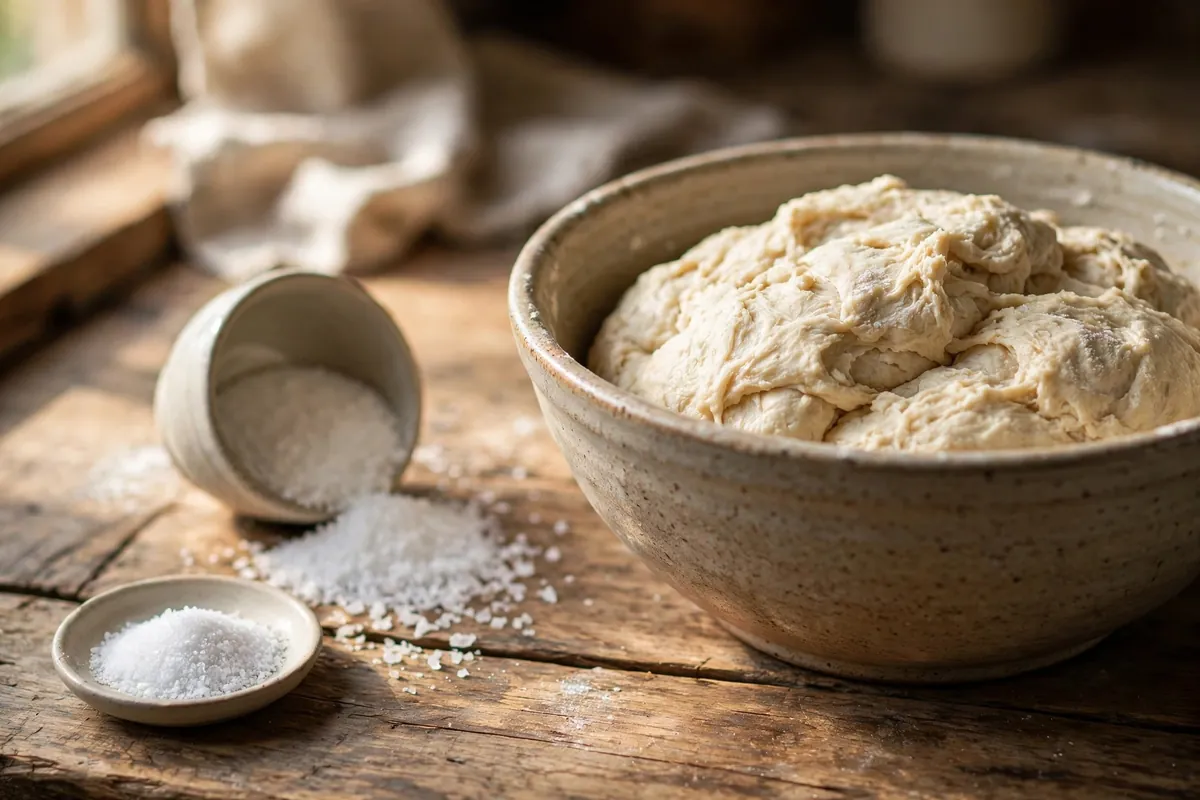
You were scaling a recipe, the salt slipped, and now you’re staring at a bowl of dough with twice the salt it should have. First, the bad news, stated plainly so we can move past it: you cannot remove salt from dough. No rinsing, no trick, no hack extracts dissolved salt from a mixed dough. But the good news is better than you’d expect: in most cases you don’t need to remove it — you dilute it, and the math is simple. I’ve saved more over-salted batches than I can count, and the rescue below works every time.
Quick diagnosis: Salt can’t be removed, only diluted. If you added roughly double the salt (say 4% instead of 2%), double the flour, water, and yeast — with NO additional salt — and mix it in: you’re back to 2%. For small overshoots (up to ~2.5–3%), just bake it; the difference is barely noticeable. Only truly extreme salt (5%+) means starting over.
What too much salt actually does to dough
Understanding the damage tells you how urgent the fix is. Salt does three things in dough, and excess amplifies all of them:
It slows the yeast. Salt draws water out of yeast cells by osmosis, dehydrating and stunning them. At the correct 2%, this is desirable — it paces fermentation for better flavor. At 4%+, the yeast barely functions: expect a sluggish, under-risen loaf no matter how long you wait. (This is the same mechanism behind slow rises generally — see Why Didn’t My Bread Rise?.)
It tightens the gluten. Salt strengthens gluten networks — good in moderation, but excess makes dough stiff, resistant to shaping, and prone to tearing.
It tastes salty. Obvious, but worth stating: above ~3%, most people can taste it, and above 4% it’s unpleasant in plain bread.
Step 1: Figure out how bad it is
Before doing anything, estimate the damage. The target is 2% salt by flour weight — 10g per 500g flour, about 2 teaspoons of fine salt per 4 cups.
- ~2.5–3% (a heavy hand, a rounded spoon): Bake it. Seriously. At this level the difference is subtle — slightly slower rise, slightly firmer crumb, a touch more flavor. Extend the rise time a little and carry on.
- ~3–4% (doubled the salt, or used tablespoons instead of teaspoons): Dilute — the rescue below. Fully salvageable.
- 5%+ (poured freely, or confused salt with something else): Start over. At this level you’d need to triple the batch to dilute it, the yeast is severely compromised, and the result isn’t worth the flour.
How to estimate: Think back to what you added versus what the recipe called for. If the recipe said 2 teaspoons and you added 2 tablespoons, that’s 3× — roughly 6%, which means starting over. If it said 10g and you added 20g, that’s 4% — dilutable.
Step 2: The dilution rescue (the actual fix)
The math is straightforward: salt percentage = salt weight ÷ flour weight. To halve the percentage, double the flour (and everything else except salt).
Worked example: Your recipe used 500g flour and you accidentally added 20g salt (4%) instead of 10g (2%).
- Mix a second batch of the same dough — 500g flour, the recipe’s water, the recipe’s yeast — with zero salt.
- Knead the two doughs together thoroughly until completely homogeneous (5–8 minutes). Don’t just stack them; the salt must distribute evenly.
- You now have 1000g flour and 20g salt = 2%. Correct.
- Proceed with the recipe, allowing a slightly longer rise (the yeast had a head start in the salty half).
No scale? Work in the recipe’s own units: if the recipe was “4 cups flour, 2 teaspoons salt” and you added 4 teaspoons, make a second identical batch with no salt and combine. The units cancel out as long as both halves match.
Yeast note: the yeast in the over-salted half is sluggish but alive. The fresh yeast in the new half carries the rise. Combined and given time, the batch ferments fine — just expect it to need a bit longer than usual. Judge by the dough (doubled, poke test), not the clock.

Step 3: Adjust the bake
A rescued batch needs two small accommodations:
- Longer fermentation. Give it 25–50% more rise time than the recipe states. The yeast is recovering; don’t rush it.
- Watch the shaping. The combined dough may be slightly stiffer than usual (salt tightened the first half’s gluten). If it resists shaping, rest it 15 minutes and try again — relaxed gluten stretches willingly.
What does NOT work (don’t waste your time)
- Rinsing the dough. Salt is dissolved throughout; surface rinsing removes almost nothing and waterlogs the dough.
- Adding sugar to “balance” it. Sugar doesn’t cancel salt on the palate the way people hope — you get sweet and salty, and the yeast is still stunned.
- Adding more yeast alone. Extra yeast in a 4%-salt dough just gives you more stunned yeast. Dilution first, then the yeast already present is plenty.
- Baking it salty and hoping. Above ~3.5%, hope is not a strategy. Dilute or discard.
Prevention (so this is the last time)
- Weigh salt. 10g per 500g flour. A scale eliminates the tablespoon/teaspoon confusion that causes most over-salting.
- Know your salt. Fine table salt packs denser than kosher — a tablespoon of fine salt can weigh nearly twice a tablespoon of coarse kosher. If a recipe doesn’t specify, assume fine and measure accordingly.
- Add salt with the flour, not the yeast. Mixing salt through the dry ingredients distributes it evenly and avoids concentrated pockets stunning the yeast on contact.
- Mise en place. Measure everything before mixing starts. Most salt accidents happen mid-recipe, reaching for the wrong spoon in a hurry.
Frequently asked questions
Will the rescued dough taste normal?
Yes — that’s the point of the math. At a true 2% after dilution, the salt level is exactly what the recipe intended. The crumb, crust, and flavor will be indistinguishable from a correct batch, provided you gave it the full rise.
My dough hasn’t risen at all — is the yeast dead?
Probably stunned, not dead. Salt at 4% slows yeast dramatically but rarely kills it outright (that takes much higher concentrations or heat). Give it time in a warm spot (75–80°F / 24–27°C) — up to twice the normal rise. If there’s genuinely zero movement after hours, then yes, start fresh; but sluggish is normal here, not fatal.
Can I just make the recipe salt-free to compensate?
That’s exactly what the dilution rescue is — a second salt-free batch combined with the first. Don’t try to “average it out” by serving salty bread with bland toppings; fix the dough itself.
Does this work for pizza dough too?
Yes — same math, same method. Pizza dough is actually more forgiving because toppings and sauce mask minor salt variations. For a 3% overshoot on pizza dough, many bakers just proceed; the toppings carry it.
What if I used salted butter instead of unsalted by mistake?
Different problem, smaller scale: salted butter adds roughly 1–1.5% salt equivalent to the dough — usually within the tolerable range. Proceed, and skip any additional salt the recipe calls for. No rescue needed.
Is over-salted dough safe to eat?
The dough itself is safe — salt isn’t a food-safety hazard at these levels. The question is purely palatability and yeast function. (Truly extreme salt — a cup in a single loaf — would be inedible but still not dangerous.)
Related troubleshooting: Why Didn’t My Bread Rise? · Make-Ahead Bread Dough · No-Yeast Bread