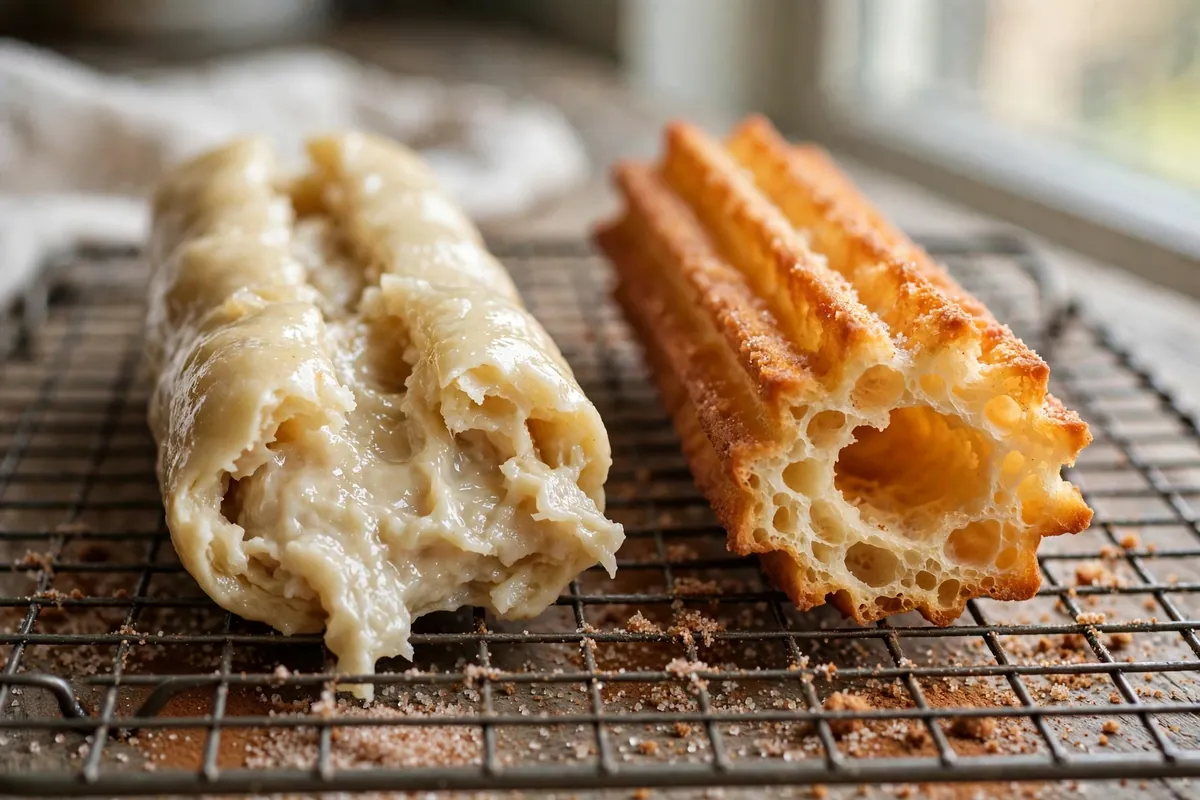
Churros are fried choux pastry — the same dough as éclairs — and frying is less forgiving than baking. In hot oil, the outside goes from pale to burnt in about ninety seconds while the inside needs every one of those seconds. Raw-inside-greasy-outside is the signature of that race being lost, and it’s almost always the oil temperature.
Quick diagnosis: Your oil was too cool — below 350°F (175°C), the dough soaks up oil before the crust sets, so it’s greasy outside and raw inside. Hold 350–375°F (175–190°C) with a thermometer, fry 3–4 at a time so the temperature doesn’t crash, and pipe no thicker than ½-inch with a star tip.
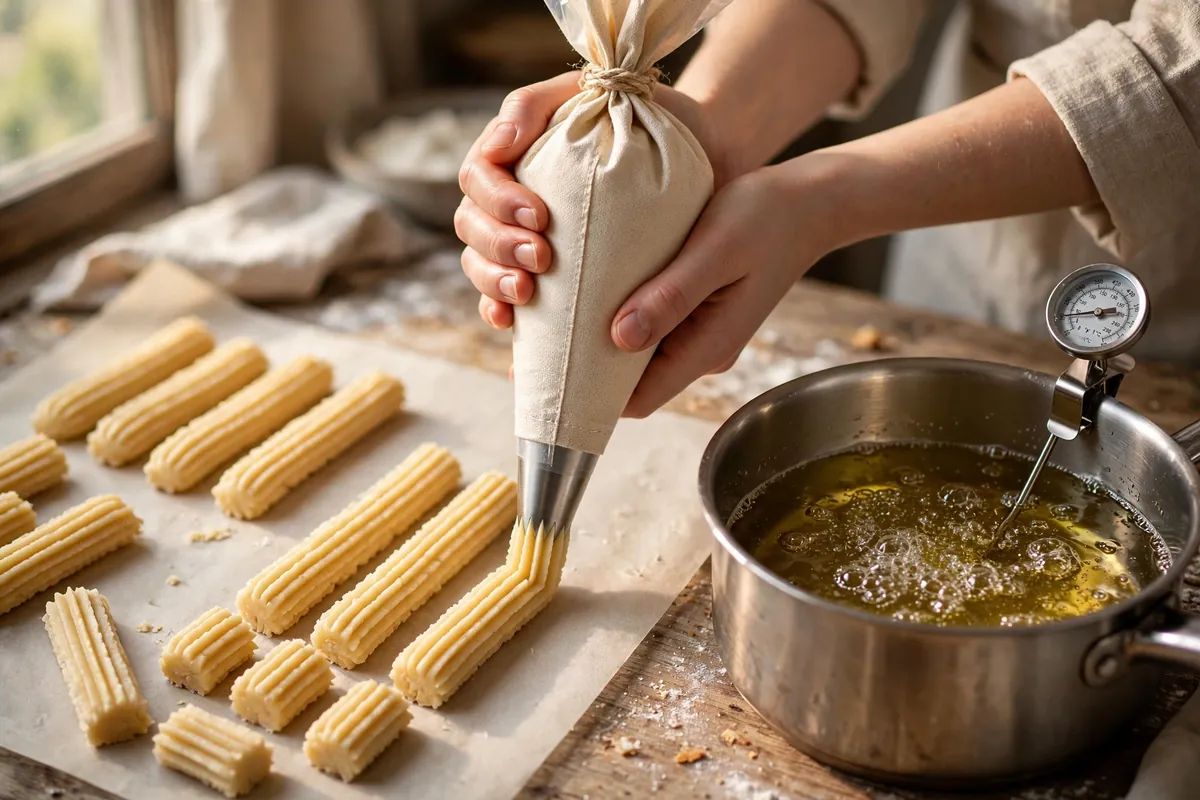
My tested baseline: 1 cup (240ml) water, 100g butter, 1 tbsp sugar, ½ tsp salt — boiled together. Off heat, stir in 1 cup (125g) flour all at once and cook 2–3 minutes, stirring, until a film forms on the pan. Cool 5 minutes, beat in 3 eggs one at a time until the dough is smooth, glossy, and holds a V-shape off the spoon. Pipe 4-inch lengths through a ½-inch open star tip into 350–375°F (175–190°C) oil, 2–3 minutes per side. Drain on a wire rack, toss in cinnamon sugar while hot.
1. The oil was too cool — the master cause of both symptoms
This one mistake produces both halves of your problem simultaneously. Below about 350°F (175°C), the dough’s surface doesn’t set fast enough to seal, so oil seeps in (greasy outside) while gentle heat fails to drive through to the center before the outside is done (raw inside). It always comes from frying without a thermometer.
How to tell: Churros took forever to brown, came out pale and heavy, left an oil slick on the plate, and the centers were doughy. The oil barely bubbled around the dough.
The fix: Use a deep-fry thermometer clipped to the pot. Heat to 365°F (185°C) before the first batch; the cold dough drops it into the 350–375°F (175–190°C) working zone. Fry only 3–4 churros at a time; crowding crashes the temperature. (Temperature discipline is the whole game in fried pastry, same as Choux Pastry Collapse: Why Your Éclairs Fell.)
2. The oil was too hot — burnt outside, raw inside
The mirror image. Above 375°F (190°C), the exterior browns in under a minute — gorgeous, tempting, done-looking — while the center is still wet choux paste.
How to tell: Deep brown or spotty-dark crusts in under 2 minutes total frying, with raw doughy centers; the oil smoked or the churros darkened almost immediately.
The fix: Between batches, the oil reheats fast with no dough in it; always check the thermometer before the next drop, not after.
3. You piped them too thick — the center can’t catch up
Heat penetrates from the outside in, and doubling a churro’s thickness more than doubles the time the center needs. A ¾-inch churro in correct-temperature oil will still be raw inside when the outside is perfectly golden — the geometry defeats the temperature.
How to tell: The crust color was perfect and the oil temperature verified, but centers were still doughy; churros looked fat and round rather than ridged.
The fix: A ½-inch (1.3cm) open star tip — Ateco 847 or 827 are the standards.
4. The dough was wrong — panade or egg errors
Churro dough must be a proper choux: the flour cooked in the butter-water (the panade) until it forms a film on the pan, then enough egg to make it pipeable but firm. Too much egg makes a slack dough that spreads and fries up greasy; too little makes a stiff dough that cracks and stays dense inside.
How to tell: Dough tasted floury or the centers were gummy even at correct oil temp and thickness (undercooked panade). Dough oozed flat off the tip instead of holding ridges (too much egg); dough cracked and wouldn’t pipe smoothly (too little egg).
The fix: Cook the panade a full 2–3 minutes over medium heat, stirring constantly, until a thin film coats the pan bottom — that’s the visual cue the flour is cooked. Cool 5 minutes (hot panade scrambles the eggs), then beat eggs in one at a time, fully incorporating each. The finished dough should be smooth and glossy, fall from the spoon in a thick V that holds its shape, and pipe clean ridges that stand up.
5. You drained them wrong — the soggy finish
Churros emerge from oil carrying surface oil and internal steam. Laid on paper towels, they sit in both: the towel traps steam underneath, and the surface oil has nowhere to go. Thirty seconds on paper is the difference between shattering crisp and disappointingly soft.
How to tell: Churros were crisp coming out of the oil but softened within minutes; bottoms were oily; paper towels were saturated.
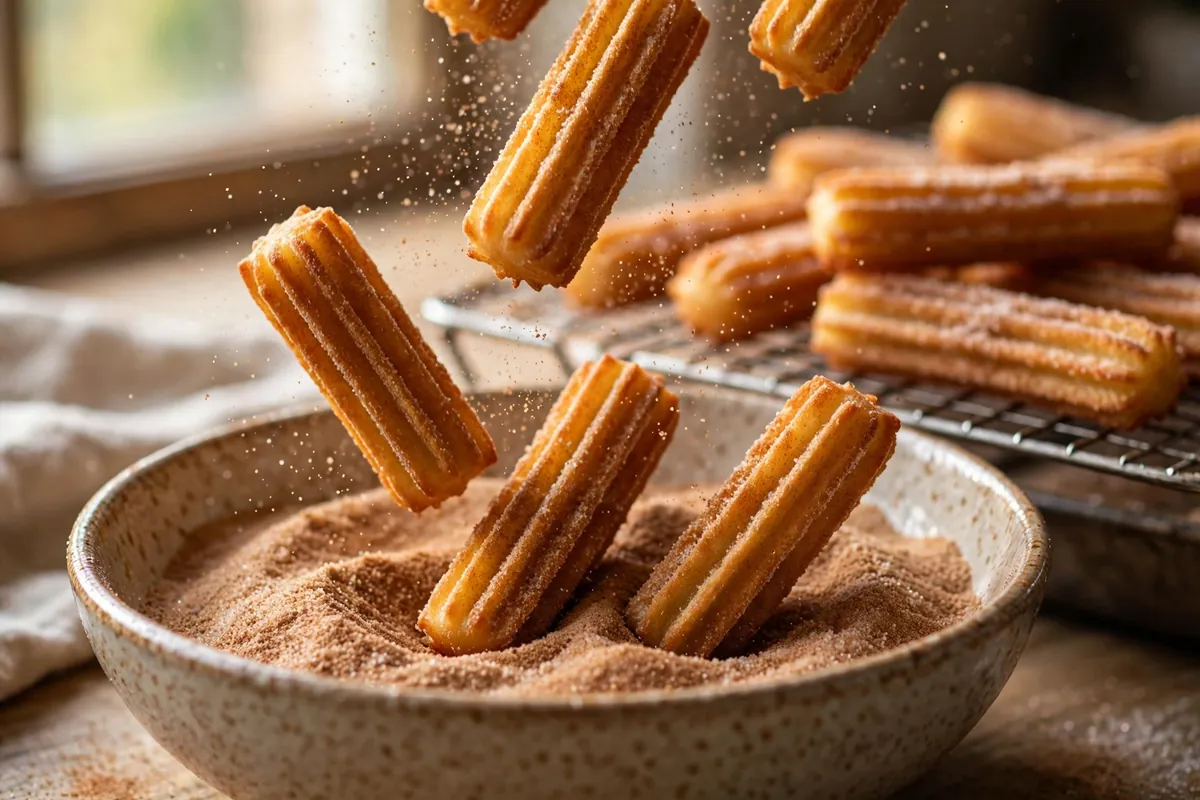
The fix: Drain on a wire rack over a sheet pan so steam escapes and oil drips away. Toss in cinnamon sugar within a minute of draining, while the surface is still tacky — that’s what makes the sugar stick.
6. You stored them — churros are a fresh-or-nothing pastry
Churros stale faster than almost anything I make. Ambient humidity softens the crisp shell within an hour; never refrigerate them.
How to tell: Leftover churros were chewy and soft the next day; reheating in the microwave made them rubbery.
The fix: Fry only what you’ll eat within the hour. If you must hold them, keep fried churros uncovered at room temperature up to 2 hours — covering traps steam. Better plan: pipe the raw dough onto a parchment-lined tray, freeze the shapes solid, and fry from frozen (add 1–2 minutes) — frozen piped churros fry up nearly as well as fresh, and the dough holds a week in the freezer. The dough itself can be made a day ahead and refrigerated in the piping bag.
Frequently asked questions
Are raw-inside churros safe to eat?
Mostly yes — the dough is just flour, butter, egg, and water, and the outside reached full frying temperature. But a truly raw, wet center is unpleasant and undercooked egg is best avoided. When in doubt, the fix is easy: split them and finish in a 375°F (190°C) oven for 5–8 minutes.
Can I fix greasy churros after frying?
Partially. A hot oven (400°F/200°C, 5 minutes on a rack) drives off surface oil and re-crisps them. It won’t fix a raw center, but it rescues the grease. Next batch, check the oil temperature — that’s the real fix.
Can I bake churros instead of frying?
You can, but they’re a different pastry — baked choux, closer to an éclair stick. Pipe onto parchment, bake at 400°F (200°C) for 20–25 minutes until deeply golden, brush with melted butter, and toss in cinnamon sugar. Good, but not churros.
What oil is best for frying churros?
A neutral oil with a high smoke point: vegetable, canola, or peanut. You’ll need enough for 2–3 inches of depth.
Can I make the dough ahead?
Yes — the choux dough keeps 24 hours refrigerated in a sealed piping bag, or pipe shapes and freeze up to a week. Fry from frozen, adding 1–2 minutes to the time. Don’t hold fried churros; fry to order.
Related troubleshooting: Choux Pastry Collapse: Why Your Éclairs Fell · Puff Pastry Not Puffing: Lamination Mistakes · High-Altitude Baking Adjustments