
Quick diagnosis: A soggy bottom means the lower crust never got hot enough, fast enough. The fix order is: blind-bake the shell, bake on a preheated steel or stone on the oven’s bottom third, and thicken wet fillings before they go in. Those three together never fail — skip any one and the bottom stays pale.
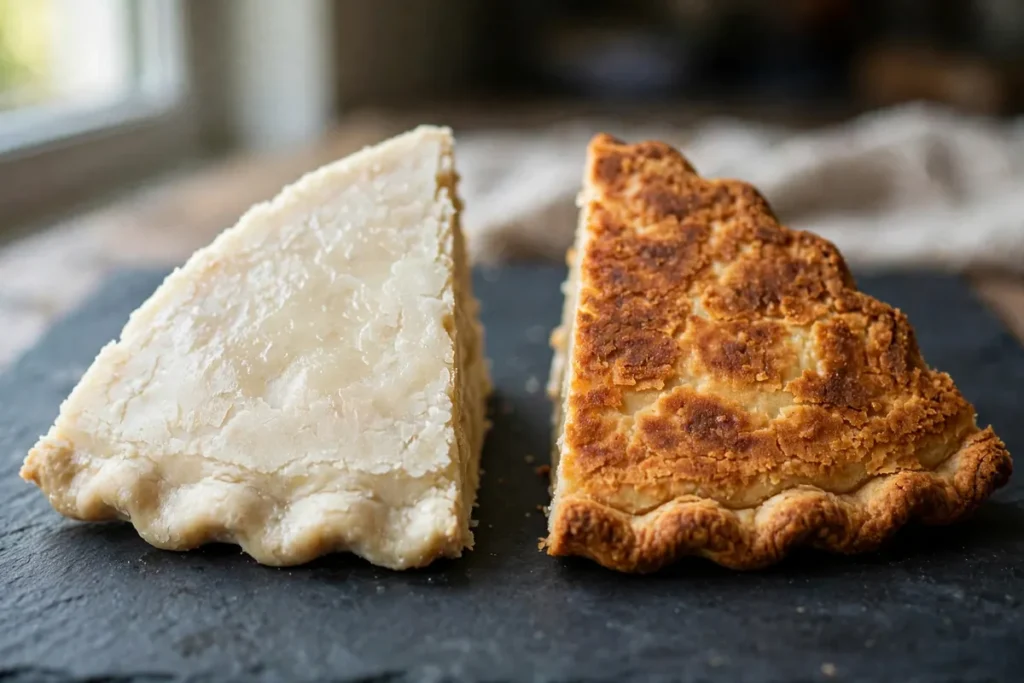
The top of a pie lives in the oven’s hot air. The bottom lives pressed against a pan, insulated by filling, with steam rising from below. It’s the hardest part of the pie to bake — and the filling is actively working against it, releasing juice as it heats. Getting a crisp base means attacking from both sides: drive more heat into the bottom, and put less free liquid against it.
1. The shell wasn’t blind-baked
For any wet filling — custard, pumpkin, fruit — an unbaked raw shell has almost no chance. The filling’s moisture soaks the raw dough before the oven heat can set it, and from that point the bottom is steaming, not baking. Blind baking (pre-baking the empty shell) sets the crust’s structure first, so it meets the filling as a barrier, not a sponge.
How to tell: The filling recipe said “pour into unbaked pie shell” and the bottom came out gummy while the top browned perfectly.
The fix: For wet fillings, blind-bake the chilled shell at 400°F (200°C) — 15–20 minutes with pie weights, then 5–10 minutes unweighted until the bottom looks dry and just starting to color. For custard pies, a full blind bake (bottom completely set and lightly golden) is the standard; the filled pie then only needs enough oven time to set the custard. (Blind-baking technique in detail: Pie Crust Shrinking in the Oven.)
2. Nothing hot was under the pan
Oven air heats the top; the bottom needs conduction — direct contact with something hot. A pie set on a room-temperature tray on the middle rack gets gentle, indirect bottom heat. That’s not enough to crisp pastry through a layer of wet filling.
How to tell: The bottom is uniformly pale rather than patchy — a heat problem, not a filling problem.
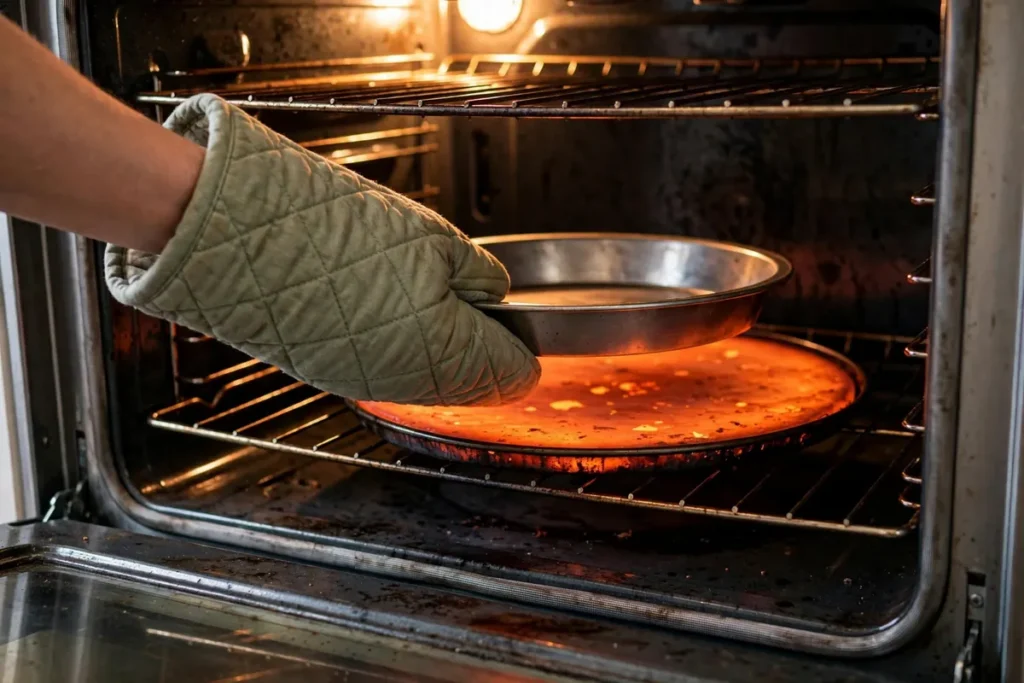
The fix: Preheat a baking steel, pizza stone, or heavy inverted sheet pan on the oven’s bottom third for a full 45 minutes, and bake the pie directly on it. The stored heat blasts the bottom crust the moment the pan lands. When I switched from a middle-rack tray to a preheated steel, bottom browning went from nonexistent to deep golden on the same recipe. Metal pie pans beat glass here too — metal conducts heat to the bottom faster, while glass insulates slightly.
3. The filling released too much free juice
Fruit fillings can be half water by weight. As the pie heats, cell walls break and juice floods out — far more liquid than the bottom crust can handle, especially before thickeners activate. A filling that tastes perfect raw can drown the base.
How to tell: There’s a visible pool of liquid under the fruit, or the slice weeps juice onto the plate after cutting.
The fix: Macerate and drain. Toss sliced fruit with the sugar and let it sit 30–60 minutes, then drain off the exuded juice — you’ll be shocked how much there is. Reduce that juice in a saucepan to a syrup and add it back (concentrated flavor, minimal water), then thicken: 2–3 tablespoons of cornstarch per 9-inch fruit pie, tossed with the fruit. The filling must reach a full bubble in the center — 212°F (100°C) — for starch thickeners to activate; a filling that never bubbled never thickened, no matter how much cornstarch you used.
4. The bottom wasn’t sealed
Even a blind-baked shell is porous. Hot filling finds every microscopic gap. An egg wash seal — brushed on and briefly set with heat — waterproofs the base the way varnish seals wood.
How to tell: Sogginess is worst directly under the wettest part of the filling, in patches rather than uniformly — liquid penetrating, not just underbaking.
The fix: After blind baking, brush the hot bottom with beaten egg white and return to the oven 3–5 minutes until the wash looks dry and glossy. For fruit pies, a thin dusting of fine breadcrumbs or ground almonds under the filling also works — they absorb stray juice and vanish into the finished slice. I use the egg-white seal on every custard pie without exception.
5. The top crust trapped the steam
Steam has to escape. A sealed double crust with no vents turns the pie into a pressure cooker — moisture condenses on the underside of the top crust and rains back down onto the filling and bottom. Lattice tops exist partly for this reason.
How to tell: The top crust is puffy and pale underneath, with visible condensation, while the filling looks soupy.
The fix: Cut generous vents — at least four 1-inch slashes, or go lattice. Vents should go all the way through the top crust, opened slightly so they don’t seal shut in the oven. For single-crust pies this isn’t a factor, which is one reason custard and single-crust fruit pies are more forgiving on bottoms.
6. The pie was sliced too soon (or cooled wrong)
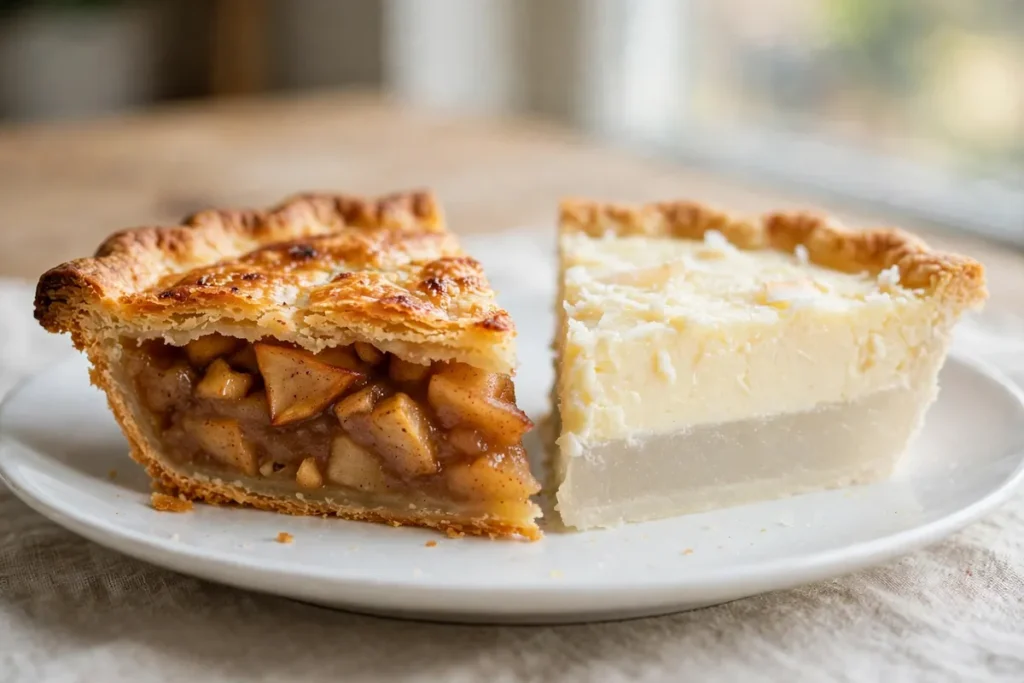
A pie continues to set as it cools — starches firm up, juices redistribute. Slice a fruit pie hot and the still-fluid filling floods the cut faces, making even a well-baked bottom eat soggy. And cooling flat on the counter traps steam underneath the pan.
How to tell: The bottom looked fine out of the oven but turned gummy by serving time, or slices wept on the plate.
The fix: Cool fruit pies on a wire rack (airflow underneath carries steam away) for at least 3–4 hours — yes, really; the filling needs that long to fully set. Custard pies need 2 hours at room temperature then refrigeration. The wait is structural, not optional. I know it’s hard. It’s still structural.
FAQ
Is a soggy bottom safe to eat?
Yes — it’s a texture defect, not a safety issue, as long as the pie reached proper temperatures (fruit fillings bubbling, custards set). The one exception is a raw-flour concern: if the bottom crust is truly raw and doughy rather than just soft, give it more oven time rather than serving it.
Can I fix a soggy bottom after baking?
Partially. Return the pie (or individual slices) to a hot oven — 375°F (190°C) on a preheated steel — for 10–15 minutes to drive off moisture and re-crisp the base. It won’t match a properly blind-baked bottom, but it meaningfully improves a disappointing one. This rescue works once; don’t re-bake repeatedly.
Do I need a special pan to avoid soggy bottoms?
No, but pan choice helps. Light-colored metal pans give the best bottom browning through conduction. Glass works but browns bottoms more slowly — if you use glass, add 5 minutes and drop to the bottom rack. Dark nonstick browns fast but can overdo the edges; shield with foil if needed.
Should I use cornstarch, flour, or tapioca to thicken?
Cornstarch gives the clearest, glossiest set — 2–3 tablespoons per 9-inch pie. Flour (¼ cup) works but clouds the juices. Instant tapioca (3 tablespoons) is excellent and never gets gummy, but needs the full bubble to activate. All three fail identically if the filling never reaches 212°F (100°C) in the center.
Why is my pumpkin pie bottom soggy but the top perfect?
Custard fillings are the worst offenders: they’re essentially liquid when they go in, and they insulate the bottom while the top sets quickly. Pumpkin pie demands a fully blind-baked shell — no exceptions — plus the preheated steel underneath. It’s the highest-difficulty bottom in pie baking.
Can I blind-bake with the filling already planned the same day?
Yes — blind baking adds about 30 minutes, and the shell can cool while you make the filling. The shell must be at least warm (not fridge-cold) when filling goes in, or the cold pastry will shock the filling’s timing. Room-temperature shell, filling in, straight into the hot oven.
Related troubleshooting: Pie Crust Shrinking in the Oven · Puff Pastry Not Puffing: Lamination Mistakes to Avoid · Why Did My Cake Sink in the Middle?