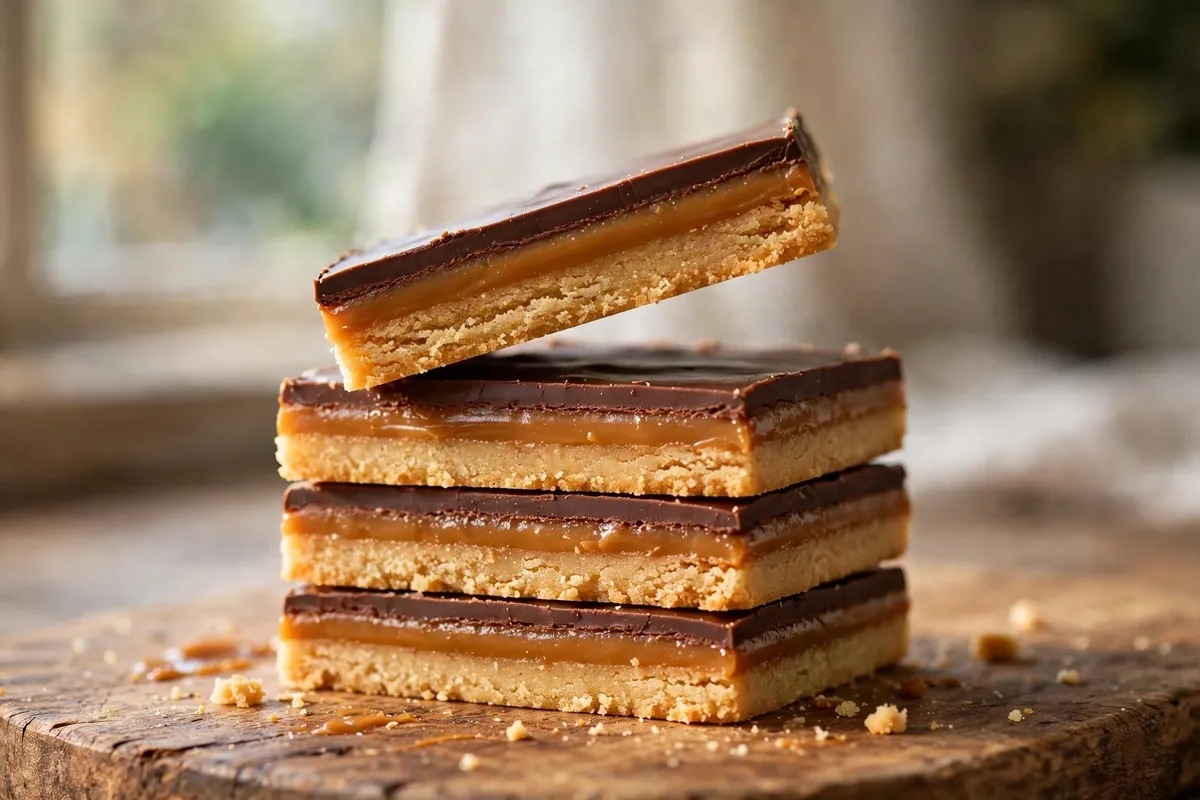
Millionaire’s shortbread fails at the joints. Each layer is easy alone, but stacked, physics takes over: smooth shortbread gives caramel nothing to grip, soft caramel slides under chocolate, a thick chocolate cap shears off. Separated bars were assembled, not bonded.
Quick diagnosis: The caramel was undercooked (too soft to grip — most common), the shortbread surface was too smooth and glassy, or you skipped the chill between layers. Fix: cook the caramel to 240°F (115°C), prick and slightly roughen the shortbread, and chill 30 minutes between every layer.
My tested baseline: shortbread — 225g flour, 150g cold butter, 75g sugar, baked 20–25 minutes at 350°F (175°C) in a 20cm lined pan until golden at the edges. Caramel — 175g butter, 150g light brown sugar, 1 can (397g) sweetened condensed milk, cooked to 240°F (115°C). Chocolate — 200g dark chocolate + 1 tablespoon neutral oil, spread thin. Chill 30 minutes between layers; cut with a hot dry knife.
1. The caramel was undercooked — soft caramel is a lubricant
This is the number-one cause of separating layers. At 225–230°F (107–110°C), caramel is a flowing sauce — great on ice cream, useless as glue. Under the chocolate it migrates and layers hydroplane apart. At firm-ball stage, 240–245°F (115–118°C), caramel bonds: firm enough to hold, soft enough to bite.
How to tell: The caramel oozes when you cut; bars slump sideways in the pan; the caramel layer looks glossy and fluid rather than matte and set.
The fix: Cook to 240°F (115°C), stirring constantly — 8–12 minutes at a steady bubble. No thermometer? Cold-water test: a spoonful should form a firm, pliable ball that holds shape but flattens when pressed. Undercooked caramel can’t be fixed once layered.
2. The shortbread surface was too smooth — the caramel had nothing to grip
A smooth, glassy shortbread top is beautiful and structurally useless — caramel bonds mechanically and needs texture to key into. I roughen the surface deliberately now; base-layer separation dropped to zero.
How to tell: The caramel lifts off the shortbread in one clean sheet; the shortbread top is smooth and shiny where the caramel sat.
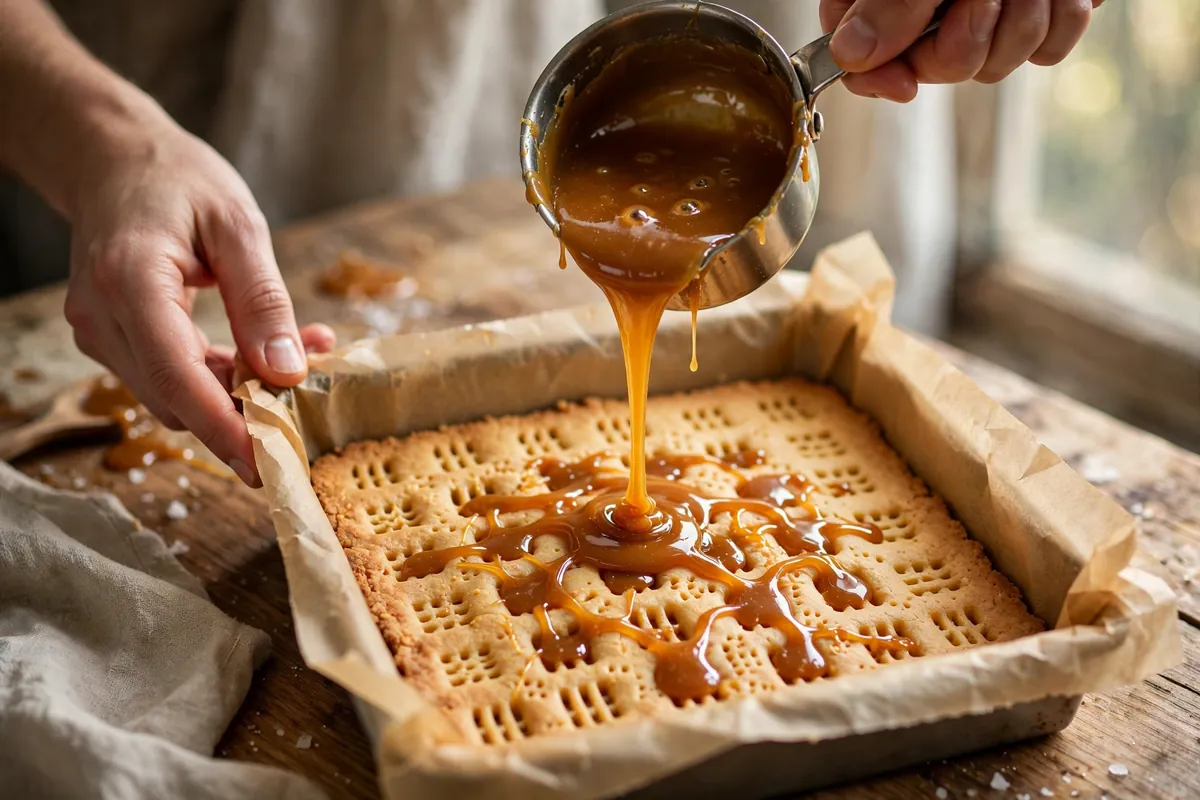
The fix: While the shortbread is still warm from the oven, prick it all over with a fork (docking also prevents puffing) and lightly score the surface with the fork tines. Pour the hot caramel over the warm — not cold — shortbread; warmth on both sides helps the layers meld. Some bakers brush the warm shortbread with a whisper of the hot caramel first as a “primer” — it works.
3. You skipped the chill between layers — warm layers never bond
Each layer must set before the next goes on. Chocolate over warm caramel softens it further; the boundary never forms cleanly and shears later. Chill 30 minutes after caramel (firm to a light touch), 20–30 after chocolate.
How to tell: The layers look marbled or blended at the boundary rather than distinct; the chocolate slid while you were spreading it.
The fix: Caramel layer: refrigerate 30 minutes until it dents but doesn’t stick when pressed lightly. Then pour the melted chocolate (cooled to about 90°F / 32°C, just warm) and spread gently — don’t press down. Refrigerate again 30+ minutes until the chocolate is fully set. Distinct, clean boundaries in the finished bar mean the chills worked.
4. The chocolate layer is too thick — a heavy cap shears off
300g+ of chocolate on a 20cm pan contracts into a rigid plate with no flex; the slightest pressure pops it off in one sheet. 150–200g flexes with the bar instead of fighting it. This is the same plate-shear failure as a too-thick glaze on opera cake.
How to tell: The chocolate comes off in large clean shards; the underside of the chocolate is perfectly smooth with no caramel clinging to it.
The fix: Use 150–200g chocolate for a 20cm pan, spread to 2–3mm. Add 1 tablespoon of neutral oil or butter per 200g chocolate — it keeps the chocolate slightly pliable and less snap-prone. Score the chocolate lightly with a knife 10 minutes into the final chill (when it’s set but not hard) to guide clean cuts later.
5. You cut the bars cold and straight from the fridge — thermal shock splits layers
Fridge-cold chocolate is brittle; a room-temperature knife fractures the cap along the caramel boundary. The layers were bonded — the cutting broke them. I ruined a perfect batch before learning the hot knife.
How to tell: The bars looked perfect in the pan but separated during cutting; the breaks are clean fractures, not slides.
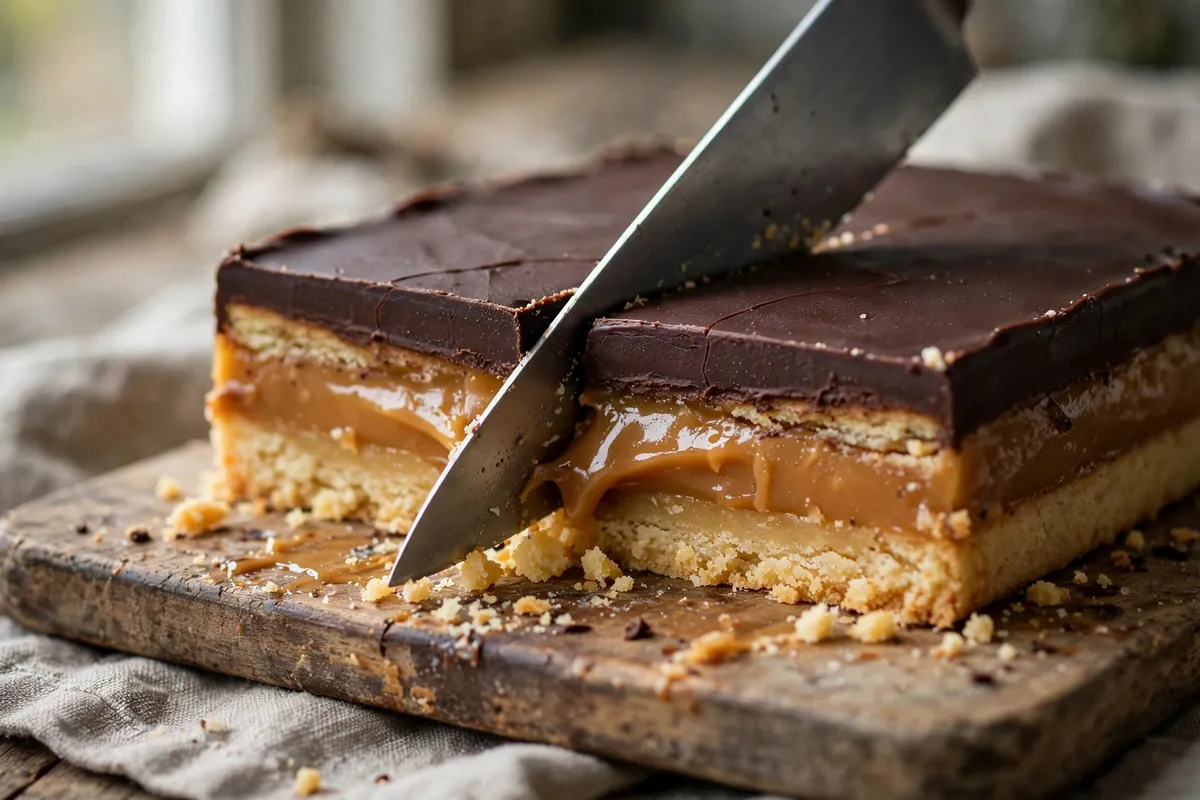
The fix: Let the slab sit 10 minutes at room temperature, then cut with a long sharp knife dipped in hot water and wiped dry between every cut. Press straight down — no sawing. The hot blade melts through the chocolate instead of fracturing it, and the brief tempering keeps the caramel from cracking.
6. The shortbread was underbaked — a soft base can’t anchor anything
Underbaked shortbread is pale, soft, and slightly steamy inside. Caramel poured over it sinks into the damp crumb instead of sitting on top, and the whole base layer turns to flavored mush that releases the caramel as it cools. The bar separates from the bottom up.
How to tell: The shortbread layer is pale and soft rather than golden and crisp; it crumbles damply instead of snapping; the base tastes slightly raw.
The fix: Bake the shortbread until the edges are golden and the center looks set and matte — 20–25 minutes at 350°F (175°C) for a 20cm pan. It firms as it cools, so pull it when the center still looks a touch soft but the edges are clearly golden. A crisp base is a structural member, not just a flavor layer.
FAQ
Is it safe to eat separated millionaire’s shortbread?
Completely — this is a texture and structure issue, not a food safety one. The layers taste exactly as intended; serve the pieces as-is or crumble them over ice cream.
Can I re-stick layers that separated?
Not really — cut layers won’t re-bond. Salvage it: warm pieces slightly, press together, re-chill. They’ll hold for serving.
Why is my caramel grainy instead of smooth?
The sugar crystallized — from stirring too early or crystals on the pan walls. Wash sides down with a wet brush, don’t stir until fully boiling. A tablespoon of golden syrup also inhibits it.
Can I use store-bought caramel or dulce de leche?
Dulce de leche works as a shortcut but it’s softer than proper 240°F caramel — expect slightly less structural hold. If you use it, cook it down a few minutes to thicken, or accept softer bars and chill them well.
How long do millionaire’s shortbread bars keep?
5–7 days airtight at cool room temperature; 2 weeks refrigerated. Fridge bloom (white streaks) is harmless. Don’t freeze — caramel texture suffers on thawing.
Can I make these gluten-free?
Yes — swap the flour for a 1:1 gluten-free blend in the shortbread and bake 2–3 minutes longer. The caramel and chocolate layers are naturally gluten-free. The adhesion fixes above apply identically.
Related troubleshooting: Why Did My Opera Cake Layers Slide? · Fixing Grainy Fudge · Fixing Seized Chocolate