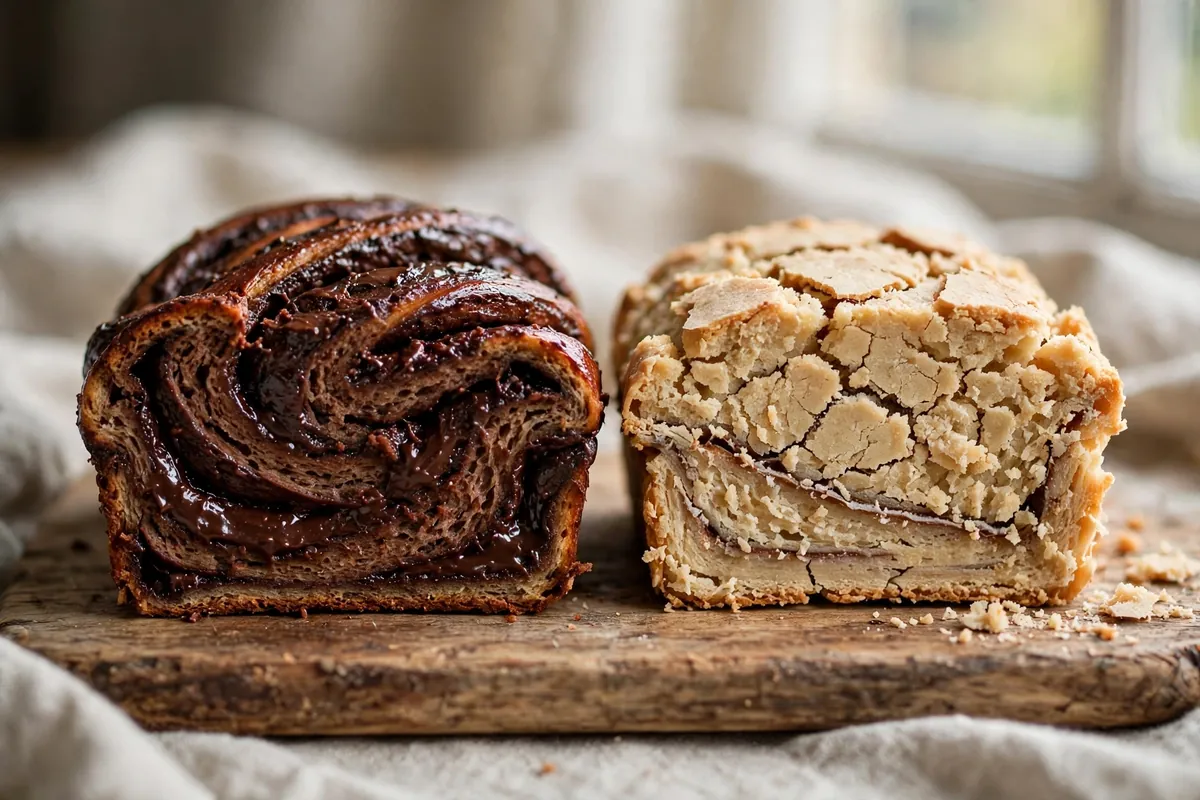
Babka should be the opposite of dry bread: enriched dough, a thick ribbon of chocolate, a glossy syrup glaze. When you cut in and find a parched, crumbly slice instead, the cause is almost never the ingredient list — it’s one of five handling mistakes, most of them invisible until the loaf cools.
Quick diagnosis: You probably overbaked it — the swirl insulates the center, so the outside looks done before the inside finishes. Or the filling was too lean, the roll too loose (air pockets dry out), or you skipped the syrup soak classic babka depends on. Check 190–195°F (88–90°C) internal and brush hot loaves with sugar syrup.
My tested baseline: 500g bread flour, 7g instant yeast, 80g sugar, 10g salt, 2 eggs plus 1 yolk, 120ml warm milk, 100g soft unsalted butter. Filling: 170g dark chocolate, 60g butter, 2 tbsp cocoa, 50g sugar, pinch of salt. Bake in a 9×5-inch pan at 350°F (175°C) for 35–45 minutes. Syrup: 100g sugar in 100ml water, boiled 2 minutes, brushed on hot.
1. You baked past the point of no return — the swirl lies to you
The number one cause, and it’s structural: the chocolate swirl insulates. The outside browns and looks done while the dense center is still catching up, so you give it “five more minutes” — and those minutes take the crumb from moist to dry.
How to tell: Dark crust, light-feeling loaf, crumb that tears instead of stretching, swirl dull rather than glossy.
The fix: Start checking at 32 minutes, not 40. A probe in the center (avoiding the chocolate) should read 190–195°F (88–90°C). The skewer test lies with babka — melted chocolate coats the skewer — so trust temperature. Tent with foil at 25 minutes if the top browns fast, and pull when the center reads done; carryover heat finishes the job.
2. Your filling was too lean — chocolate needs fat to stay molten
A filling of cocoa and sugar alone bakes into a dry ribbon that wicks moisture from the surrounding crumb. It has to stay soft and fudgy after baking, and only fat does that: real chocolate plus butter, spreadable when warm, sliceable when cool.
How to tell: The swirl is matte, crumbly, and separates from the dough; the dough touching it is drier than the rest.
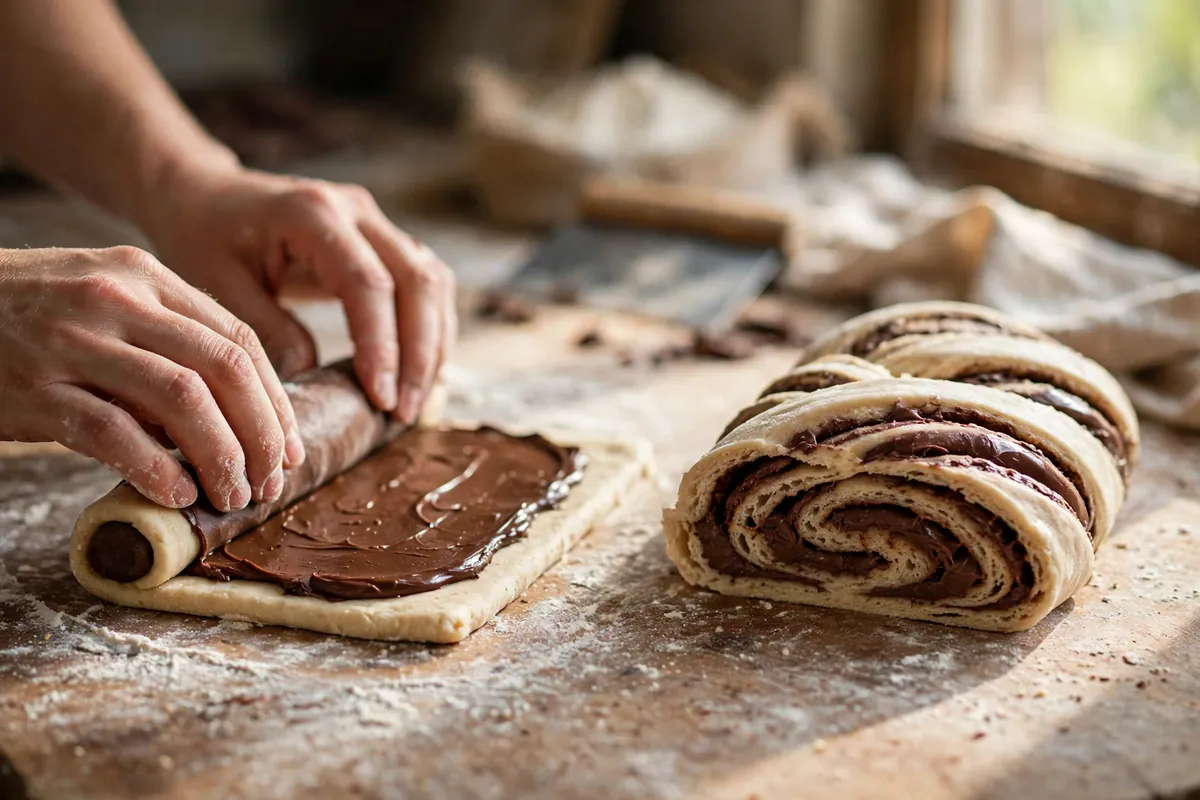
The fix: My ratio per loaf: 170g dark chocolate melted with 60g butter, then 2 tbsp cocoa and 50g sugar stirred in — it should spread like thick peanut butter, edge to edge. A bare border becomes dry, filling-less crust. For cinnamon babka: 80g soft butter, 100g brown sugar, 2 tbsp cinnamon — the butter is the moisture, not optional.
3. You rolled it loose — air pockets bake into dry gaps
A loose roll leaves air channels through the swirl. They let steam escape during baking, drying the crumb from inside, and create gaps where filling pulls away from dough, leaving dry surfaces that stale fast.
How to tell: Tunnels and gaps around the swirl instead of tight ribbons; the loaf feels oddly light for its size.
The fix: Roll firmly from the long edge, tucking as you go, and pinch the seam. Then the classic twist: halve the log lengthwise and twist the halves together, cut sides up. The twist presses filling against dough and eliminates the loose middle. (Same rolling discipline as Why Did My Cinnamon Rolls Unravel? Shaping and Proofing Fixes.)
4. You skipped the syrup soak — babka’s built-in insurance policy
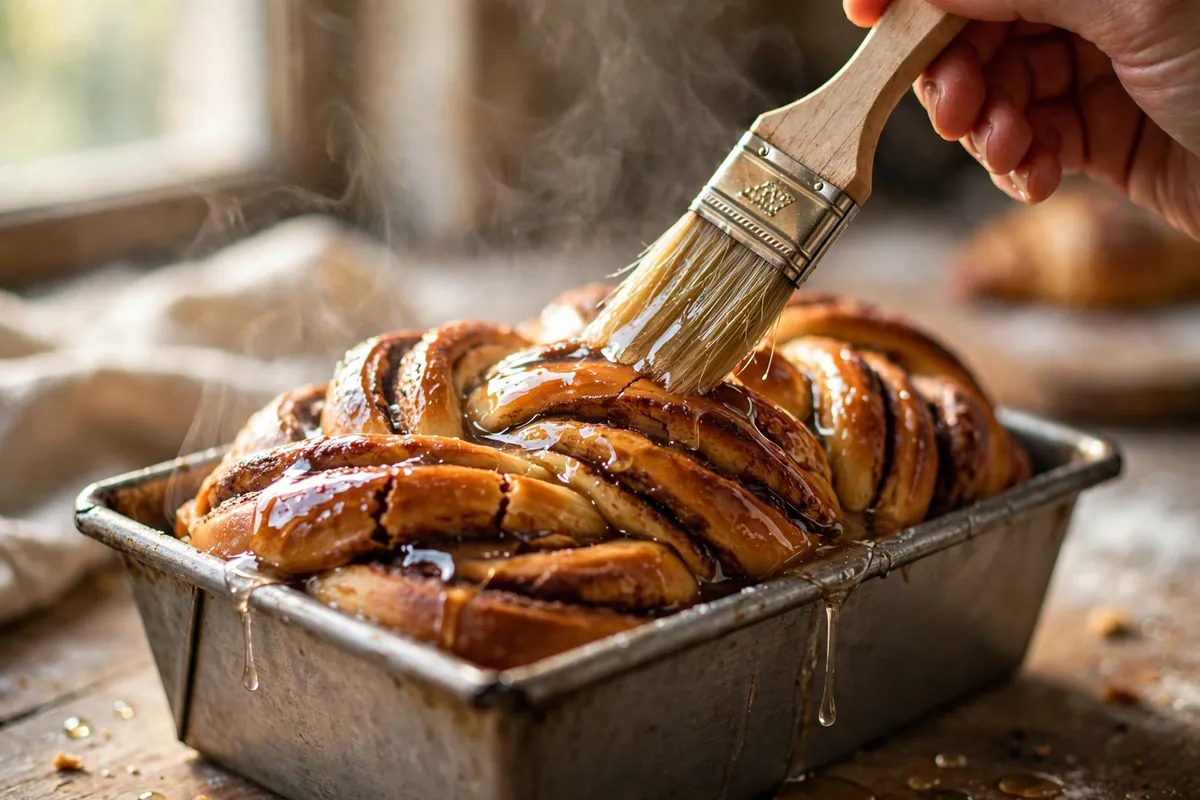
Classic babka gets drenched in sugar syrup the moment it leaves the oven, and it isn’t decoration. The hot crumb drinks it deep, replacing oven-lost moisture and giving the signature shine. Many formulas are written leaner than they look because the syrup is assumed — skip it and you’ve removed the moisture reserve.
How to tell: Matte crust, crumb drying within hours, loaf stale by next morning even wrapped.
The fix: While it bakes, boil 100g sugar with 100ml water for 2 minutes. The second the loaf comes out, brush half the syrup over the top, letting it pool into the cracks; add the rest after 5 minutes. Use it all — it looks like too much, and it isn’t. Unmold after 15 minutes, while the syrup is still fluid enough to release.
5. The dough was under-enriched or under-proofed — dry crumb starts here
Two quieter causes. Cutting the butter or eggs “to be safe” gives a lean dough wearing a rich filling’s name — the fat is structure, not garnish. And under-proofing: a dense, under-risen crumb reads as dry on the tongue even at correct moisture, because there’s no airy network to feel soft.
How to tell: Tight, bread-like crumb rather than soft and shreddable; the loaf barely rose in the pan before baking.
The fix: Don’t cut the butter or eggs — enriched dough forgives extra fat better than less. (Same lesson as Why Did My Brioche Come Out Dry? Enriched Dough Fixes.) Proof the shaped loaf until visibly puffy, about ¾ above the pan rim — a gentle press should spring back slowly, leaving a faint indent. In a cool kitchen that’s 60–90 minutes; the look matters, not the clock.
Frequently asked questions
Is dry babka safe to eat?
Yes — dryness is a texture failure, not a safety one. If the center baked through with no raw streaks, it’s completely fine. Toast slices and butter them, or turn the loaf into French toast or bread pudding, where custard erases the dryness entirely.
Can I fix a dry babka after baking?
Partly. Brush warm slices with simple syrup, or repurpose the loaf — babka makes outstanding French toast because the enriched crumb soaks up custard without falling apart. You can’t re-moisturize the crumb itself, but you can make nobody care.
Why is my chocolate filling leaking out instead of staying in the swirl?
The filling was too hot or too thin when spread, or you overfilled. Let it cool to lukewarm — spreadable, not pourable — and pinch the seam firmly shut.
Can I make babka dough ahead?
Yes. After kneading, refrigerate overnight (up to 24 hours), then roll, fill, and shape straight from the fridge — cold dough rolls thinner and easier. Give the shaped loaf its full room-temperature second rise before baking.
How long does babka stay fresh?
With the syrup soak, 2–3 days wrapped airtight at room temperature; without it, one day. Slice and freeze up to 2 months; refresh at 300°F (150°C) for 8 minutes. Never refrigerate — it stales faster.
Related troubleshooting: Why Did My Cinnamon Rolls Unravel? Shaping and Proofing Fixes · Why Did My Brioche Come Out Dry? Enriched Dough Fixes · Why Is My Cake Dry? Moisture Science for Home Bakers