
You shaped beautiful rings and pulled flat discs from the oven — bagels in outline only, with none of the tall, chewy bite that defines them. Deflation is the classic home-bagel failure, and it comes down to structure: the dough couldn’t hold its shape through boiling and baking. Here’s the full diagnosis.
Quick diagnosis: Bagels deflate from weak structure: over-proofed dough (the #1 cause — do the float test), under-kneaded dough or weak flour, or a bad boil. Fix the proof first; it’s the culprit in most flat batches.
Why bagels deflate (the mechanism)
A bagel must survive a boiling-water bath then bake at high heat while holding a ring shape — that takes a strong gluten network and correct fermentation. Weak gluten (under-kneaded, low-protein flour) or over-fermentation means the network can’t support the dough through the boil: it slumps, spreads, and sets flat.
1. The bagels were over-proofed
The single most common cause. An over-proofed bagel has a gluten network that’s already stretched to its limit and yeast that’s exhausted its food. It looks puffy and promising on the counter — then hits the boiling water and collapses, because there’s no strength left to hold the shape through the shock.
How to tell: The shaped bagels looked very puffy, maybe doubled, before boiling. They may have felt fragile or airy when you lifted them. In the water they flattened within seconds.
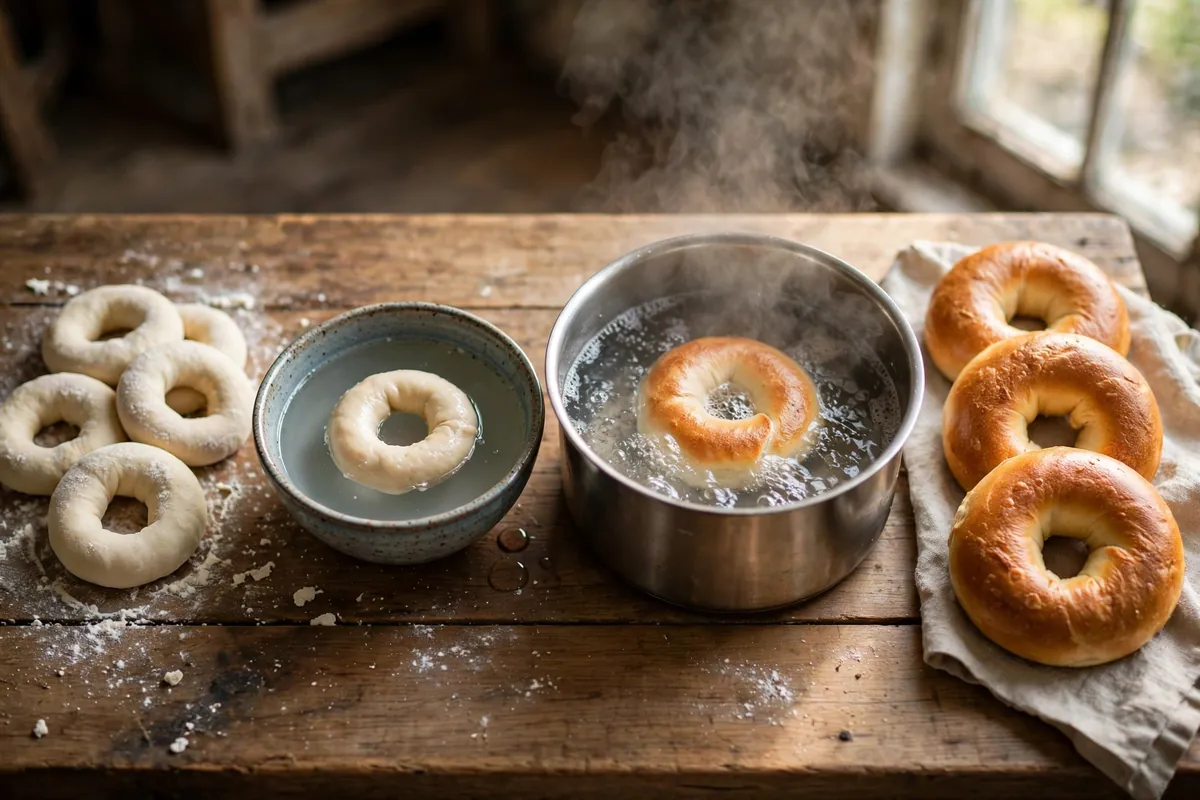
The fix: Use the float test — it’s the bagel proofing standard for a reason. Drop one shaped bagel into a bowl of cool water: if it floats within 10 seconds, it’s ready to boil. If it sinks like a stone, it needs more time. If it floats high and looks bloated, it’s over-proofed — and unfortunately, there’s no rescue; reshape and re-proof won’t restore the spent structure. Proof at cool room temperature and check early: shaped bagels typically need 20–40 minutes, not hours. (Over-proofing ruins all bread the same way — see Why Didn’t My Bread Rise? for the mirror image.)

2. The dough was under-kneaded
Bagel dough is stiff and low-hydration (typically 50–57%), and it needs full gluten development to hold its shape. Under-kneaded dough has a ragged, weak network — fine for a soft dinner roll, fatal for a boiled bagel. The rings look okay shaped, then relax and spread in the water.
How to tell: The dough tore when pulled, never passed the windowpane test, or felt rough after kneading.
The fix: Knead 10–12 minutes by hand (8–10 in a mixer with a dough hook) until smooth, firm, and elastic — it should pass a rough windowpane test. High-protein flour helps enormously (see cause #3).
3. The flour was too weak
All-purpose flour (10–12% protein) makes a tender bagel — tender being the problem. Bagels need chew, and chew needs protein: bread flour at 12.7% or higher is the minimum, and high-gluten flour at 14% is the professional standard. Weak flour means weak gluten means flat bagels, no matter how well you knead.
How to tell: You used all-purpose, the dough felt soft and extensible rather than firm and springy, and the baked bagels are bready-soft instead of chewy.
The fix: Switch to bread flour or high-gluten flour. If all-purpose is all you have, you can still make bagels — knead thoroughly and handle gently — but expect a softer, less chewy result. This is one of the few cases where flour choice alone decides the outcome.
4. The boil was wrong
The boil does two jobs: it sets the crust (gelatinizing the starches on the surface, which is what gives bagels their shine and chew) and it finishes the rise with a final burst of oven spring. Get it wrong and the structure fails at the worst moment.
Too timid: a bare simmer doesn’t set the crust fast enough — the bagel softens and spreads. Too long: past a minute per side, the crust over-gelatinizes into a thick, tough skin.
How to tell: Spreading in the water means too timid; thick, wrinkled skins mean too long.
The fix: A full rolling boil, 30–60 seconds per side. Add malt syrup or honey (a tablespoon per quart) for crust color and flavor. Use a wide pot so the boil recovers quickly, don’t crowd, flip once, and get them into the hot oven promptly.

5. The shaping lacked surface tension
A bagel holds its shape because the dough skin is pulled tight around it — surface tension. A loosely shaped ring with a slack skin relaxes the moment it hits hot water, spreading outward instead of holding tall.
How to tell: The rings looked a bit lumpy or uneven before proofing, the holes closed up or went ragged, and the bagels spread rather than rising.
The fix: Shape with tension. The poke method: roll each portion into a smooth ball first (tucking edges underneath to build a tight skin), then poke a floured finger through the center and stretch the hole to about 2 inches — it shrinks back as it proofs. Or the rope method: roll into a 9-inch rope, overlap the ends, and roll the seam to seal. Either way, the surface should look smooth and taut, not slack. Rest the shaped rings 5 minutes before the final stretch so the gluten relaxes just enough to hold the shape.
The bagel structure checklist
- High-protein flour: bread flour (12.7%+) or high-gluten (14%).
- Knead to smooth and elastic — rough windowpane.
- Shape with a tight skin; 2-inch holes.
- Proof to the float test — 10 seconds, not bloated.
- Rolling boil, malted water, 30–60 seconds per side.
- Into a 425°F (220°C) oven immediately; bake 20–25 minutes until deep golden.
Frequently asked questions
Can I rescue bagels that already deflated in the boil?
Not really — once the structure collapses in the water, baking sets the flat shape permanently. But don’t throw them out: flat bagels still taste like bagels. Slice and toast them, and they’re excellent. Next batch, watch the proof with the float test.
Why do my bagels look fine before boiling but flat after?
That’s the signature of over-proofing or a weak boil. The shaped rings look promising because the gas is still in them; the boiling water is a stress test, and weak structure fails it. Float-test every batch and keep the boil rolling.
Should bagel dough be sticky?
No — proper bagel dough is stiff and firm, noticeably drier than bread dough (50–57% hydration). If your dough is soft and tacky, the flour absorbed less water than expected or the formula is off. A stiff dough is a feature: it’s what builds chew.
Can I make bagels without malt syrup?
Yes — honey, brown sugar, or plain water all work for the boil. Malt gives the most authentic flavor and deepest color, but the boil’s structural job (setting the crust) happens regardless of what’s dissolved in it.
Why did the holes close up?
Under-stretched holes plus over-proofing. Stretch to a full 2 inches — they shrink dramatically — and don’t let the proof run long. A closed hole is cosmetic; the bagel still eats fine.
Is it safe to eat a dense, flat bagel?
Completely — flat is a texture failure, not a safety issue, as long as it baked through (deep golden crust, hollow-ish sound when tapped). Dense bagels toast beautifully.
Related troubleshooting: Why Didn’t My Bread Rise? · Why Is My Bread Dense? · No-Knead Bread for Beginners