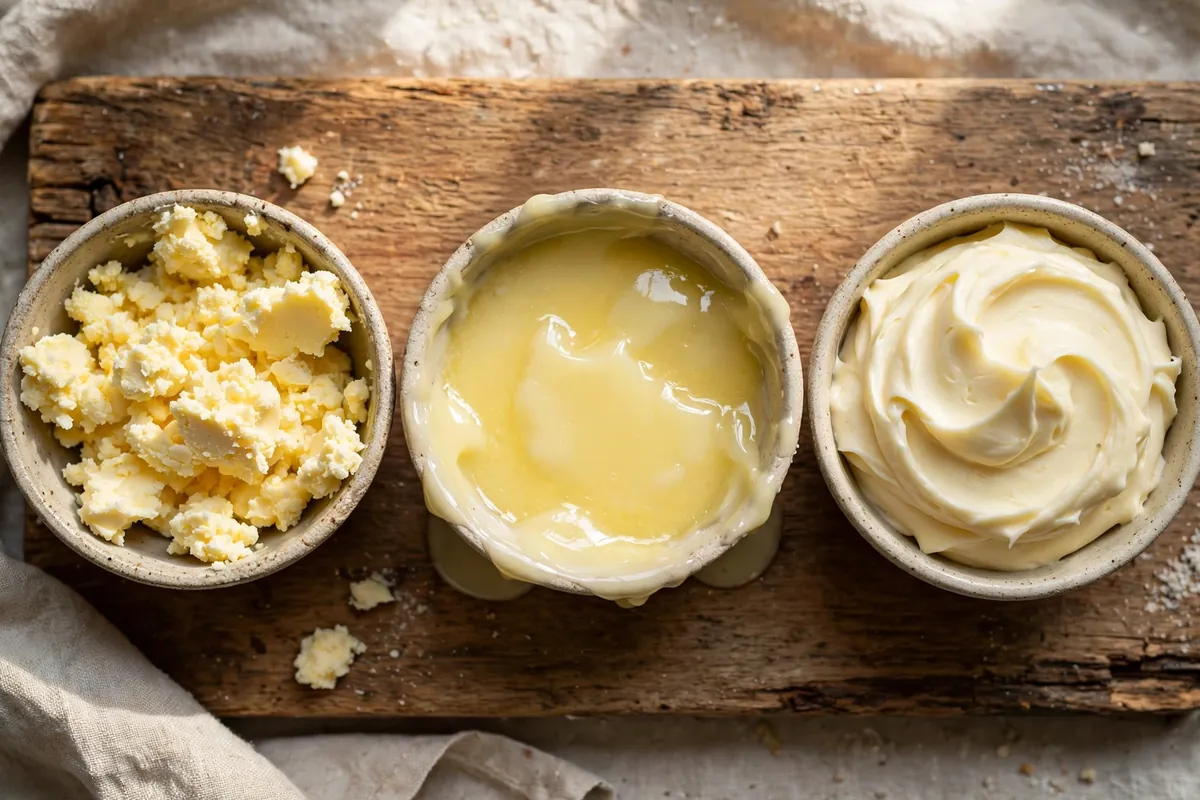
You’re halfway through frosting a cake when the buttercream turns. One minute it’s coming together; the next it’s a curdled, lumpy mess — or a sad soup sliding off the spatula — or so sweet it makes your teeth ache. Before you throw the bowl in the sink: broken buttercream is almost always fixable. I’ve rescued every version of this failure, and the fix depends entirely on which break you’re looking at. Diagnose first, then rescue.
Quick diagnosis: Curdled and lumpy? The butter was too cold — warm the bowl and keep beating, it almost always comes together. Soupy and slide-y? The butter was too warm or there’s too much liquid — chill 15–20 minutes, then re-whip. Way too sweet? A pinch of salt and a spoonful of cream fix more than you’d think; details below.
Buttercream is an emulsion: fat, sugar, and a little liquid beaten into a stable foam. Every break is that emulsion failing for a specific reason — temperature, ratio, or technique. Fix the reason and the emulsion reforms. Here’s each failure and its rescue.
1. Curdled and lumpy — the butter was too cold
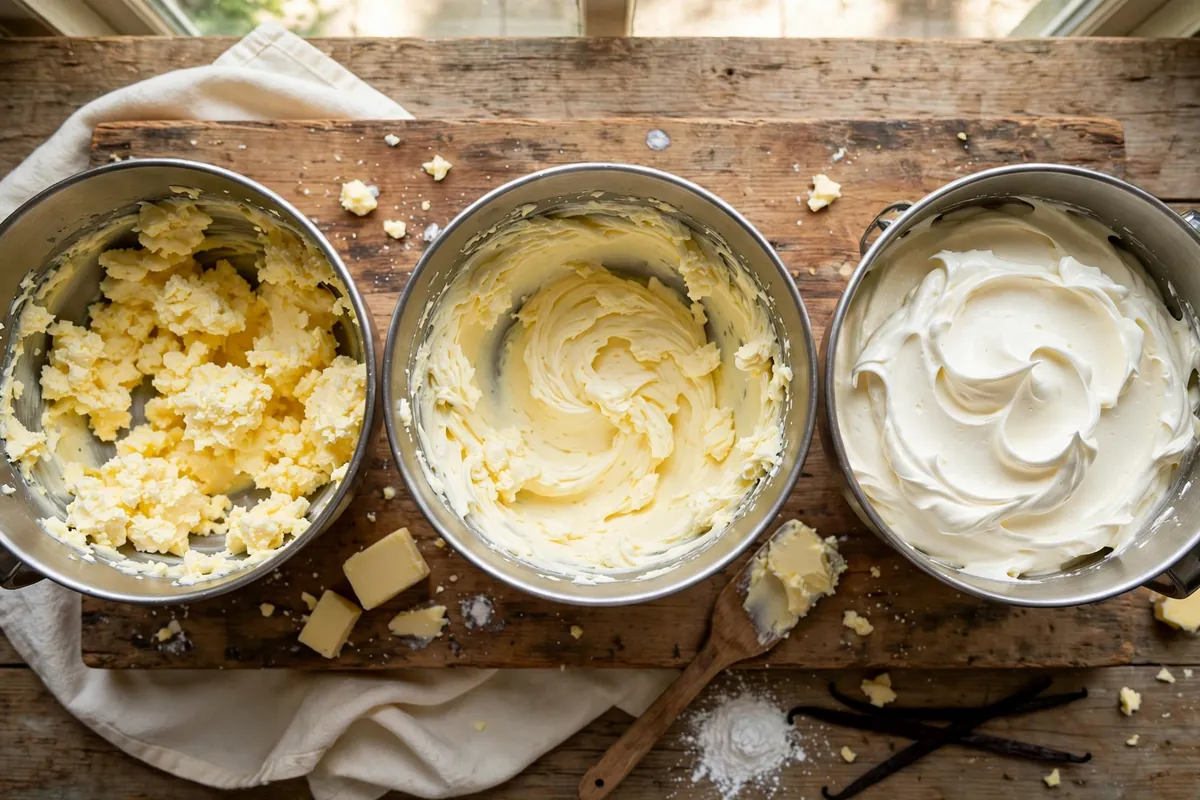
The most common break and the easiest to fix. Cold butter (straight from the fridge, or a cold kitchen) can’t emulsify smoothly — the fat stays in distinct lumps while the sugar and liquid form a separate thin base around them. It looks like cottage cheese and feels like a disaster. It isn’t.
How to tell: Distinct lumps of butter suspended in a thinner, almost watery base. The butter was cold to the touch when you started, or your kitchen is cool.
The fix: Warm it gently and keep beating. The single most reliable rescue: warm the outside of the mixing bowl with your hands, a warm towel, or 10-second bursts of a hairdryer on low while the mixer runs on medium. As the butter softens to the right temperature, the lumps melt into the emulsion — you’ll literally watch it come together, usually within 2–3 minutes. Don’t add anything; don’t start over. Just warmth + time. When I first learned this, I stopped throwing away curdled batches entirely — I’ve never had one fail to come back.
2. Soupy and melting — the butter was too warm
The mirror image. Butter above about 72°F (22°C) is too soft to hold air — instead of a fluffy emulsion you get sweetened grease that slides off the spatula and won’t hold a swirl. Warm kitchens, butter left out for hours, or liquid added too fast all cause this.
How to tell: Shiny, loose, almost pourable frosting. It won’t hold peaks or piped shapes; it slumps within seconds. The butter felt soft and greasy before you started.
The fix: Chill, then re-whip. Refrigerate the whole bowl 15–20 minutes until the edges firm up but the center is still workable — then beat on medium-high for 2–3 minutes. The re-whip rebuilds the air structure now that the fat is firm enough to hold it. If it’s still soft, chill another 10 minutes and repeat. Don’t add more powdered sugar to “thicken” soupy buttercream — you’ll just make sweet soup. Temperature is the problem; temperature is the fix. (For a full guide to heat-stable frosting, see Dairy-Free Frosting That Holds Its Shape — the same principles apply.)

3. Grainy — the sugar never dissolved into the fat
Grainy buttercream has a sandy mouthfeel: tiny undissolved sugar crystals throughout. This happens when the powdered sugar goes in too fast, the butter wasn’t beaten smooth first, or (common with older powdered sugar) the sugar absorbed moisture and formed micro-clumps.
How to tell: It looks smooth-ish but feels gritty on the tongue. Rub a dab between your fingers — you’ll feel the grains.
The fix: Two options. The reliable one: add liquid one teaspoon at a time (cream or milk), beating a full minute after each — the extra moisture dissolves the crystals. Usually 1–2 teaspoons does it. The thorough one: sift your powdered sugar before it goes in. I sift every time now — it takes 60 seconds and prevents the problem entirely. If the graininess came from clumped old sugar, sifting is the only real fix; no amount of beating dissolves actual lumps.
4. Too sweet — rebalance, don’t dilute
American buttercream is inherently sweet (it’s mostly powdered sugar by weight), but sometimes it crosses into inedible: teeth-aching, throat-catching sweet. The instinct is to add more butter — resist it. More butter without rebalancing just makes sweet butter.
How to tell: You taste sugar first, second, and third; no butter flavor, no depth.
The fix, in order of impact:
1. Salt — ¼ teaspoon per 3 cups of powdered sugar. Salt doesn’t make frosting salty; it suppresses the flat one-note sweetness and lets the butter and vanilla come forward. This single addition fixes most “too sweet” complaints.
2. A spoonful of cream or milk (1–2 tablespoons). Liquid dilutes the sugar concentration slightly and improves mouthfeel.
3. Acid — a teaspoon of lemon juice or a tablespoon of cream cheese. Acidity cuts sweetness perception sharply. Cream cheese especially: it adds tang and body while reducing the sugar ratio.
4. If it’s truly beyond saving: beat in 4 oz (115g) of softened cream cheese. It transforms the frosting into something closer to cream cheese frosting — tangy, less sweet, still pipeable. Different frosting, saved dessert.
5. Separated after adding flavoring — liquid went in too fast
Melted chocolate, fruit purée, coffee, or liqueur added all at once can shock a stable emulsion into separating — the extra liquid overwhelms the fat’s ability to hold it, and you get a weeping, split mess.
How to tell: The buttercream was smooth, then you added the flavoring and it broke within seconds.
The fix: Match temperatures and go slow. Flavorings should be at room temperature (melted chocolate cooled to barely warm, ~85°F / 29°C — warm chocolate melts butter on contact). Add in a thin stream with the mixer running, giving each addition 30 seconds to emulsify before the next. If it’s already broken: warm the bowl slightly and beat hard for 2–3 minutes — heat + agitation rebuilds most flavoring breaks. As a last resort, beat in 2–3 tablespoons of additional powdered sugar to give the emulsion more structure to grab onto.
6. Buttercream “broke” overnight in the fridge — it’s fine
Not actually a failure, but it panics everyone once. Refrigerated buttercream turns hard, and when you bring it back to room temperature it can look curdled or separated as the fat warms unevenly.
How to tell: It was perfect yesterday; today it’s firm and looks split around the edges.
The fix: Let it come fully to room temperature (1–2 hours — don’t microwave it), then beat on medium for 3–4 minutes. It will look worse before it looks better — grainy, then lumpy, then suddenly smooth. This always works. Never frost a cold cake with cold buttercream straight from the fridge; the temperature shock tears the cake surface.
Frequently asked questions
Can curdled buttercream always be saved?
Nearly always. Curdling from cold butter is the most rescuable failure in baking — warmth plus continued beating reforms the emulsion in minutes. The only truly dead buttercream is one where the fat has fully melted and separated into grease (from serious overheating), and even that can sometimes be chilled and re-whipped.
Why does my buttercream taste like butter and nothing else?
Under-sweetened or under-flavored — the mirror of “too sweet.” Add powdered sugar ¼ cup at a time, plus 1 teaspoon vanilla and ¼ teaspoon salt. (Full flavor-balance guide: Why Does My Frosting Taste Like Butter?.)
Can I fix buttercream that’s too thin for piping?
Chill it 15–20 minutes, then re-whip — that’s the fix in most cases. If it still won’t hold a peak, the ratio is off: beat in powdered sugar 2 tablespoons at a time until it firms up. For hot-weather piping, a tablespoon of cornstarch per 3 cups of sugar adds heat stability.
Is broken buttercream safe to eat?
Yes — every failure here is textural, not a food-safety issue. Curdled, soupy, grainy, or over-sweet buttercream is all perfectly safe. The only discard signal is off smells or mold from dairy left too long at room temperature (buttercream is fine at cool room temp for 2–3 days; beyond that, refrigerate).
Can I re-freeze buttercream that I’ve already thawed?
Yes, once. Freeze in an airtight container up to 3 months; thaw overnight in the fridge, bring to room temp, and re-whip. Each freeze-thaw cycle degrades the texture slightly, so don’t do it twice.
Why did my chocolate buttercream seize?
The melted chocolate was too hot when added, or a drop of water got in. Chocolate seizes on contact with water and melts butterfat on contact with heat. Cool melted chocolate to barely-warm (85°F / 29°C) and add it in a stream with the mixer running.
Related troubleshooting: Why Does My Frosting Taste Like Butter? · Dairy-Free Frosting That Holds Its Shape · Why Did My Cake Sink in the Middle?