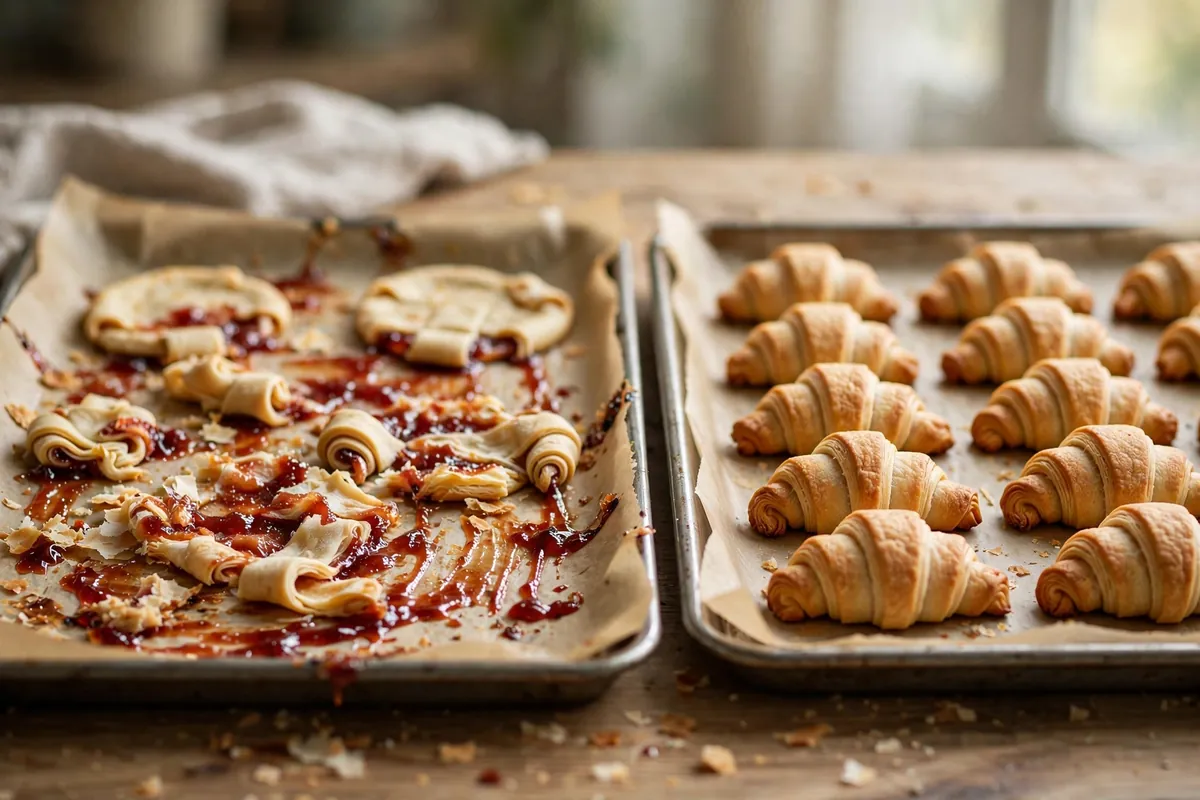
Neat crescents went in; flat open spirals with oozing filling came out. Unravelling is temperature and tension: dough too warm, filling too wet, or roll too loose. All three are fixable, and the fixes stack.
Quick diagnosis: Rugelach unravels because the dough got too warm (chill discipline is everything), the filling was too wet, or the crescents were rolled too loosely. Chill the dough 2+ hours, chill shaped rugelach 15–20 minutes before baking, roll tight, and bake seam-side down.
My baseline: 225g unsalted butter and 225g full-fat cream cheese (both cool room temp), 250g flour, ¼ teaspoon salt, tablespoon of sugar optional. Mix just until combined — overmixing develops gluten that fights your rolling. Divide into 3–4 disks, wrap, chill at least 2 hours or overnight. That chill is the cookie’s structural foundation.
1. The dough was too warm — chill discipline is everything
Cream cheese dough is roughly half butter and cream cheese — both soften fast at room temperature. Warm dough is slack: it stretches instead of rolling, won’t hold a spiral, and the fat melts in the oven before the flour sets — the crescent relaxes and lies flat.
How to tell: Dough felt soft and floppy while rolling, stuck to the counter; baked cookies spread flat, spiral opened like a party blower.
The fix: Chill disks 2 hours minimum; overnight is better. Work one disk at a time. Above 75°F (24°C), chill the filled log 15 minutes before slicing — and chill the shaped crescents on the tray 15–20 minutes before baking. Cold fat hitting hot heat sets the structure before it melts. (Same principle as Why Did My Scones Come Out Hard?.)
2. The filling was too wet — steam is a crowbar
Wet filling turns to steam, and steam pressure pushes the spiral open from inside. Thick jam is the classic offender — mostly water and sugar, it liquefies at baking temperature and floods the layers apart. Chocolate spread does the same.
How to tell: Filling leaked in sticky puddles, cookies taste fine but look exploded, layers separated with gaps.
The fix: Thin filling is the golden rule. Jam: a translucent layer, 2–3mm max, thick jam not runny preserve. Cinnamon-sugar: 1–2 teaspoons melted butter per disk, light sprinkle. Chocolate: chopped chocolate or mini chips, not spread — they melt in place. Always leave a ½-inch clean border; that bare strip seals the roll.
3. The roll was too loose — tension is structure
Loose rolling leaves air gaps between layers — that’s where unravelling starts. Heat expands the trapped air, soft fat lubricates, the spiral unwinds. Tight rolling eliminates gaps so layers bake into each other.
How to tell: Baked cookies show separated layers with visible space between them, like a loosely wound cinnamon roll.
The fix: Roll wide-end to point with gentle constant tension — like a yoga mat. Dab the point with water or beaten egg, tuck it under, place seam-side down. Slice with a sharp knife or floss; a dull blade loosens the roll.
4. The oven was too cool — the fat melted before the structure set
Rugelach needs 350°F (175°C), verified. In a cool oven, butter and cream cheese melt while the flour is still soft — the crescent slumps before the starches set. The quiet cause that gets blamed on rolling.
How to tell: Cookies spread wide and flat, pale bottoms, full 25 minutes without real color.
The fix: Verify 350°F (175°C) — many ovens run 15–25°F cool, exactly the margin that ruins rugelach. Bake middle rack 20–25 minutes until deeply golden; pale means underbaked and unset. Don’t open the door for the first 15 minutes.
5. The dough was overworked — gluten springs back
Mixing past “just combined” develops gluten — and gluten is elastic. It resists rolling, springs back during shaping, and unwinds itself in the oven. Overworked dough feels bouncy, not pliable.
How to tell: Dough kept shrinking back as you rolled, felt elastic; baked cookies tough as well as unravelled.
The fix: Mix only until no dry flour remains. If the dough fights rolling, chill 20 minutes — cold relaxes gluten. Re-roll scraps once. If it’s springing back, it needs rest, not force. (See Why Did My Pie Crust Shrink?.)


The shape-and-bake sequence that doesn’t unravel
The full sequence: cold dough, thin filling, tight roll, point tucked under, seam-side down, chill shaped tray 15–20 minutes, bake at verified 350°F (175°C) 20–25 minutes until deeply golden. Egg wash and coarse sugar optional. Miss one step and you might survive; miss two and the oven tells on you.
Frequently asked questions
Can I fix rugelach that already unravelled?
Not after baking — but serve them anyway; it’s purely cosmetic. Call them “rustic.” Next batch: the chill-and-tight-roll sequence above.
Can I freeze rugelach?
Yes, at two stages. Freeze the dough disks up to a month (thaw overnight in the fridge). Or freeze the shaped, unbaked crescents on a tray, then bag them — bake from frozen at 350°F (175°C), adding 3–5 minutes. The frozen state actually helps them hold their shape. (Same freeze-first advantage as Can I Freeze Cookie Dough?.)
Why is my rugelach dough so sticky?
Warm kitchen, over-softened butter/cream cheese, or too little flour. Chill 30 minutes, dust lightly when rolling. Work in a tablespoon of flour max if still sticky.
Can I use low-fat cream cheese?
Don’t. Low-fat cream cheese has more water and stabilizers, which makes the dough sticky, wet, and prone to spreading — exactly the unravelling you’re trying to fix. Full-fat block cream cheese only, never the tubbed spreadable kind.
Why did all the filling leak out?
Too much or too wet filling, no sealed border. Thin layer, thick jam, ½-inch border, tight roll, seam down. Trick: stir a teaspoon of cornstarch into ¼ cup jam and warm until thickened.
How do I get the classic crescent shape?
Cut each dough disk into 12 wedges like a pizza. Place a small mound of filling (not a spread layer) near the wide end of each wedge, roll toward the point, then curve the ends slightly inward as you set it seam-side down. Chilling before baking locks the curve.
Related troubleshooting: Why Did My Cinnamon Rolls Unravel? · Why Is My Puff Pastry Not Puffing? · Why Did My Pie Crust Shrink in the Oven?