
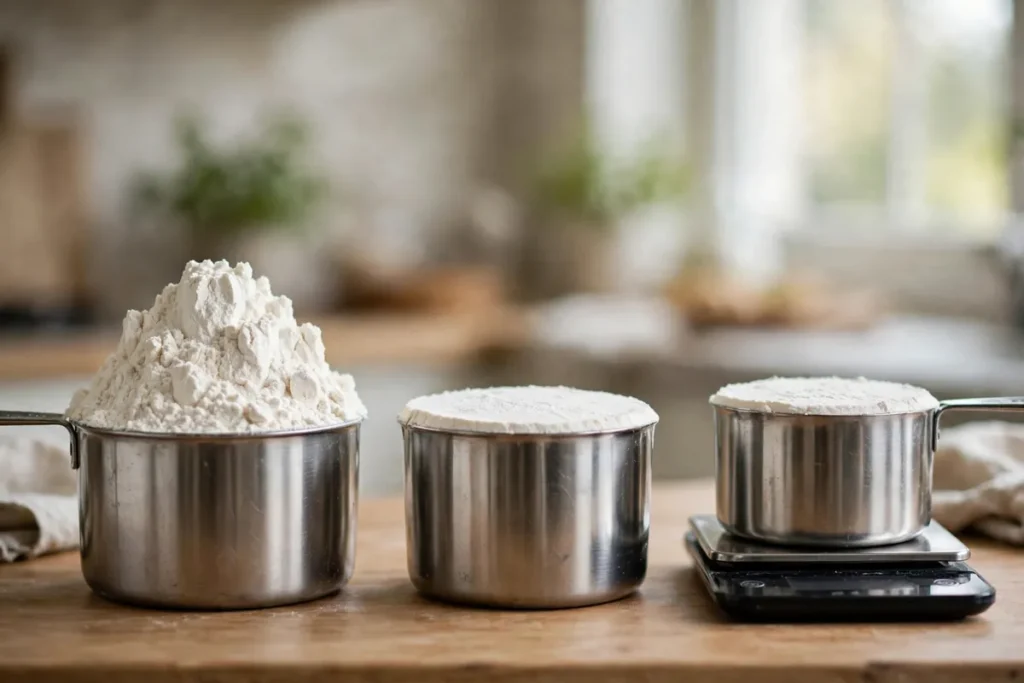
You’re mid-recipe. The blogger wrote “250g flour” and your kitchen has measuring cups. Or the reverse — “2 cups” and all you trust is your scale. Every baker hits this wall, and the stakes are real: in baking, unlike cooking, measurement errors don’t forgive. A cup of flour can weigh anywhere from 120g to 150g depending on how you scoop it — that’s a 25% swing in the most important ingredient in the recipe. (Scooped-packing flour is one of the sneakiest causes of dry cake — see Why Is My Cake Dry?.)
This is the definitive conversion resource I wish I’d had taped inside my cupboard door. Bookmark it.
Quick answer: 1 US cup = 236.6ml. For baking, the weights that matter most: 1 cup all-purpose flour = 120g (spooned and leveled), 1 cup granulated sugar = 200g, 1 cup butter = 227g (2 sticks), 1 cup water or milk = 240g. A kitchen scale beats cups every time — but when cups are all you have, the tables below keep you accurate.
Why Weight Beats Volume (The 30-Second Case for a Scale)
Flour is compressible. Scoop your cup straight from the bag and you pack in ~150g. Spoon it in lightly and level it off: ~120g. Same cup, 25% more flour — and that extra flour drinks the recipe’s liquid, producing the dense, dry results I diagnose in Why Is My Bread Dense?.
A basic digital kitchen scale costs less than a bag of good chocolate and eliminates this entire category of failure. Weigh everything 120g-and-up; use spoons only for small quantities (leaveners, salt, spices, extracts). If you’re converting a cups recipe to weights for the first time, the tables below are your Rosetta Stone.
Volume Equivalents (US Cups, Tablespoons, Milliliters)
| Cups | Tbsp | Tsp | Milliliters |
|---|---|---|---|
| 1 cup | 16 tbsp | 48 tsp | 237ml |
| 3/4 cup | 12 tbsp | 36 tsp | 177ml |
| 2/3 cup | 10 tbsp + 2 tsp | 32 tsp | 158ml |
| 1/2 cup | 8 tbsp | 24 tsp | 118ml |
| 1/3 cup | 5 tbsp + 1 tsp | 16 tsp | 79ml |
| 1/4 cup | 4 tbsp | 12 tsp | 59ml |
| 1/8 cup | 2 tbsp | 6 tsp | 30ml |
| 1 tbsp | — | 3 tsp | 15ml |
Note: US cup = 236.6ml. Australian tablespoons are 20ml (not 15ml) — if you’re using an Australian recipe, that difference matters in small-batch baking.
Weight Tables: Cups to Grams
These use the spooned-and-leveled standard — spoon flour into the cup, level with a knife. This matches how most professional recipe developers measure.
Flours
| 1 cup | Grams | Ounces |
|---|---|---|
| All-purpose flour | 120g | 4.25 oz |
| Bread flour | 127g | 4.5 oz |
| Cake flour | 114g | 4 oz |
| Whole wheat flour | 113g | 4 oz |
| Rye flour | 102g | 3.6 oz |
| Almond flour | 96g | 3.4 oz |
| Cornstarch | 128g | 4.5 oz |
Sugars
| 1 cup | Grams | Ounces |
|---|---|---|
| Granulated sugar | 200g | 7.1 oz |
| Brown sugar, packed | 220g | 7.8 oz |
| Powdered/confectioners’ sugar | 120g | 4.25 oz |
| Cocoa powder (Dutch) | 100g | 3.5 oz |
Fats and dairy
| Measure | Grams |
|---|---|
| 1 cup butter | 227g (2 sticks / 16 tbsp) |
| 1 tbsp butter | 14g |
| 1 cup oil | 224g |
| 1 cup milk/buttermilk | 240g |
| 1 cup heavy cream | 238g |
| 1 cup sour cream/yogurt | 245g |
Sweeteners and misc.
| 1 cup | Grams |
|---|---|
| Honey / golden syrup | 340g |
| Maple syrup | 315g |
| Molasses | 328g |
| Water | 236g |
| Rolled oats | 90g |
| Chocolate chips | 170g |
| Chopped nuts | 120g |
| Raisins | 145g |
Temperature Conversions
| °F | °C | Gas Mark | What it’s for |
|---|---|---|---|
| 325°F | 165°C | 3 | Slow bakes, cheesecakes, meringues |
| 350°F | 175°C | 4 | The standard — most cakes, cookies, quick breads |
| 375°F | 190°C | 5 | Biscuits, scones, golden crusts |
| 400°F | 200°C | 6 | Puff pastry, artisan breads |
| 425°F | 220°C | 7 | Pizza, soda bread, high-heat roasts |
| 450°F | 230°C | 8 | Pizza steel, flatbreads |
Quick formula: °C = (°F − 32) × 5/9. For oven settings, round to the nearest 5°C — ovens aren’t more precise than that anyway.
Pan Size Conversions
Pan size changes batter depth, which changes bake time. Going from an 8-inch round to a 9-inch round increases area ~25% — the layer bakes thinner and faster.
| Original | Substitute | Adjustment |
|---|---|---|
| 8″ round | 9″ round | Reduce time ~5 min, same temp |
| 9″ round | 8″ round | Increase time ~5–8 min, check center |
| 9×13″ sheet | Two 8″ rounds | Similar depth; watch edges |
| Loaf pan 9×5″ | 8″ square | Slightly thicker; add 5 min |
| Muffin tin (12) | 8″ square pan | Same batter; add 10–15 min |
Rule of thumb: keep the batter depth similar and adjust time, not temperature. A toothpick test overrules every chart.
How to Convert a Recipe: A Worked Example
Recipe says: 2 cups flour, 1 cup sugar, 1/2 cup butter, 350°F.
- Flour: 2 × 120g = 240g
- Sugar: 1 × 200g = 200g
- Butter: 0.5 × 227g = 114g (1 stick + 1 tbsp, or just weigh it)
- Temperature: 175°C / Gas 4
Write the weights on the recipe the first time. Next time, you skip the cups entirely.

Frequently Asked Questions
Why does my cup of flour weigh differently every time?
Because flour compresses. Scooping packs it down; humidity changes its density. The fix isn’t a better cup — it’s a scale. Until then, always spoon flour into the cup and level it off; never scoop from the bag.
Can I convert baking powder and baking soda by volume?
Yes — and you should. Small quantities (under ~20g) are more accurate by spoon than by scale, since most kitchen scales round to whole grams. Level your measuring spoons with a straight edge.
My recipe is in Australian cups — does it matter?
An Australian cup is 250ml vs the US 236.6ml — about 6% more. For most home baking it won’t ruin anything, but in precise recipes (macarons, sponge cakes), use the weight tables above instead of converting cup-for-cup.
How do I convert eggs to weight?
One large egg ≈ 50g total (about 30g white + 20g yolk). Medium ≈ 44g, extra-large ≈ 56g. When a recipe’s success hinges on egg quantity — custards, sponges — weigh them.
Does altitude change these conversions?
No — grams are grams everywhere. But altitude changes how the recipe behaves (faster rise, more moisture loss). For that, see High-Altitude Baking Adjustments.
Cups or grams for sourdough?
Grams, always. Sourdough runs on baker’s percentages — every ingredient expressed as a percentage of flour weight. Cups can’t do that math reliably. (New to the terms? Why Didn’t My Bread Rise? covers the fundamentals.)
Related troubleshooting: Why Is My Cake Dry? · Why Is My Bread Dense? · High-Altitude Baking Adjustments