
Banana cake should be tender, moist, and light enough to layer — the refined cousin of banana bread, not its twin. But it goes gummy with depressing ease: a dense wet streak through the middle, a gluey bottom layer, a crumb that sticks to your teeth. Unlike bread, where density is forgiving, cake is a creamed batter — gumminess means something structural went wrong. It comes down to three things: overmixed batter, too much banana, or an underbaked center.
Quick diagnosis: Your banana cake is gummy from excess gluten (overmixed after the flour went in), too much banana (bananas are 75% water), or an underbaked center. Mix just until the flour disappears, use no more than 1 to 1½ cups mashed banana for a two-layer cake, and bake to 200–205°F (93–96°C) internal.
My tested baseline, two 9-inch (23 cm) layers: 340g (2¾ cups) flour, 1½ tsp baking soda, 1 tsp baking powder, 1 tsp salt, 1 tsp cinnamon; 170g (¾ cup) cool-room-temp butter, 300g (1½ cups) granulated + 100g (½ cup) brown sugar; 3 eggs; 240g (1 cup) well-mashed very ripe banana (2–3); 120ml (½ cup) buttermilk; 2 tsp vanilla. Cream butter and sugars 3–4 minutes until pale and fluffy, beat in eggs one at a time, mix in banana, add dries in three additions alternating with buttermilk — start and end with dry, low speed, just until each disappears. Bake at 350°F (175°C) 28–32 minutes.
1. You overmixed the batter — gluten is the #1 gumminess maker
In bread you want gluten; in cake, developed gluten kills tenderness. The moment flour meets liquid, gluten forms, and every extra mixer revolution tightens it. Overmixed banana cake doesn’t just toughen — the wet banana amplifies it into that gummy, gluey texture, worst where the batter was worked most.
How to tell: Dense, slightly elastic crumb rather than crumbly-tender; pale gummy streaks or tunnels; the cake feels wet though a toothpick came out clean.
The fix: Once flour goes in, mixer on low, stop the instant the last streak vanishes — finish with three or four spatula folds. Sift lumps out before dries meet batter, never beat them out after. (Same gluten discipline as Why Are My Muffins Tough? The Muffin Method Explained.)
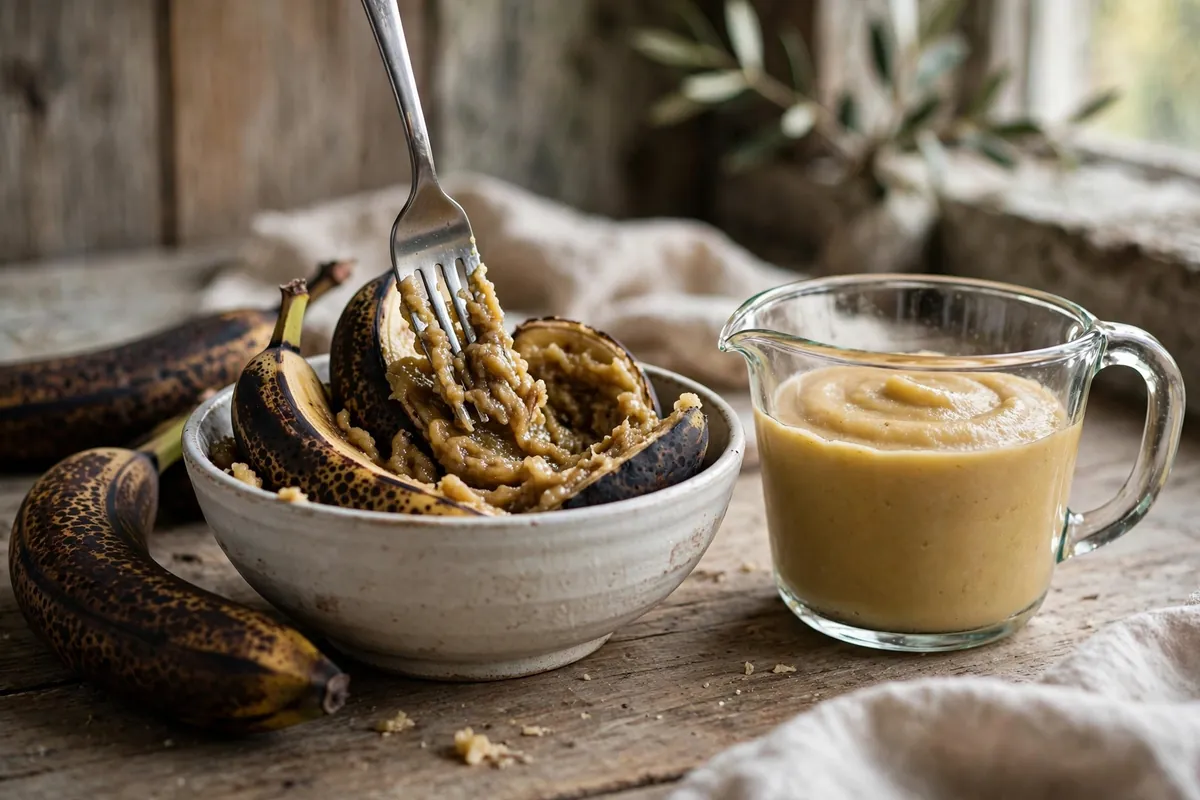
2. You used too much banana — it’s three-quarters water
This is the trap separating banana cake from banana bread. In bread, an extra banana just adds moisture. In cake — a balanced emulsion — 2 cups of banana where the formula expects 1 adds half a cup of unaccounted water the flour and eggs can’t structure. The excess settles into a gummy bottom layer.
How to tell: The recipe said “3–4 bananas” without a cup measure (a large banana can be ¾ cup mashed); the batter looked thin before baking; gumminess worst at the bottom.
The fix: Measure, don’t count: 1 to 1½ cups (240–360g) mashed for a two-layer 9-inch cake. Use heavily speckled to black bananas — sweeter, smoother, incorporating evenly instead of leaving wet pockets.
3. The center was underbaked — the toothpick lied to you
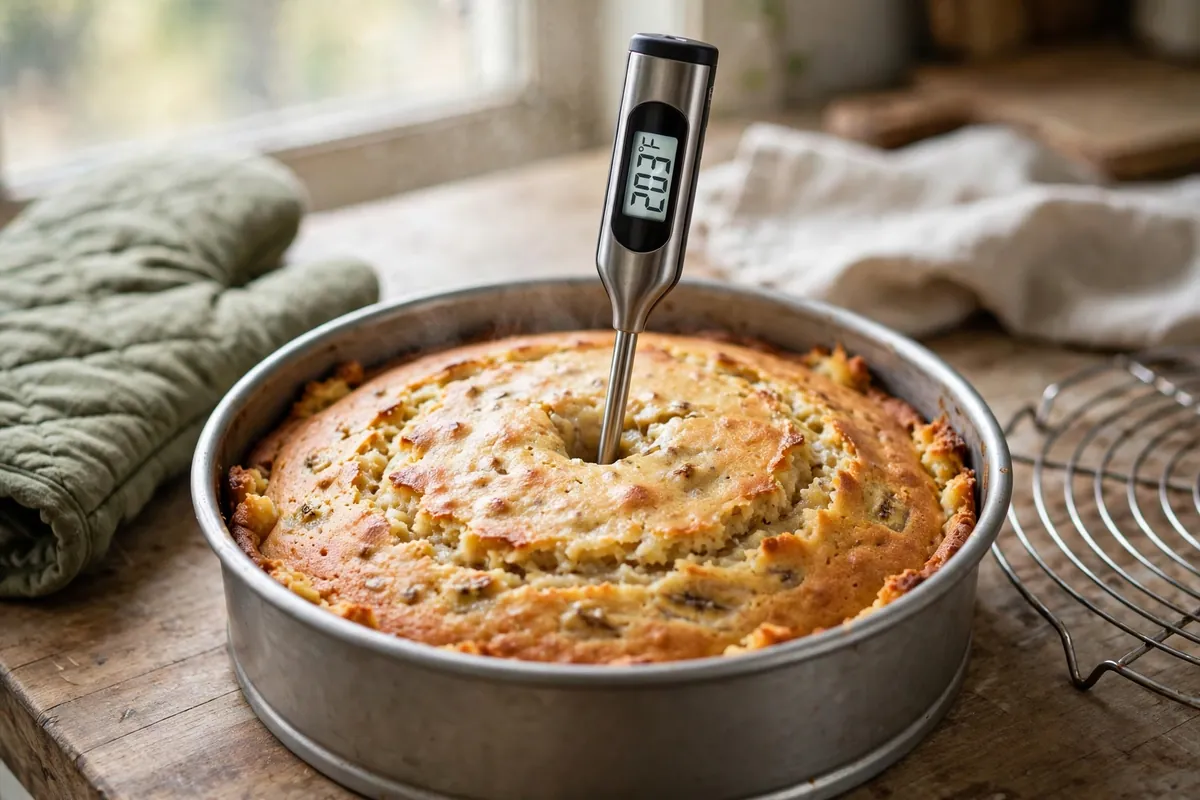
Banana batter is wet and heavy, setting from the outside in more slowly than plain cake. The toothpick test is treacherous: clean from the outer two-thirds while the center is a degree from set — and that last degree is the difference between tender and gummy. Underbaked banana cake doesn’t look raw; it just eats wet.
How to tell: Gumminess concentrated in the center, fading toward the edges; slight sink as it cooled; the center feels cool-damp at room temperature.
The fix: Bake to temperature, not time: 200–205°F (93–96°C) center. Top springs back when pressed, edges just pulling from the pan. Top browning early? Tent with foil the last 10 minutes. Cool in the pan only 10 minutes — longer and trapped steam sogs the bottom. (Same doneness discipline as Why Did My Cake Sink in the Middle? 7 Causes, Tested Fixes.)
4. Oil vs. butter isn’t the cause — but it changes the margin of error
Neither fat causes gumminess, but they forgive different mistakes. Oil coats flour proteins and inhibits gluten — harder to overmix into gumminess. Butter gives better flavor and a finer crumb, but an overmixed butter cake goes gummy faster as the collapsed creamed structure turns dense.
How to tell: Gummy with oil? The banana quantity or the bake is your problem, not the mixing. Gummy with butter? Check whether you actually creamed a full 3–4 minutes — under-creamed butter never built the aeration that keeps the crumb open.
The fix: For oil: whisk oil, sugars, eggs, banana, fold in dries gently — simple and forgiving. For butter: cream 3–4 minutes until pale and fluffy, then don’t overmix the flour. I use butter for flavor, oil when baking with kids or in a hurry. (Fat-ratio science: Why Did My Brownies Turn Out Cakey? Fudgy vs Cakey Science.)
5. The pan was too small or too deep — geometry matters
Batter for two 9-inch layers, baked in one deep 9×13 or a loaf pan, can’t bake through before the outside over-sets. Exterior looks done, center stays wet — the classic gummy middle, amplified by banana batter’s moisture. Dark pans worsen it by over-browning the outside early.
How to tell: Edges and top well-browned or dry while the center is gummy; you baked in a different pan than specified.
The fix: Match pan to recipe. In a 9×13, expect 35–40 minutes; check temperature, not color. In dark or glass pans, drop 25°F (to 325°F / 165°C) so the exterior doesn’t race ahead. (See Glass vs Metal vs Dark Pans: What Changes in Your Bake.)
Frequently asked questions
Can I fix a banana cake that’s already gummy?
Not structurally — but repurpose it: cube, toast at 325°F (165°C) for 15–20 minutes into croutons, and layer into a trifle with whipped cream and caramel. Toasting drives off the excess moisture and the complaint disappears under cream.
Is gummy banana cake safe to eat?
Yes, if fully baked — gumminess is texture, not raw batter. If the center tastes of raw flour or egg, it was underbaked; 200°F (93°C) or above on the thermometer means it’s cooked.
How is banana cake different from banana bread, really?
Banana bread is a quick bread: muffin method, no creaming, loaf format, density acceptable. Banana cake is a creamed cake: aerated fat and sugar, layered, frosted, expected light and tender. Different recipes sharing a fruit. (Bread version: Why Is My Banana Bread Dense? Quick Bread Fixes.)
Can I reduce the sugar to fix gumminess?
Sugar isn’t the cause, and cutting it backfires — sugar tenderizes by interfering with gluten. Under-sugared banana cake is tougher, not less gummy. Fix the mixing, banana quantity, and bake; leave the sugar alone.
Why does my banana cake have tunnels?
Tunnels are the signature of overmixing plus too much leavening — the gluten network trapped large gas bubbles that tunneled upward. Same fix as gumminess: gentle mixing, measured leavening, correct banana quantity.
Should I use baking powder, baking soda, or both?
Banana batter is acidic, so baking soda is essential — 1 to 1½ teaspoons for a two-layer cake. A little baking powder (about 1 teaspoon) adds insurance lift. Too much of either gives a soapy taste and a fragile crumb that collapses into gumminess.
Related troubleshooting: Why Is My Banana Bread Dense? Quick Bread Fixes · Why Did My Tres Leches Turn Soggy? Soak Ratios That Work