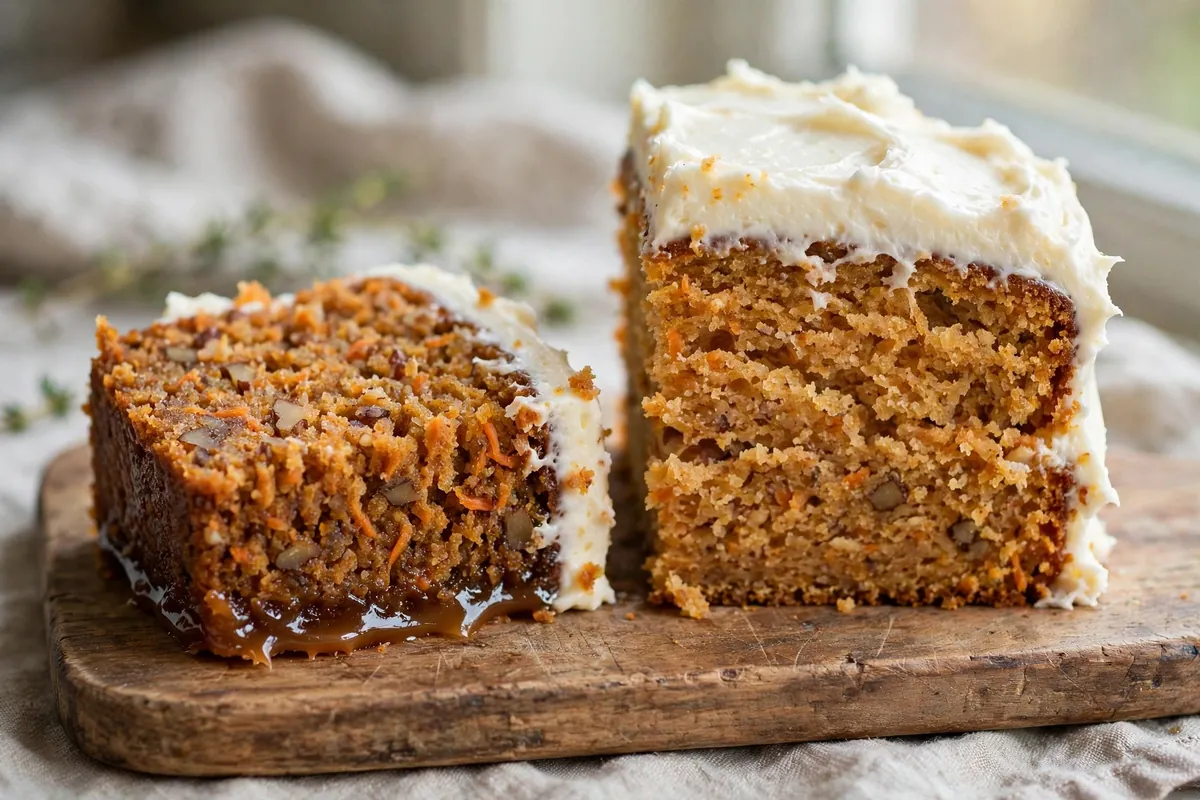
Carrot cake should be the most forgiving cake in the book — oil-based, no creaming, stir-together simple. The reason is structural: this is a heavy batter carrying up to three cups of wet grated carrots plus nuts and raisins, asking a modest amount of leavening to lift all of it. When anything in that equation slips — too much add-in weight, tired leavening, overmixed batter — the cake can’t climb, and you get the brick.
Quick diagnosis: You overloaded it — too many carrots, nuts, and raisins for the batter to lift. Cap total add-ins at about 3 cups, grate carrots fine (never food-processor mush), check your baking soda is fresh and correctly balanced with the batter’s acidity, and mix just until combined.
My tested baseline: 2 cups (250g) all-purpose flour, 2 tsp baking soda, 1 tsp baking powder, 1½ tsp cinnamon, 1 cup (200g) granulated + 1 cup (220g) brown sugar, 1¼ cups (295ml) neutral oil, 4 eggs, 3 cups finely grated carrots (about 340g), 1 cup chopped walnuts. Two 9-inch rounds, 350°F (175°C), 30–35 minutes, until a toothpick comes out with moist crumbs. Moist, tender, and sliceable — never heavy.
1. The add-ins outweighed the batter — the classic cause
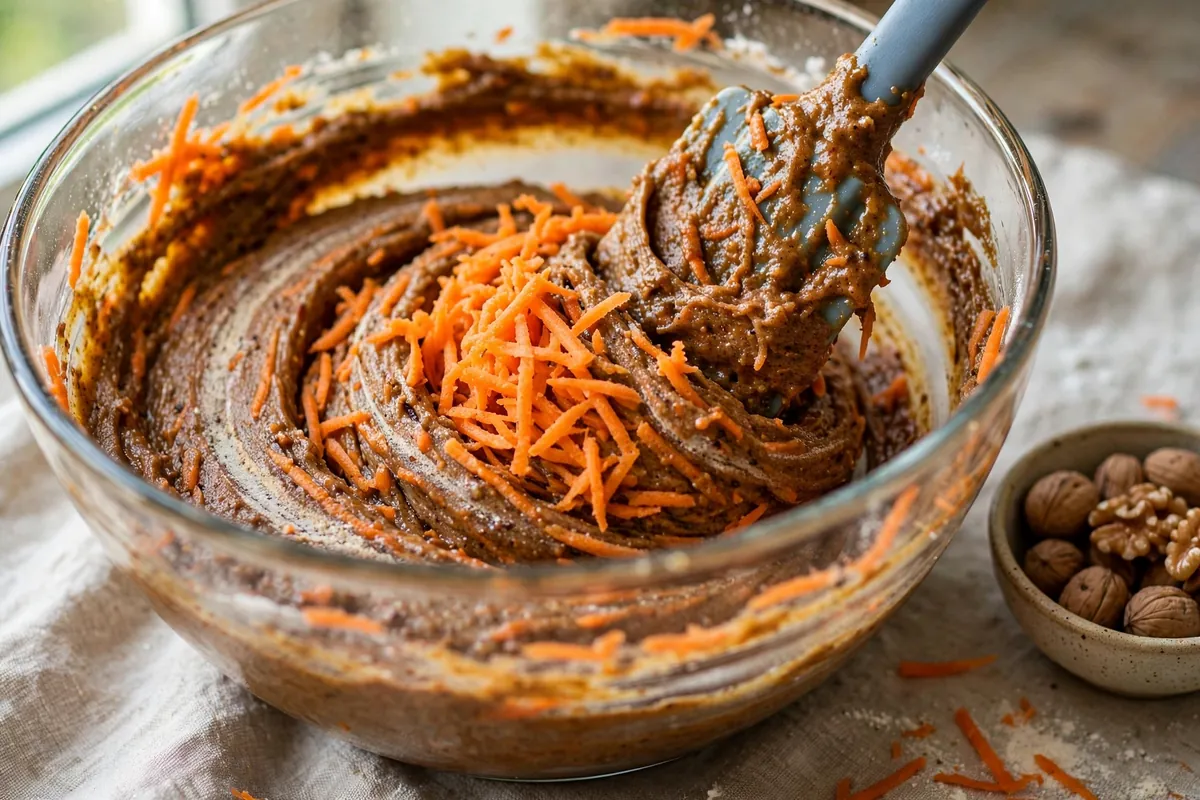
This is the number one reason, and it’s always too much love: an extra cup of carrots “for moisture,” a heavy hand with the walnuts, a full cup of raisins. Every add-in is dead weight the leavening must lift. Carrots are the worst offender because they’re wet — they don’t just weigh the batter down, they add water that extends the bake and compacts the structure.
How to tell: The cake is heaviest at the bottom, sometimes with a visible gummy layer; the batter looked more like carrot salad than cake batter.
The fix: Cap total add-ins around 3 cups — that’s the ceiling, not the floor. Grate carrots on the fine holes of a box grater: fine shreds distribute evenly and release moisture gradually. Never use a food processor — it makes pulp that floods the batter all at once. (Add-in weight sinks everything: Why Did My Banana Bread Turn Out Dense? is the same physics with a different fruit.)
2. Your leavening was wrong — too little, too old, or unbalanced
Carrot cake leans hard on baking soda, and soda only works in the presence of acid. Brown sugar, and buttermilk or yogurt if your recipe uses them, supply that acid. Too little (or dead) soda gives no lift; too much gives a fast rise that collapses, plus a soapy taste.
How to tell: Flat, heavy cake with no soapy taste = under-leavened or dead soda. Good rise that fell, with a chemical aftertaste = too much soda. Test old soda: drop ½ tsp in hot vinegar — vigorous fizz means alive, weak fizz means replace.
The fix: My ratio per 2 cups flour: 2 tsp soda + 1 tsp double-acting baking powder.
3. You overmixed — oil cakes punish extra strokes
Without a creaming step, bakers stir “until it looks right” — usually 30 strokes past right. The crumb goes from tender to bready to gummy, and the cake eats dense even when the leavening did its job.
How to tell: The crumb is tough and elastic rather than tender; it bounced back when pressed; the texture reads more like bread than cake.
The fix: Combine wet and dry with a spatula in 15–20 strokes, stopping the moment the last flour streak disappears. If you’re using a mixer, use the lowest speed and stop early; a spatula is honestly the better tool here.
4. The pan was wrong — deep batter can’t bake through
Carrot cake batter in a too-small or too-deep pan is a density trap. The edges set while the center stays raw, and by the time the center tests done the outside is overbaked.
How to tell: The center stayed wet long after the edges browned; the finished cake has a dense ring around a gummier middle; the top domed then sank.
The fix: Two 9-inch rounds (or one 9×13) for a standard batch — batter depth around 1½ inches. Grease and line with parchment. Bake at a true 350°F (175°C) — an oven running at 325°F stretches the bake and lets the heavy batter settle before it sets. (Pan geometry ruins more cakes than recipes do: Why Did My Cake Sink in the Middle?.)
5. Too much sugar weighed it down — sweetness has mass
Carrot cake recipes are notoriously sweet — some call for 2½ cups of sugar to 2 cups of flour. It also over-browns the crust early, tempting you to pull the cake before the center sets.
How to tell: The crust browned fast and dark while the center lagged; the cake tastes cloying; the crumb is moist but compact, almost fudgy in a bad way.
The fix: My ceiling is 2 cups total sugar to 2 cups flour, split between granulated and brown. If the top browns before the center is done, tent loosely with foil for the last 10–15 minutes rather than pulling early — a pale top on a fully baked cake beats a gorgeous top on a raw middle.
6. You underbaked it — the toothpick lied
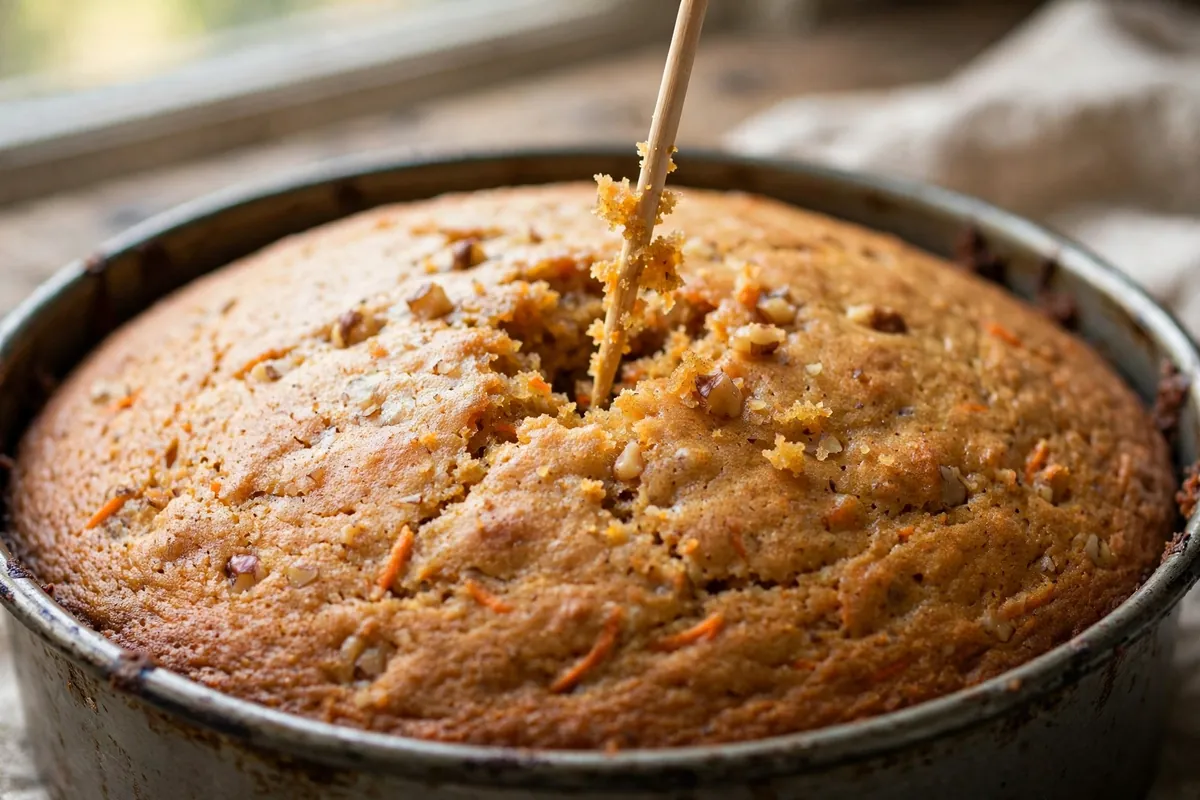
Dense carrot cake is often just unfinished carrot cake — the heavy batter needs its full time. A toothpick that comes out with wet batter means keep going; moist crumbs clinging to it means done.
How to tell: The center dipped as it cooled; the bottom layer looked wet and translucent when sliced; the cake tasted eggy or pasty in the middle.
The fix: Look for moist crumbs, not wet batter, and a center that springs back when lightly pressed. Cool in the pan 10–15 minutes, then turn out to cool fully before frosting. (Underbaking masquerades as a dozen other problems: How to Rescue an Overbaked Cake covers the thermometer habits that prevent both extremes.)
Frequently asked questions
Is dense carrot cake safe to eat?
Yes — density is a texture issue, not a safety one. The one exception: if the center is genuinely raw and wet (not just dense), give it more oven time. Fully baked but heavy cake is perfectly fine to serve.
Can I fix a carrot cake that’s already baked dense?
You can’t lighten the crumb after baking, but you can redeem the cake: warm slices and serve with ice cream, cube it for a trifle with whipped cream and fruit, or make cake pops. Dense cake is actually ideal for trifles — it holds its shape.
Why does my carrot cake taste soapy?
Too much baking soda. Cut it back and make sure there’s enough acid (brown sugar, buttermilk) to neutralize it. Soapy taste plus a fallen center is the textbook signature of excess soda.
Does it matter if I use oil vs melted butter?
Yes, and it’s why carrot cake is oil-based: oil coats flour proteins and limits gluten, giving a moister, more tender crumb that stays soft refrigerated (important under cream cheese frosting). Melted butter firms up when cold and gives a denser, richer crumb. For carrot cake, oil wins.
Related troubleshooting: Why Did My Cake Sink in the Middle? · Why Did My Banana Bread Turn Out Dense? · Why Is My Cake Dry?