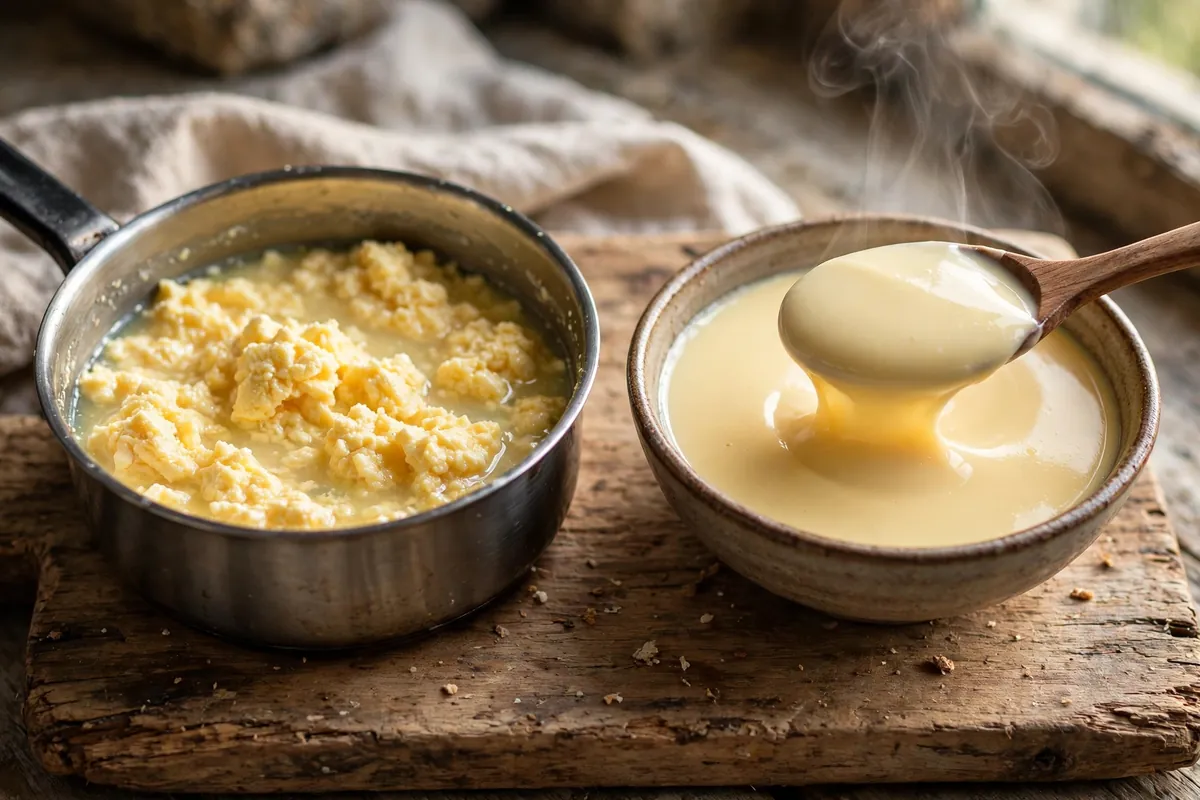
One minute your custard is a silky, spoon-coating sauce; the next it’s grainy, weeping liquid, with the unmistakable look of sweet scrambled eggs. A split custard feels like a disaster, but it’s one of the most fixable failures in baking — if you catch how far it went. I’ve rescued custards that looked completely lost — and learned to recognize the ones past saving.
Quick diagnosis: Your custard split because the egg proteins got too hot — stirred custards curdle above about 185°F (85°C). If it’s only slightly grainy, an ice bath plus vigorous whisking (or a 20-second blender blitz, then a strain) will usually save it. If it looks like fully scrambled eggs, the proteins are set — strain it and repurpose the liquid.
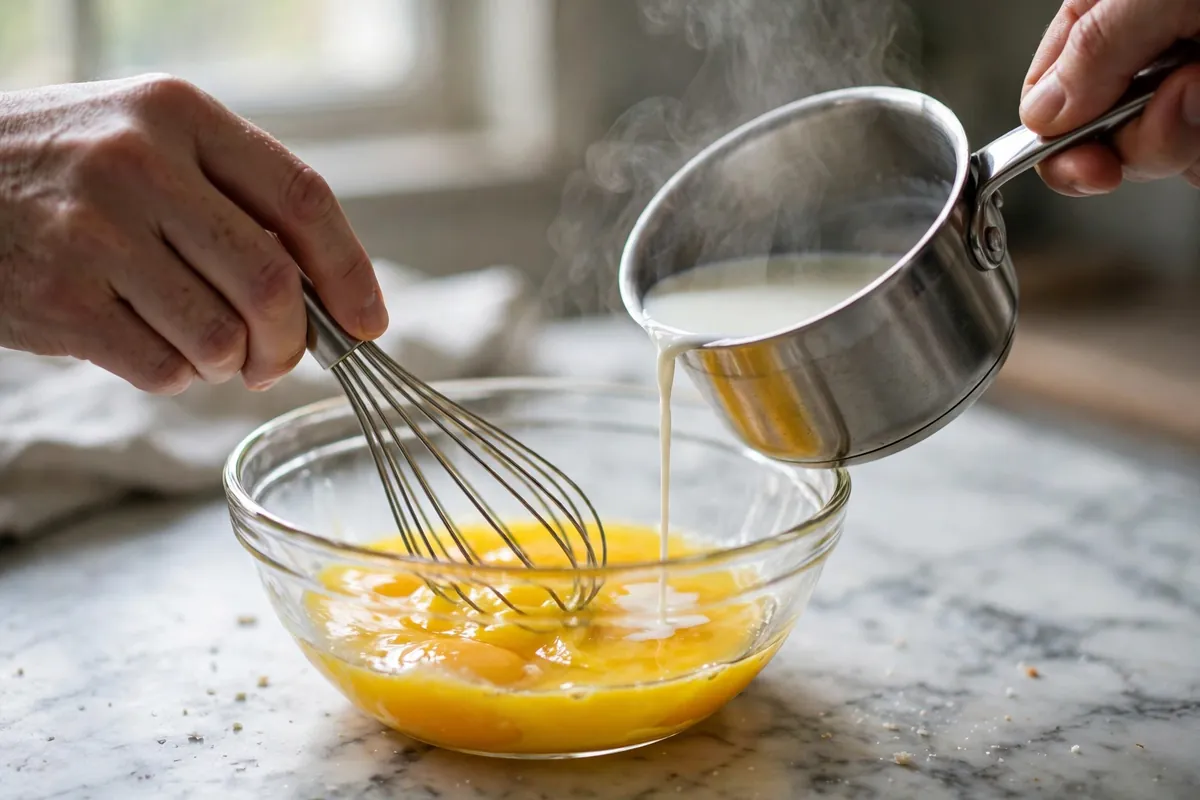
My tested baseline, crème anglaise: 500ml (2 cups) whole milk or half-and-half, 1 vanilla bean or 2 teaspoons vanilla, 5 large yolks (about 90g), 75g sugar (⅓ cup + 1 tablespoon), pinch of salt. Heat the milk to steaming. Whisk yolks and sugar, then temper: drizzle in a third of the hot milk while whisking constantly, pour back into the pan, and cook over medium-low heat, stirring constantly, until it reaches 175–180°F (80–82°C) and coats the spoon — the nappé stage, where a finger drawn across the back of the spoon leaves a clean line. Never let it boil.
1. You boiled it — heat is the #1 custard killer
Yolk proteins begin setting around 150°F (65°C) and tighten into curds as temperature climbs; by 185°F (85°C) a stirred custard is in real danger, and a boil guarantees scrambled texture. Silky to split can be thirty seconds of inattention — a heavy pan, constant stirring, and a thermometer are the entire defense.
How to tell: The custard thickened suddenly, then turned grainy; you may have seen it bubble or felt the spoon drag. The classic “I looked away for a minute” split.
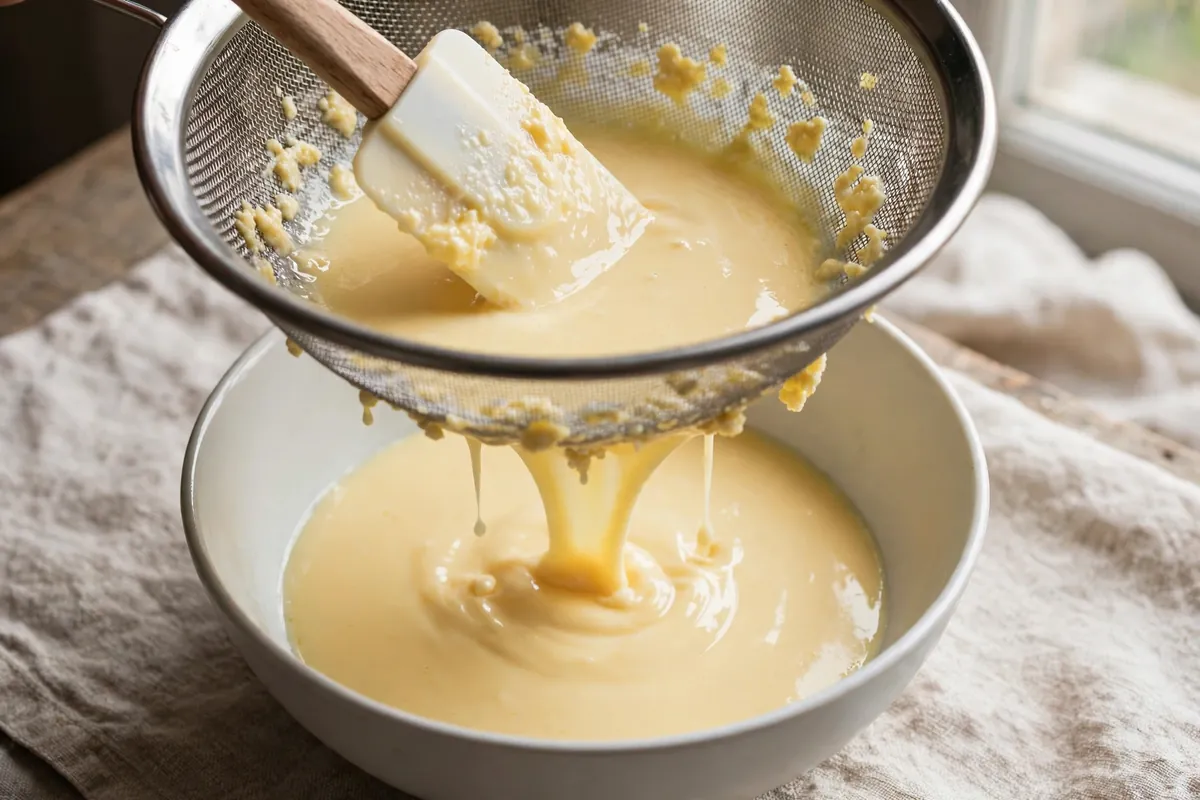
The fix: If only lightly grainy: off the heat, into an ice bath, whisk hard for a full minute. The cold stops the cooking; the whisking breaks early clumps before they set. Still grainy? Blitz 15–20 seconds with an immersion blender, then strain through a fine-mesh sieve. (Same emulsion-rescue logic as How to Fix Curdled Ganache: Emulsion Rescue.)
2. Your tempering was too aggressive — hot milk shocked the yolks
Tempering brings yolks up gradually. Pour hot milk in too fast, or into ice-cold yolks, and proteins at the contact point seize into tiny curds before the pan is on the heat. The custard starts faintly grainy and only gets worse.
How to tell: Graininess appeared during tempering, before the custard went back on the stove; small cooked-egg flecks visible in the mixture.
The fix: Temper with room-temperature yolks and milk at a bare simmer, not a rolling boil. Drizzle in the first few tablespoons while whisking hard, then increase to a steady stream once the yolks are warm. If the yolks and the first milk addition are within about 30°F (17°C) of each other, you’re safe. Once tempered curds form, only the strainer saves you.
3. Acid or alcohol curdled it — lemon and liqueurs are protein magnets
Acid lowers the temperature at which egg proteins coagulate — that’s why lemon custard, wine sabayon, or custard with a slug of rum splits at temperatures perfectly safe for plain vanilla. Adding citrus juice to the hot custard, or cooking after the addition, is asking for curds.
How to tell: The split happened at a temperature you know was safe, right after adding lemon juice, wine, or spirits; the curdling is fine-grained and uniform rather than lumpy.
The fix: Add acids and alcohol off the heat, at the very end, below 160°F (70°C). For lemon custard, use a starch-stabilized pastry cream (below) — starch physically blocks protein clumping and buys real insurance. If acid already split it, the blender-and-strain rescue still works for mild cases.
4. You needed a sturdier custard — pastry cream vs. crème anglaise
Crème anglaise has no starch — pure egg thickening, delicate. Pastry cream (crème pâtissière) includes cornstarch or flour, which thickens and physically gets between egg proteins so they can’t clump. A starch custard can be boiled a minute or two — in fact it must be, to cook out raw starch taste and deactivate the amylase enzyme in yolks that would otherwise thin it overnight.
How to tell: You needed a sturdy custard for éclairs, tarts, or trifle layers but made anglaise-style; or your pastry cream thinned in the fridge overnight — that’s amylase, and it needed a full boil.
The fix: For anything baked, chilled overnight, or mixed with acid, use pastry cream: 500ml milk, 4 yolks, 100g sugar, 30g cornstarch, vanilla. Whisk yolks, sugar, and starch; temper; return to the heat and whisk through the lumpy stage until it boils glossy — 1 to 2 minutes at a full bubble. It looks split when the starch first hits the heat; keep whisking. Strain, press wrap on the surface, chill. (Starch behavior: Why Is My Pie Filling Runny? Starch and Fruit Fixes.)
5. You held it too long or reheated it — custard has a short fuse
A finished custard kept warm on the stove keeps cooking — residual heat creeps past the safe zone, and twenty minutes of “holding” does what a boil does in one. Reheating is worse: microwaves heat unevenly, curdling hot spots while the rest stays cool.
How to tell: Perfect off the heat, grainy after sitting — or split during reheating the next day.
The fix: Serve promptly or chill fast: bowl, wrap on the surface, fridge within an hour. Reheat gently — double boiler or very low heat, constant stirring, never past 170°F (77°C). Most stirred custards are best at room temp or cold; plan for that.
Frequently asked questions
Is split custard safe to eat?
Yes — curdling is a texture failure, not a safety one, as long as it was cooked properly and refrigerated promptly. Same rule as any dairy: don’t leave it out more than 2 hours, refrigerate leftovers within an hour.
Can I fix custard that looks like fully scrambled eggs?
No — once proteins fully set into distinct curds, no blending makes it silky again. Strain out the solids and repurpose the liquid: still sweet vanilla milk, good for bread pudding or a milkshake base.
Why did my custard split in the fridge overnight?
Usually not heat curdling — it’s syneresis, the gel weeping liquid as it sits, or amylase thinning in under-boiled pastry cream. Whisk smooth before serving. If it thinned dramatically, it needed that full boil (see section 4).
Can I make custard without a thermometer?
You can, with the nappé test: draw a finger across the back of the dipped spoon — if the line holds, it’s done (about 175–180°F / 80–82°C). But a $15 thermometer removes the guesswork that splits custard.
Why does my custard taste eggy?
Overcooking — the sulfurous note comes from yolks held too hot too long. Vanilla and a pinch of salt mask it; next time, pull at 175°F (80°C) sharp.
Can I freeze custard?
Stirred custard (anglaise) freezes poorly — it splits on thawing. Starch-based pastry cream freezes acceptably up to a month; thaw in the fridge and whisk vigorously. For anglaise, make it fresh — it takes fifteen minutes.
Related troubleshooting: How to Fix Curdled Ganache: Emulsion Rescue · How to Fix Broken Buttercream (Curdled, Soupy, Too Sweet) · Why Did My Tres Leches Turn Soggy? Soak Ratios That Work