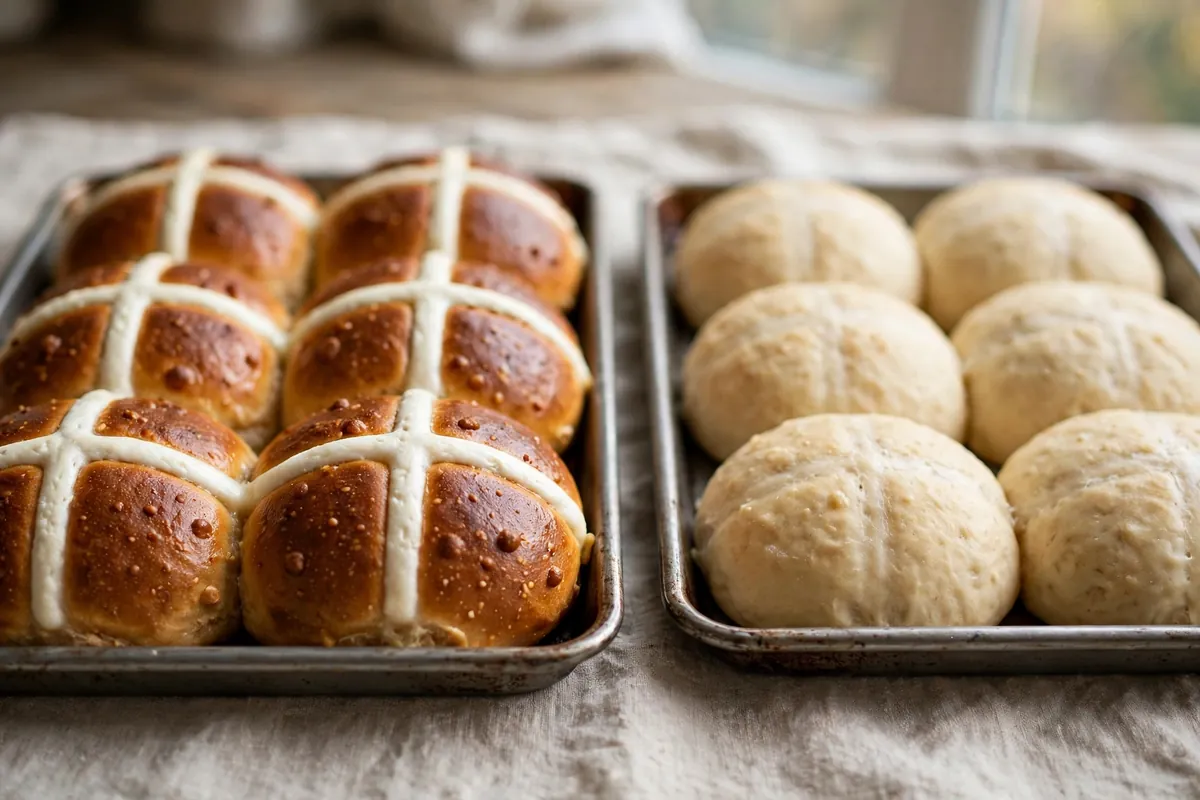
Hot cross buns fail in threes: dense as hockey pucks, pale as dinner rolls, the signature cross melted into a ghost of itself. Each fault has its own cause, but they share a root — enriched, spiced dough is slower and fussier than plain bread dough, and it punishes every shortcut. Once you understand what the enrichment is doing, all three faults fix themselves.
Quick diagnosis: Dense buns mean under-proofed enriched dough — it rises slower than lean dough, so give it time and a warm spot, and judge by the poke test, not the clock. Pale tops mean missing or thin egg wash. Vanishing crosses mean your flour paste was too thin — toothpaste-thick, piped after the egg wash. Bake at 375–400°F (190–200°C).
My tested baseline: 500g bread flour, 7g instant yeast, 60g sugar, 10g salt, 2 tsp cinnamon, ½ tsp allspice, ¼ tsp nutmeg, 1 egg plus 200ml warm milk, 60g soft butter, 150g raisins soaked 20 minutes and patted dry. Divide into 12 buns (~85g each), proof until puffy and touching, egg-wash twice, pipe crosses, bake at 375°F (190°C) for 18–22 minutes. Glaze: 3 tbsp apricot jam warmed with 1 tbsp water, brushed on hot.
1. Dense buns — you under-proofed enriched dough
Fat, sugar, and eggs all slow yeast down — the price of a tender crumb. Enriched dough can take twice as long to rise as lean dough, and bakers on plain-bread timing shape and bake far too early. An under-proofed bun has no air network to expand; it bakes into a dense lump no matter how hot the oven is.
How to tell: Tight, even crumb with no airiness; buns barely grew in the oven; dough felt firm when shaped rather than puffy.
The fix: Proof somewhere warm — 75–80°F (24–27°C), like the oven with the light on. Shaped buns should look visibly puffy, nearly doubled and touching, before baking; in a cool kitchen that’s 60–90 minutes, not 30. Poke test: a gentle press should spring back slowly, leaving a slight indent. Fast spring-back means wait. Too much kneading flour also compacts the crumb — the dough should be soft and slightly tacky. (Proofing fundamentals: Why Didn’t My Bread Rise? A Step-by-Step Diagnosis.)
2. Pale tops — the egg wash was missing, thin, or single-coated
Burnished mahogany tops come from egg wash, full stop. Without it, the same bake gives a matte, anemic crust — and the flour-paste cross has nothing to contrast against. A thin or single coat gives patchy color; milk-only washes barely brown.
How to tell: Uniformly pale, dull tops after a full bake; crosses invisible for lack of contrast; crust soft and floury, not glossy.
The fix: Beat 1 whole egg with 1 tablespoon of milk and brush on gently — then a second coat right before baking. Two thin coats beat one thick one (thick pools and streaks). The milk thins the egg so it spreads evenly. For extra shine, brush hot buns with warmed apricot jam the moment they leave the oven. And bake at a true 375°F (190°C) — too cool an oven never browns enriched dough, however good the wash.
3. The crosses vanished — your flour paste was too thin
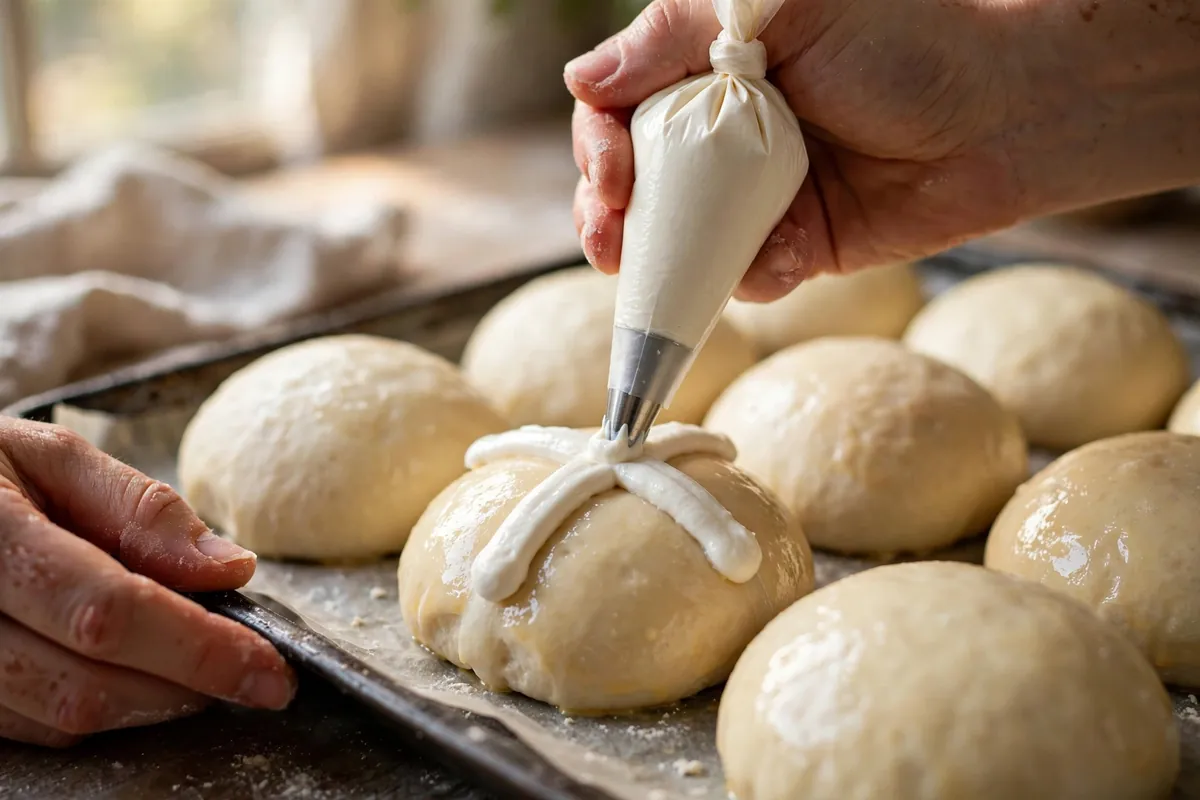
The traditional cross is flour-and-water paste piped on before baking. Mixed too wet, it spreads and melts into the crust in the oven’s heat — by serving time there’s a pale smear where the cross should be. The most common hot cross bun complaint I hear, and a two-minute fix.
How to tell: Faint blurry lines or nothing at all; paste spread wider than piped; crosses look “absorbed.”
The fix: Mix 60g flour with just enough water — about 4 tablespoons — for a toothpaste-thick paste that holds its shape on a spoon. Pipe through a small bag in confident lines, after the egg wash (the wash helps it grip), keeping lines thin — they spread slightly in the heat. Shortcut: skip the baked cross and pipe icing crosses onto cooled buns. Not traditional, but it never vanishes.
4. Burnt bottoms, raw middles — wrong rack, hot oven
Spiced, sugared dough browns fast, and surface fruit chars faster. Buns baked too low or in a hot-running oven get scorched bases with doughy centers — sugar caramelizes aggressively on the hot pan while the middle lags.
How to tell: Near-black bottoms with pale sides; doughy centers; raisins on top turned bitter and hard.
The fix: Middle rack, always. Verify a true 375°F (190°C) — many home ovens run 25°F hot, the difference between golden and scorched here. Line the pan with parchment; it insulates the bottoms just enough. Tops browning before centers finish? Tent loosely with foil for the last 5 minutes. Tuck surface raisins slightly into the dough when shaping so fewer sit exposed.
5. Dry fruit and harsh spice — hydrate the fruit, measure the spice
Two flavor faults that read as dryness. Unsoaked raisins pull moisture from surrounding dough as they bake, leaving dry pockets and turning themselves into hard, bitter pellets. And unmeasured spice — a heavy hand with cloves or allspice — gives a harsh, medicinal edge.
How to tell: Hard, dark raisins; a dry halo of crumb around each piece; spice that’s sharp rather than warm.
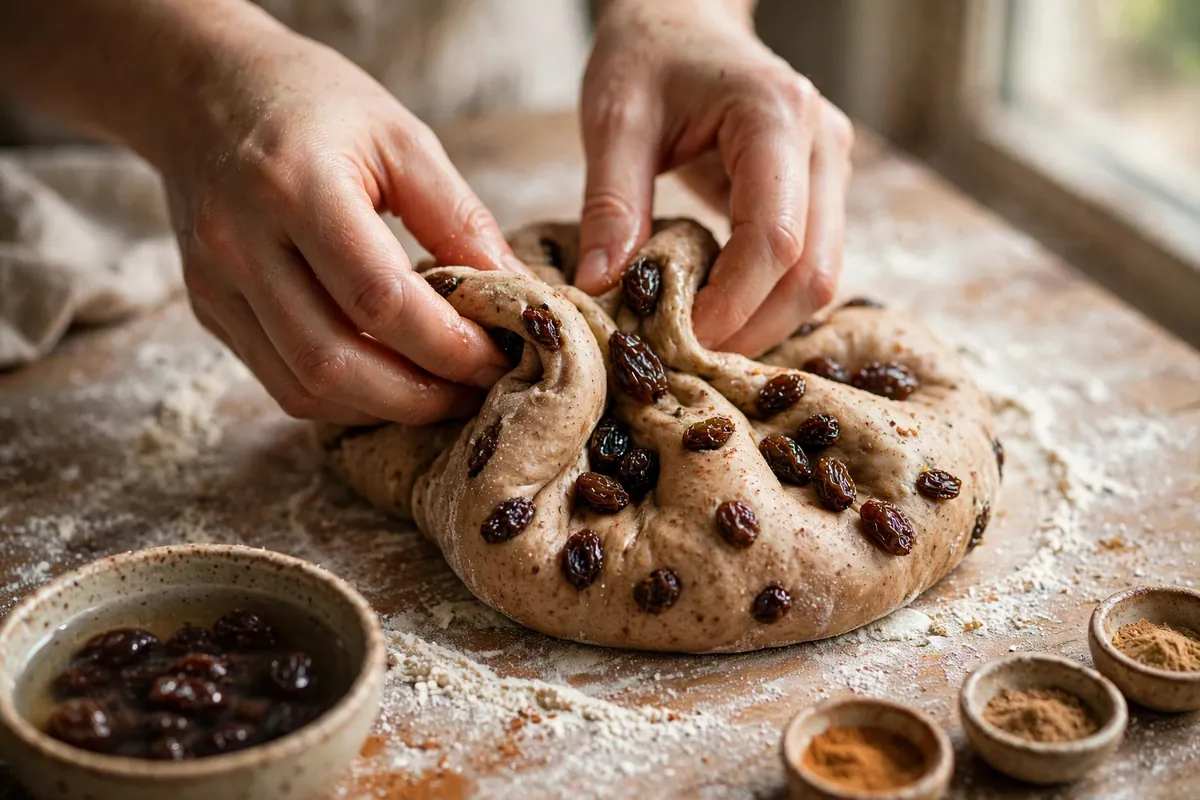
The fix: Soak 150g raisins in warm water (or orange juice) 20 minutes, pat dry, then knead in — they’ll stay plump and jammy. Measure: per 500g flour, 2 tsp cinnamon, ½ tsp allspice, ¼ tsp nutmeg — warm and present, never harsh. Add fruit late in kneading so it doesn’t tear the gluten network; a torn network can’t hold gas, which circles back to density.
Frequently asked questions
Can I still eat dense hot cross buns?
Yes — dense buns are safe, just heavy. Split and toast them; the toaster does what the oven didn’t. Slathered with butter while hot, an under-proofed bun is still a good bun.
Can I pipe the crosses on after baking instead?
Absolutely. Icing crosses — powdered sugar with a little milk — piped onto fully cooled buns are the modern shortcut and look sharp every time. Purists use flour paste, but nobody at the table will object.
Can I make hot cross bun dough the night before?
Yes, and it’s better for it. Refrigerate after kneading (8–12 hours); shape cold the next morning — cold dough portions easier — then give the buns their full warm proof. The slow ferment deepens flavor noticeably.
Why did my raisins burn on top?
Exposed fruit chars. Tuck raisins just under the dough surface when shaping, and soak them first — hydrated fruit scorches far slower. A few darkened ones are traditional; black and bitter means fully exposed.
Can I freeze hot cross buns?
Yes — freeze baked and cooled up to 2 months in a zip bag. Refresh from frozen at 325°F (165°C) for 10–12 minutes, or split and toast straight from frozen.
Related troubleshooting: Why Didn’t My Bread Rise? A Step-by-Step Diagnosis · Why Did My Cinnamon Rolls Unravel? Shaping and Proofing Fixes · Why Did My Brioche Come Out Dry? Enriched Dough Fixes