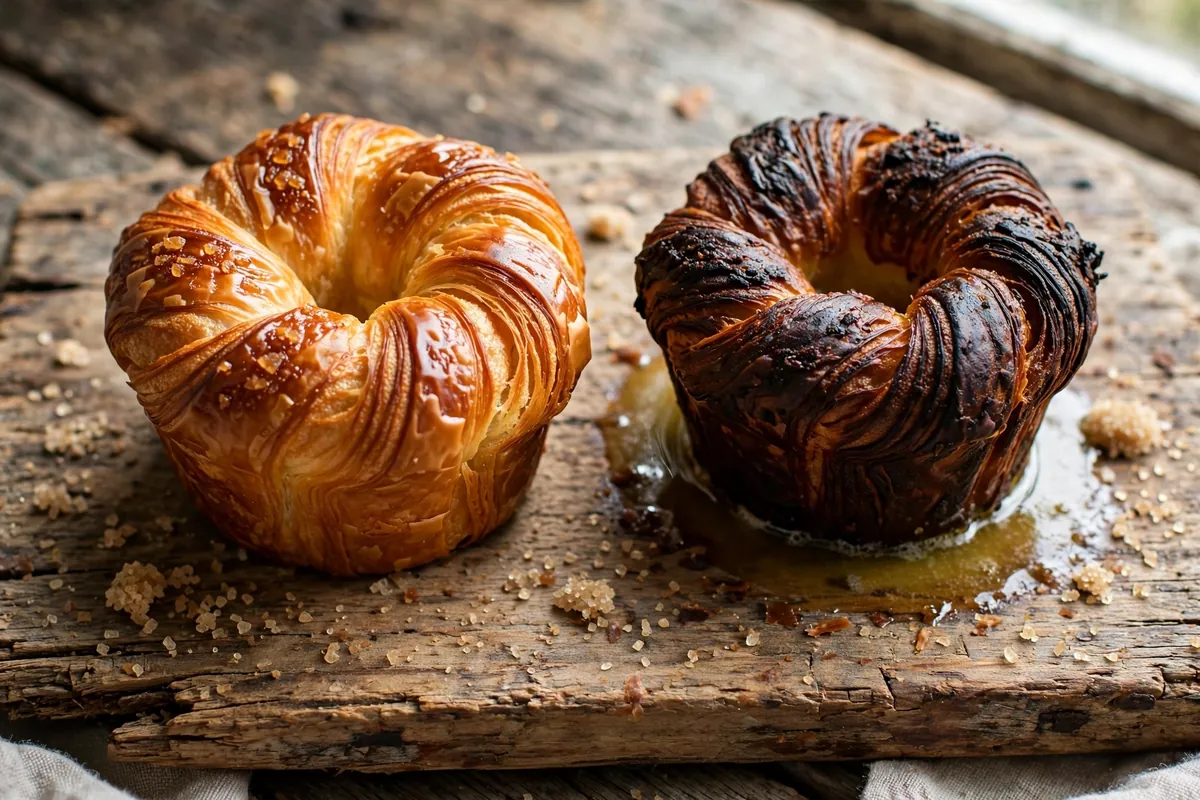
Kouign-amann is croissant dough’s reckless cousin: the same laminated layers, but with sugar folded in and baked until deeply caramelized. When it works, it’s shattering, buttery, burnished. When it fails, it fails two ways — butter floods out and fries the pastry instead of flaking it, and sugar goes from caramel to charcoal before the center finishes. Both look catastrophic; both come from the same temperature mistakes.
Quick diagnosis: Your kouign-amann leaked butter because the dough or butter got too warm during folding — the butter melted into the dough instead of staying in layers. It burned because the oven was too hot for sugared dough, or it baked too long. Keep everything at 60–65°F (16–18°C) during lamination, bake at 400–425°F (200–220°C) in snug muffin tins, pull at deep amber — not black.
My tested baseline: 250g bread flour, 175ml water, 5g salt, 5g instant yeast, kneaded smooth and chilled. Butter block: 225g European-style butter (82% fat) beaten with 25g flour into a pliable slab. One letter fold, chill 45 minutes, second letter fold, chill 45 minutes. Roll to ¼ inch, sprinkle 150g sugar, fold in thirds, roll once more, cut squares, shape into sugared muffin tins. Proof 45–60 minutes cool — barely puffy, not doubled. Bake at 400°F (200°C) 25–30 minutes.
1. Your lamination was too warm — melted butter can’t make layers
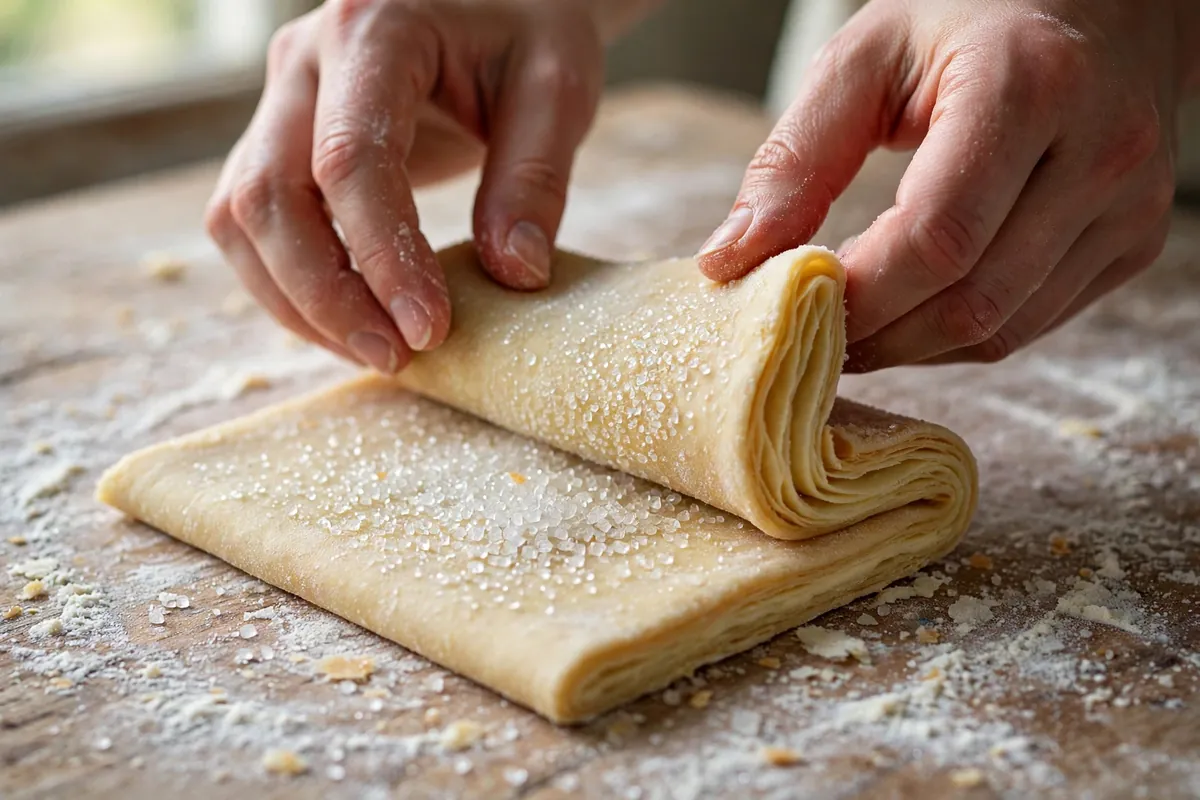
The master cause behind nearly every kouign-amann failure. Lamination needs butter in distinct, pliable sheets between dough layers. The moment it melts — warm kitchen, rushed folds, hot hands — it absorbs into the dough. No layers, no flakiness, and the absorbed butter floods out in the oven, frying the pastry instead of steaming it apart.
How to tell: Dense, greasy pastry with no visible layering in the cross-section; a pool of butter in the pan; dough that felt soft and sticky during folding rather than firm and cool.
The fix: Work at 60–65°F (16–18°C) — butter should bend without cracking or feeling greasy. Chill 45–60 minutes between folds, not 20. In a warm kitchen, chill the dough 15 minutes halfway through rolling. Finger test: the butter should dent cleanly, not smear. (Same temperature discipline as Why Did My Croissants Come Out Dense? Lamination Fixes.)
2. The sugar did what sugar does — it melted and ran
Some leaking is normal: sugar liquefies, some escapes, caramelizing into the signature crisp shell. The failure is one of degree — under-chilled dough or overloaded sugar turns runoff into a flood; the pastry sits in boiling syrup, bottom burning while the top stays pale.
How to tell: A thick pool of dark syrup in the pan; black bottoms with blonde tops; bitter rather than caramel-sweet taste.
The fix: Sugar the tin, not just the dough — a spoonful in each buttered muffin cup gives the caramelized exterior without overloading the layers. Between folds, use a moderate sprinkle, not a blizzard; 150g total is plenty. Accept a tablespoon of caramel per cup as success. Use light-colored heavy tins — dark tins scorch sugar on contact. (Pan choice matters here — see Glass vs Metal vs Dark Pans: What Changes in Your Bake.)
3. Your oven was too hot — sugar burns before dough finishes
Sugar caramelizes beautifully around 340°F (170°C) and turns bitter-black not far above. Kouign-amann needs a hot oven for steam between the layers, but above 425°F (220°C) the exterior sugar burns before the interior sets: charcoal outside, raw dough inside. Hot-running home ovens are especially punishing — there’s no frosting to hide behind.
How to tell: Deep brown-to-black exterior at 20 minutes with a doughy center; bitter, acrid taste; smoke from burning sugar runoff.
The fix: Verify with an oven thermometer and bake at a true 400°F (200°C) — 425°F (220°C) only if your oven runs cool. Start checking at 22 minutes: deep amber, the color of dark honey, not mahogany. If tops race ahead, tent with foil for the last 8–10 minutes. Pull by color, not the clock.
4. You baked on a flat sheet — they need the hug of a muffin tin
Traditional kouign-amann bakes as individual rounds in a heavy muffin tin, and the tin does structural work: it contains the melting butter and sugar so they caramelize around the pastry, and its walls support the layers as they rise. On a flat sheet, butter escapes in every direction — the pastry slumps into the runoff and you get greasy discs instead of tall, layered rounds.
How to tell: Pastries spread wide and flat; butter pooled across the whole sheet; bottoms fried-crisp and greasy rather than caramelized.
The fix: Use a standard 12-cup muffin tin, buttered and sugared. Fold the corners of each sugared square to the center and place folded-side down — the folds open upward into the classic crown. With only a sheet pan, use muffin rings or ramekins as containment. Never bake one large round unless the recipe was built for it.

5. You underbaked the center — pale is raw in laminated dough
The sugared exterior looks done at golden-brown while the interior is still a gummy mass of unseparated dough. Laminated dough needs a full, confident bake to drive moisture from between the layers — pull early and the layers never set, collapsing into doughiness as it cools. Fear of burning causes more underbaking than anything else.
How to tell: Cross-section shows compressed, doughy layers with no air gaps; raw-flour taste in the center; the pastry deflates minutes after leaving the oven.
The fix: Bake to deep amber — darker than instinct suggests, lighter than burnt. It should feel light for its size and sound faintly hollow tapped on the bottom. Cool in the tin only 5 minutes — longer and the caramel glues them in — then turn out immediately. Pale bottoms with dark tops? Move to a lower rack next time.
Frequently asked questions
Can I still eat kouign-amann that leaked all its butter?
Yes — safe, just denser and greasier, more like buttery shortbread than laminated pastry. Drain on a rack, dust with sugar to refresh the exterior, serve warm. The flavor is still good; only the texture missed.
Why did my kouign-amann stick to the pan?
Caramelized sugar is candy — it glues to bare metal as it cools. Turn them out 5 minutes after baking, while the caramel is fluid. Already stuck? Return the tin to a warm oven 2–3 minutes to re-melt the caramel, then twist each free.
Can I make kouign-amann dough ahead?
Yes — laminated dough before sugaring keeps 24 hours refrigerated or a month frozen. Thaw frozen dough overnight in the fridge, then roll, sugar, shape, bake. Don’t shape and hold: the sugar draws moisture and turns layers gummy.
Is kouign-amann just a sugared croissant?
Close, but the differences matter: croissant dough has less sugar and more, thinner layers; kouign-amann uses leaner dough, fewer folds, sugar laminated directly in, baked hotter for caramelization. Croissant dough approximates it in a pinch, but the sugar-in-the-folds technique is the real thing.
Why is my kouign-amann tough instead of flaky?
Overworked dough. Aggressive kneading of the base or re-rolling scraps built too much gluten and destroyed layer definition. The base dough needs only enough kneading to come together smoothly. (Lamination fundamentals: Puff Pastry Not Puffing: Lamination Mistakes to Avoid.)
Can I use regular butter instead of European-style?
You can, but European-style (82%+ fat) laminates better: less water, more pliable, less cracking. With standard butter, work a few degrees cooler and expect slightly less flakiness.
Related troubleshooting: Why Did My Croissants Come Out Dense? Lamination Fixes · Why Did My Whoopie Pies Spread? Batter and Pan Fixes