
A whoopie pie should be a plump, domed, cake-like round — thick enough to sandwich filling without collapsing. When the batter spreads, you get thin, lacy-edged discs that crack when lifted and can’t hold filling. The trap: whoopie batter looks like cookie dough’s cousin, but it’s chemically a little cake and follows cake rules. Spreading comes down to warm batter, too much leavening, mismeasured flour, or skipped chilling.
Quick diagnosis: Your whoopie pies spread because the batter was too warm, the leavening was overmeasured, or the flour was undermeasured. Chill the scooped batter 15–20 minutes before baking, measure leavening level (not heaped), spoon-and-level your flour, and bake at 350°F (175°C) — the mounds should hold their shape going into the oven.
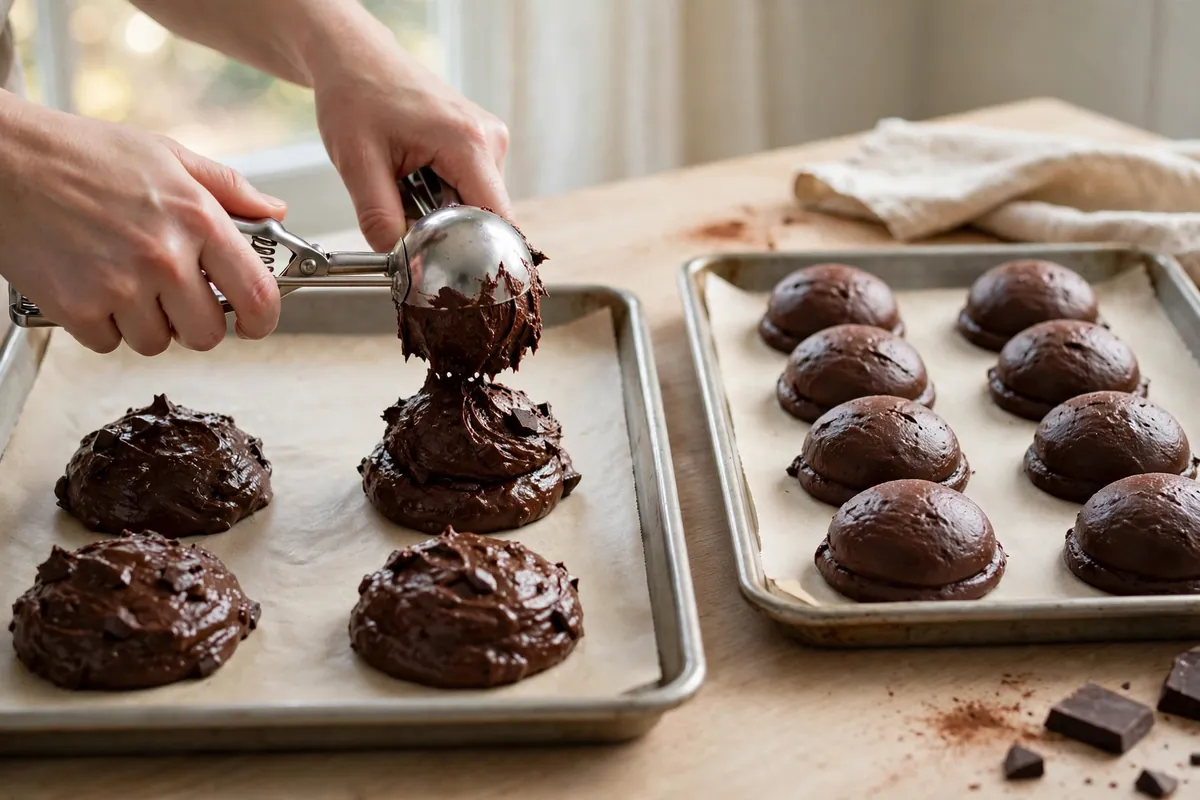
My tested baseline (chocolate): 250g (2 cups) flour, 60g (¾ cup) Dutch-process cocoa, 1¼ teaspoons baking soda, ¾ teaspoon salt; 115g (½ cup) butter at cool room temperature, 200g (1 cup) brown sugar, 100g (½ cup) granulated sugar; 1 large egg plus 1 yolk, 2 teaspoons vanilla; 240ml (1 cup) buttermilk. Cream butter and sugars 3 minutes, beat in eggs and vanilla, add dries in three additions alternating with buttermilk, mixing gently. Scoop with a medium cookie scoop (about 3 tablespoons), chill the tray 15–20 minutes, bake at 350°F (175°C) for 10–12 minutes, until tops spring back when touched.
1. Your batter was too warm — fat melts before structure sets
The #1 cause, and it starts before the oven is hot. If the creamed butter is warm — over-creamed, mixed in a hot kitchen, butter left out for hours — the batter goes in half-melted. Fat liquefies in the first minutes of baking, the batter flows outward before flour and eggs set a structure, and you get pancakes instead of domes.
How to tell: Scooped mounds slumped on the tray before baking; batter felt soft and greasy rather than thick and scoopable; baked rounds have thin, lacy edges.
The fix: Chill the scooped tray 15–20 minutes — mounds should feel firm and hold shape going into the oven. Use butter at cool room temperature (65°F / 18°C — dents, doesn’t smear) and cream no more than 3 minutes. In a warm kitchen, chill the mixing bowl 10 minutes before starting. (Same fat-temperature logic as Why Do My Cookies Spread Flat? Butter, Sugar, and Chill Time.)
2. Too much leavening — baking soda is a spreader, not just a lifter
Excess baking soda raises batter pH, which weakens structure and lets the batter flow. An extra half-teaspoon — a heaped spoon instead of level — turns domed cakes into flat discs, and leaves a soapy, metallic aftertaste as its calling card. Whoopie batter is especially sensitive: small, rich portions with a high sugar ratio.
How to tell: Rounds spread wide with a soapy or metallic taste; coarse, fragile texture rather than fine and cakey; the soda was measured with a dinner spoon or heaped.
The fix: Level measuring spoons, scraped with a knife — 1¼ teaspoons baking soda, no more. Don’t “add extra for lift”; here, extra soda is extra spread. If your soda is older than 6 months, replace it instead of adding more — dead soda doesn’t lift, and extra quantity just adds soapiness.
3. Not enough flour — the structure never had a chance
Whoopie batter walks a tightrope: enough flour for cakey structure, little enough to stay tender. Undermeasure — the classic scooped-cup error packs 20–30% less than intended — and there’s no scaffolding to contain melting fat and sugar. The most common cause, in my experience, for bakers who “followed the recipe exactly” with volume measures.
How to tell: Batter looked thin or pourable rather than thick and scoopable; flour measured by scooping the cup from the bag; baked rounds tender to the point of fragility.
The fix: Weigh the flour — 250g — or spoon into the cup and level. Already mixed a thin batter? Fold in flour a tablespoon at a time until a scooped mound holds its shape a full minute on the tray. Two to four tablespoons usually does it; more turns the texture dry.
4. Too much sugar or the wrong sugar — sugar liquefies in the oven
Sugar melts before flour sets, and a sugar-heavy batter spreads aggressively — especially all white sugar, which melts cleaner than brown. Brown sugar’s molasses adds moisture too, so the total load and the white-to-brown ratio both matter.
How to tell: Thin, caramelized, candy-like edges with fine centers; the recipe was very high in sugar relative to flour.
The fix: Keep sugar near the baseline — about 300g total to 250g flour, at least half of it brown sugar. Don’t slash sugar to fix spread, though: below about 250g the cakes go dry and bland. Fix temperature and flour first; sugar is a fine-tuning dial.
5. The pan and spacing worked against you — hot, dark, or crowded
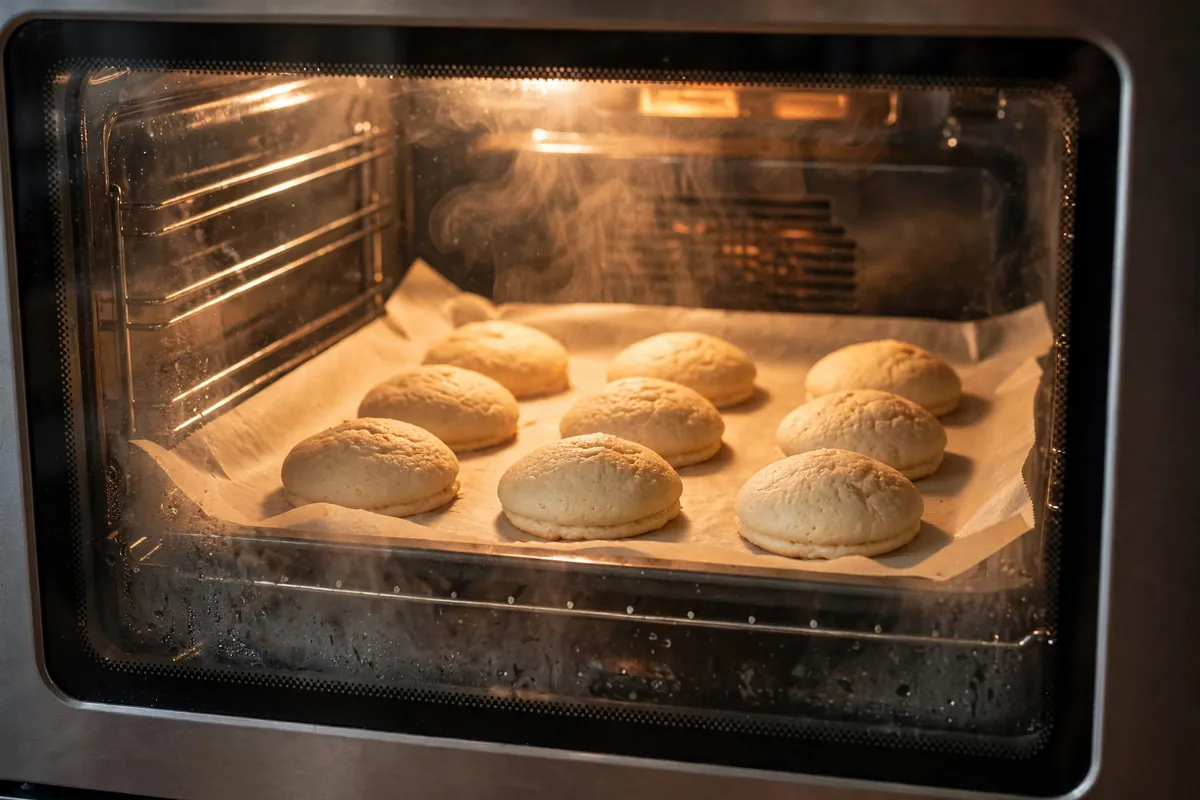
A dark, thin sheet superheats the bottoms, melting fat before tops set — the batter spreads from below. Crowded mounds merge into one giant whoopie. And a tray still warm from the previous batch starts the next round already melting.
How to tell: Over-browned bottoms with underdone tops; the second batch spread more than the first; mounds placed 1 inch apart merged.
The fix: Heavy, light-colored half-sheet pan, parchment-lined. Space mounds 2 inches apart — room to grow up, not out. Cool the tray completely between batches. With only a dark nonstick sheet, drop to 325°F (165°C) and add 2 minutes. (More on pan material: Glass vs Metal vs Dark Pans: What Changes in Your Bake.)
Frequently asked questions
Can I fix whoopie pies that already spread flat?
As cakes, no — but sandwich two flats with extra filling for a thinner whoopie, or crumble them over ice cream, where the crisp texture is an asset. Next batch: chill the scooped tray. That’s the highest-leverage fix.
Are whoopie pies cookies or cake?
Chemically, little cakes: cake-like ratios of fat, sugar, eggs, and liquid, leavened for tenderness. That’s why cookie instincts (“warm dough is fine”) betray you. Treat the batter like cake batter that happens to be scooped.
Why did my whoopie pies crack on top?
Usually too-hot oven — the exterior set before the interior finished expanding. Can also mean too much leavening (see #2). Fine cracks are traditional; deep fissures mean dropping 25°F (about 15°C). (Same mechanism as Why Did My Cake Dome and Crack on Top?.)
Can I make whoopie batter ahead?
Yes — mixed batter keeps 24 hours refrigerated, and chilled-from-mixed batter spreads less. Scoop straight from the fridge and add 1–2 minutes. Don’t freeze batter; freeze baked unfilled cakes up to a month, parchment between layers.
Why are my whoopie pies dry instead of cakey?
Overbaked — 2 minutes too long dries these small cakes. Pull when tops spring back but still look slightly soft; they firm as they cool. And weigh the flour: too much flour is the other classic route to dryness.
What’s the best filling that won’t make them soggy?
Stiff fillings: ermine frosting, Swiss meringue buttercream, or marshmallow-buttercream hybrid. Plain whipped cream weeps into the cakes within an hour — fine for immediate serving, bad for a party platter. Fill no more than 4 hours ahead unless the filling is very stable.
Related troubleshooting: Why Do My Cookies Spread Flat? Butter, Sugar, and Chill Time · Kouign-Amann Troubleshooting: Leaked Butter, Burnt Sugar · Why Is My Banana Cake Gummy? Mixing and Moisture Fixes