Tough muffins are the quietest baking failure — no dramatic collapse, no visible flaw, just a muffin that chews like bread dough and sits heavy. I’ve pulled batches from the oven that looked perfect and ate like rubber. The cause is almost always the same, and it’s the single most misunderstood technique in home baking: how you mix the batter. Master the muffin method once and tough muffins leave your kitchen permanently.
Quick diagnosis: Tough muffins come down to one thing in nearly every case: the batter was overmixed. If you stirred until smooth, beat out every lump, or used an electric mixer on the batter, start with cause #1 — it’s the answer 9 times out of 10.
1. You overmixed the batter
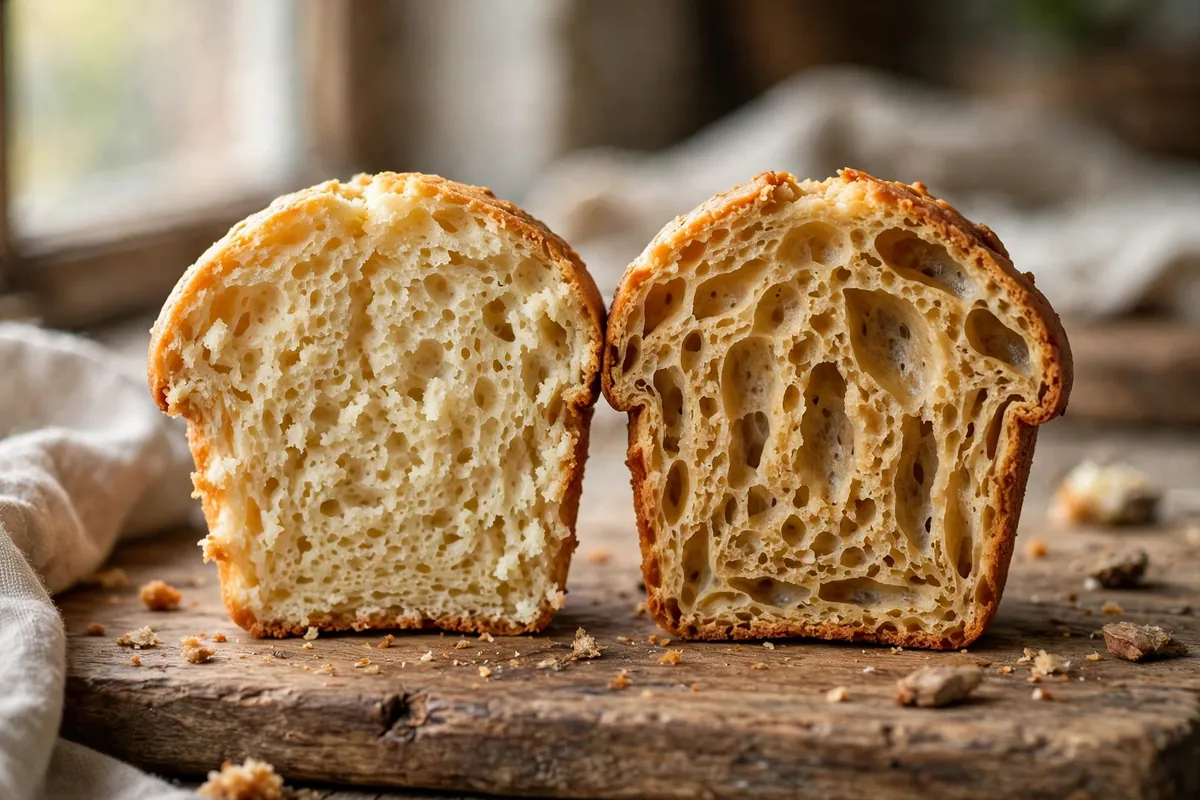
This is the cause, full stop, for the overwhelming majority of tough muffins. The moment liquid meets flour, gluten starts forming. Every additional stir develops it further. Stir a muffin batter until smooth and you’ve built a bread-dough gluten network in a batter that was supposed to stay tender — the result is chewiness, tunnels (long air channels where gas forced through the elastic network), and sometimes peaked, ugly tops.
How to tell: Cut one open. Tunnels — elongated holes running through the crumb — are the fingerprint of overmixing. The texture is chewy or rubbery rather than soft, and the tops may have peaked into odd points instead of doming smoothly.
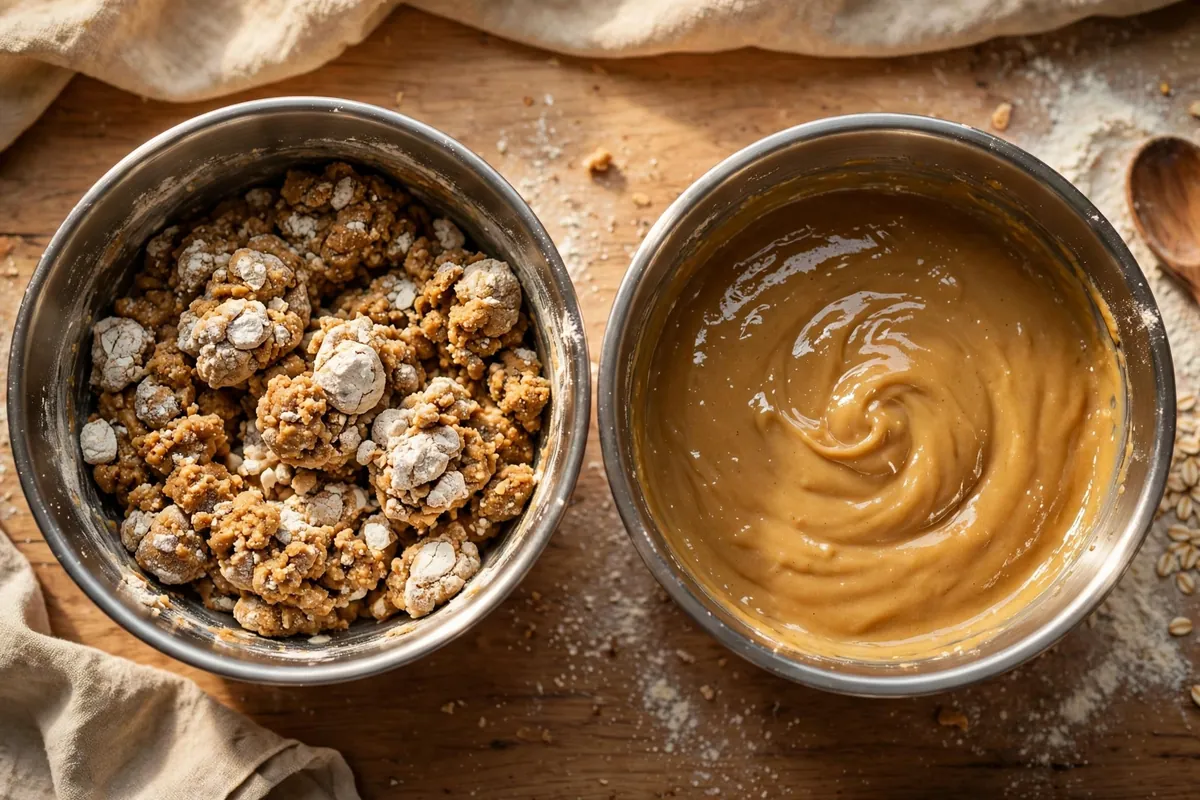
The fix: Learn the mantra: lumps are fine. The muffin method is: whisk dry ingredients in one bowl, whisk wet in another, pour wet into dry, and stir with a spatula just until the flour disappears — 10 to 12 strokes, no more. The batter should look lumpy and rough. It will feel wrong. It is right. Those lumps hydrate in the oven’s heat and vanish, leaving tender crumb. Never use an electric mixer on muffin batter after the flour goes in — a mixer overdevelops gluten in seconds.
2. You didn’t actually use the muffin method
Many recipes say “mix” without explaining the order of operations, and the order matters enormously. The muffin method exists for a reason: combining wet and dry separately, then uniting them with minimal stirring, limits the time flour and liquid spend being agitated together. Dumping everything in one bowl and stirring until combined maximizes it.
How to tell: You mixed all ingredients in a single bowl, or added flour to already-beaten wet ingredients and kept beating.
The fix: Two bowls, always. Bowl one: flour, sugar, leavening, salt, spices — whisked. Bowl two: eggs, milk, oil or melted butter, vanilla — whisked. Pour bowl two into bowl one, 10–12 strokes, done. If the recipe includes mix-ins (berries, chocolate chips, nuts), toss them in the dry bowl first — the flour coating keeps them suspended instead of sinking — and count their addition in your stroke budget.
3. The wrong fat (or the wrong handling of it)
Fat’s job in muffins is tenderness: it coats flour proteins and physically blocks gluten formation. Oil does this best — it’s liquid at room temperature and coats evenly. Melted butter works nearly as well. But creamed solid butter (the cake method) is wrong for muffins: creaming develops structure and traps air for a fine, firm crumb — the opposite of muffin tenderness.
How to tell: You creamed butter and sugar together before adding the rest, or used the cake-mixing method out of habit.
The fix: Use oil or melted (not creamed) butter, whisked into the wet bowl. If flavor matters more than maximum tenderness — it often does — melted butter is the sweet spot: nearly the tenderness of oil with real butter flavor. Never cream solid butter for muffins.
4. Too much flour (the measuring problem again)
The flour-scooping problem strikes muffins exactly as it strikes cake and bread: a scooped cup can weigh 150g against the standard 120g, adding 25% more flour — and therefore 25% more gluten potential — without you knowing. In muffins, where tenderness is the entire goal, that hidden extra flour is devastating.
How to tell: The batter was thick and stiff rather than pourable, and the baked muffins are dense as well as tough.
The fix: Weigh flour at 120g per cup, or spoon-and-level. This one habit, repeated across every post on this site, fixes more baking failures than any other single change.
5. Overbaked (even slightly)
Muffins are small and lean — they go from perfect to dry in about three minutes, and dry reads as tough. A muffin baked to a clean toothpick is overbaked; the carryover heat finishes the job after you pull them.
How to tell: The edges are dark, the tops are firm and dry rather than springy, and the toothpick came out completely clean.
The fix: Start checking 3–4 minutes before the recipe’s earliest time. Pull when a toothpick shows a few moist crumbs. Most standard muffins bake at 375–400°F (190–200°C) for 18–22 minutes — but verify with your oven, and cool in the pan only 5 minutes before moving to a rack (the pan’s residual heat keeps baking them).
6. The batter sat too long — or not at all (the nuance)
Here’s the subtle one. A brief rest — 20 to 30 minutes after mixing — actually helps: flour hydrates fully, and hydrated flour bakes into a more tender, even crumb. But an hour-plus rest at room temperature lets the chemical leaveners (baking powder especially) spend their first reaction, so the muffins rise less and bake denser — which reads as tough.
How to tell: You mixed the batter well ahead and baked later, or you always rest and your muffins are consistently a bit dense.
The fix: If you rest, keep it to 20–30 minutes, and use double-acting baking powder (its second reaction happens in the oven’s heat, so a short rest costs you nothing). For the most reliable results, mix and bake promptly.
Frequently Asked Questions
What is the muffin method in baking?
Whisk dry ingredients in one bowl and wet ingredients in another, pour wet into dry, and stir just until combined — 10 to 12 strokes, lumps remaining. Minimal stirring limits gluten development, which is what keeps muffins tender instead of tough.
Why do my muffins have tunnels inside?
Tunnels are the classic sign of overmixing. Excess stirring builds an elastic gluten network; expanding gases then force channels through it instead of distributing evenly. Stir less — lumpy batter is correct batter.
Are dense muffins safe to eat?
Completely — toughness is a texture issue, not a safety one. (Though if they’re truly inedible, cube them for bread pudding — the rescue logic is identical.)
Should muffin batter be lumpy or smooth?
Lumpy, always. Smooth muffin batter is overmixed batter. Ten to twelve strokes with a spatula, flour just disappeared, visible lumps — that’s the target. They bake out.
Can I use an electric mixer for muffins?
Only for the wet ingredients, before flour is added. Once flour meets liquid, switch to a spatula and hand-stir. A mixer develops gluten far too efficiently for muffin batter.
Why are my muffins dry as well as tough?
Overbaking compounds overmixing — dry and tough usually means both. Fix the mixing first (lumps!), then pull 3–4 minutes earlier with a moist-crumb toothpick test. Either fix alone improves things; both together transform them.
Related troubleshooting: Why Is My Cake Dry? · Why Is My Bread Dense? · Why Do My Cookies Spread Flat?