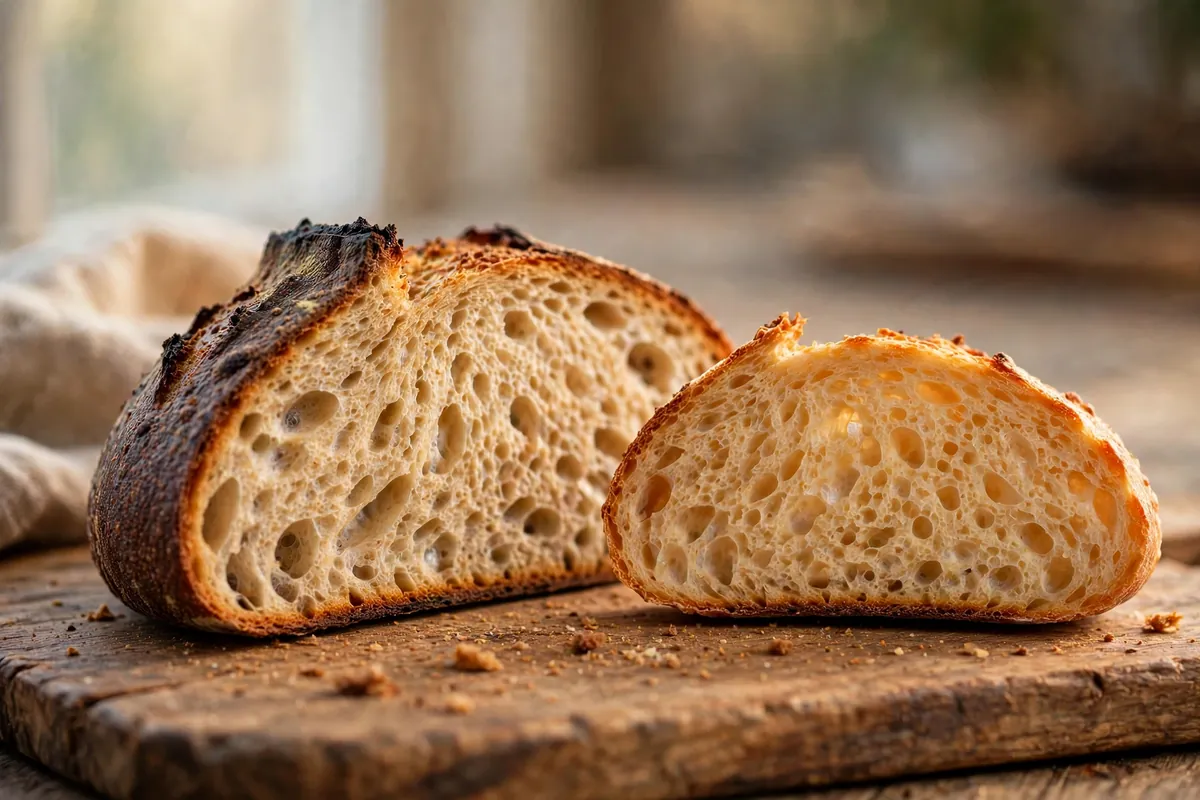
A great sourdough crust shatters; a bad one puts up a fight — thick, leathery, jaw-aching. Thickness isn’t luck: it’s bake time, steam exposure, and heat delivery. All adjustable.
Quick diagnosis: You baked too long at too low a temperature (most common), kept the steam going too far into the bake, or both. Fix: full preheat, 20 minutes covered at 450°F (232°C), then 20–25 minutes uncovered until the internal temp hits 200–210°F (93–99°C) — and pull the loaf at color, not at the clock.
My tested baseline: 500g bread flour, 375g water (75% hydration), 100g ripe starter, 10g salt (2%). Baked in a preheated Dutch oven: 20 minutes with the lid on at 450°F (232°C), 20–25 minutes lid off, to an internal temperature of 205°F (96°C). Cooled on a wire rack a full 2 hours before slicing.
1. You baked too long at too low a temperature — the classic thick-crust recipe
Crust thickens with oven time: 55 minutes at 425°F (218°C) always builds thicker crust than 40 minutes at 450°F (232°C), because the crust keeps dehydrating layer by layer. Under-heated ovens are the usual culprit — the baker compensates for pale color with extra time, and those 10–15 minutes build crust like tree rings.
How to tell: The crust is uniformly thick all around, dark but not burnt; the crumb inside is fine; total bake time was 50+ minutes.
The fix: Preheat a full 45–60 minutes with the Dutch oven inside — a cool start steals your first 10 minutes of spring and adds them to the crust. Bake 20 minutes covered at 450°F (232°C), then 20–25 uncovered, pulling at 200–210°F (93–99°C) internal — not at the timer.
2. Too much steam, for too long
Early steam keeps the crust flexible for oven spring. But steam past the first 20 minutes keeps re-wetting the surface, and each wet-dry cycle lays down another hardened layer — thick and leathery instead of thin and glassy. This is the mirror image of the too-hard-or-soft crust problem, where steam timing is also the lever.
How to tell: The crust is thick but also slightly chewy-leathery rather than crisp; you sprayed water repeatedly or left a steam pan in for the whole bake.
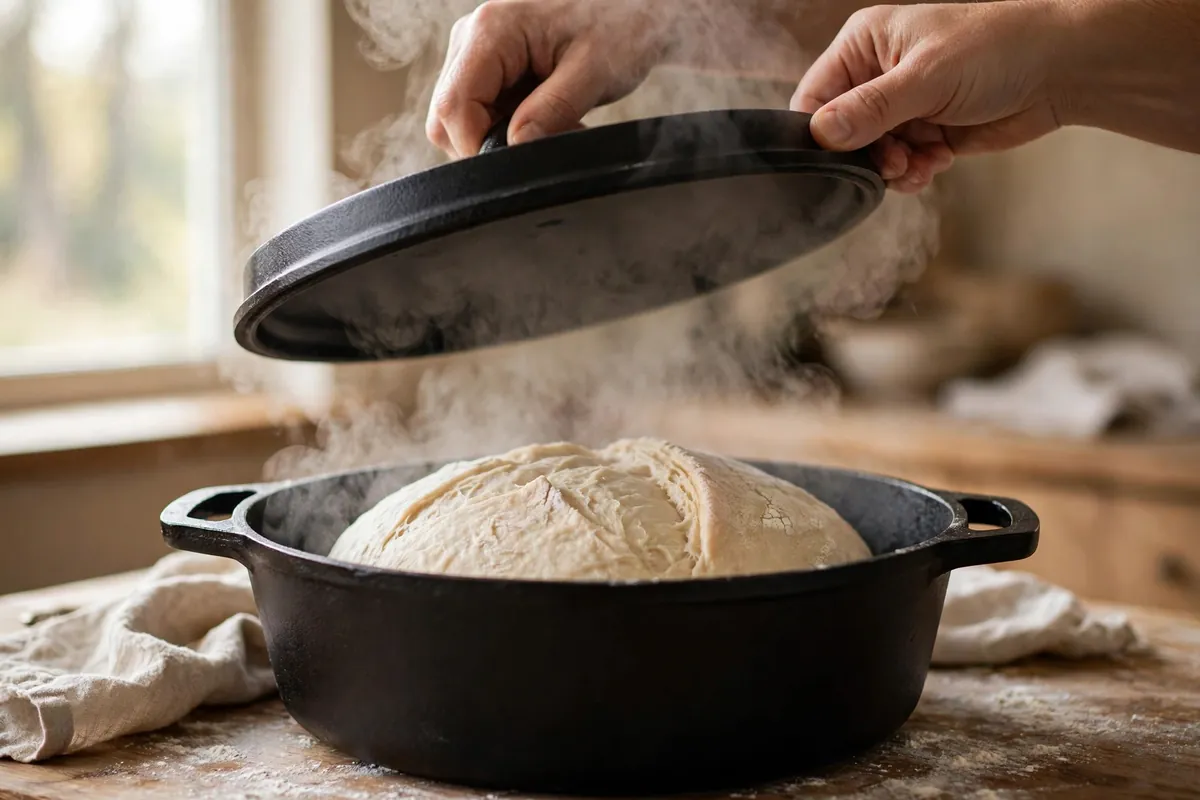
The fix: Steam belongs to the first 20 minutes only. In a Dutch oven, that’s the lid-on phase — lid off at 20 minutes, no more moisture. On a stone, remove the steam pan at 20 minutes and crack the door 30 seconds to vent humidity. The second half should be dry heat.
3. The loaf was under-proofed or over-proofed — both bake up thick-crusted
Under-proofed loaves burst and tear, exposing thick ragged crust at the scores. Over-proofed loaves spread flat — more surface area per volume, more crust per bite — and the outside over-bakes while you wait for color.
How to tell: Under-proofed: big tearing around the score, dense band under the crust. Over-proofed: the loaf spread sideways, pale and flat, with a thick bottom crust. Check with the poke test and the dense bread and didn’t rise guides.
The fix: Proof by percentage rise, not clock: shape at 50–75% bulk rise (use an aliquot jar). Poke test: slow spring-back with a slight indent means ready. A tall loaf has less crust per slice.
4. You cooled it wrong — trapped steam toughens the crust
Fresh from the oven the crust is still dehydrating. Cool on a solid surface — or worse, in the turned-off oven with the door closed — and escaping steam condenses back on, re-hardening into a thick shell. I learned this the embarrassing way: a perfect bake “kept warm” in the cooling oven came out like boot leather.
How to tell: The crust was crisp when it came out but turned thick and leathery within an hour; the bottom of the loaf feels damp.
The fix: Cool on a wire rack with full air circulation, for at least 2 hours — the crumb is still setting inside (cutting early gives gummy sourdough). Never wrap a warm loaf in plastic or a bag; that steams the crust soft, and it re-hardens thicker than before. Room-temperature air and patience.
5. The Dutch oven never got hot enough — a pale start means a long finish
Fifteen minutes of preheat means the covered phase bakes in a 380°F (193°C) vessel, not 450°F (232°C). Spring suffers, you extend the uncovered phase chasing color, and those minutes go straight into crust. The thermometer doesn’t lie even when the dial does.
How to tell: Your oven runs cool (check with an oven thermometer — most do, by 15–25°F); the loaf looked pale at the 20-minute lid-off mark; you added 10+ minutes “for color.”
The fix: Preheat the Dutch oven inside the oven for a full 45–60 minutes at 450°F (232°C). Verify with a $10 oven thermometer — if your oven runs 25°F cool, set it to 475°F. A properly preheated vessel gives you full color in the standard 40–45 minute total bake, which is exactly the window for a thin crust.
6. Low hydration doughs build thicker crusts
A 65%-hydration dough has less internal steam and sets faster and harder than 75%. If you bake stiff dough because it’s easier to handle, thick crust is partly the price. For shattering-thin, hydration is a lever.
How to tell: The dough felt firm and easy to shape; the crumb is tight; the crust is thick even when bake time and temperature were correct.
The fix: Push hydration to 72–75% (360–375g water per 500g flour) and handle the wetter dough with wet hands and confident folds. Higher hydration means more oven spring, a thinner crust, and a more open crumb — the classic artisan trio.

FAQ
Is a thick sourdough crust safe to eat?
Completely. It’s a texture issue, not a safety one. If it’s too tough to enjoy, slice it thin and toast it — thick crust makes excellent toast — or cut it off and blitz it into breadcrumbs.
Can I soften a thick crust after baking?
A kitchen towel for a few hours softens it somewhat, as does storing cut-side down. But that softens, not thins — the real fix is the next bake’s time and temperature.
Does scoring affect crust thickness?
Deep, confident scoring (½ inch / 1 cm at a shallow angle) lets the loaf expand fully, which keeps the crust thinner around the expansion. Shallow timid scores restrict spring and the crust sets thick around the tears.
Why is my sourdough crust thick on the bottom only?
The bottom sits on the hot Dutch oven floor throughout. Parchment helps; a baking sheet on the rack below deflects direct heat. Also check for over-proofing — a flat loaf over-bakes its base.
Does cold retard affect crust thickness?
It helps: cold dough springs more, and long fermentation builds flavor so you can pull at color a few minutes earlier. Bake straight from the fridge.
What internal temperature should sourdough reach?
200–210°F (93–99°C). Below 200°F the crumb is gummy — and the crust keeps thickening while the center catches up, the worst of both worlds.
Related troubleshooting: Bread Crust Too Hard or Too Soft · Why Is My Bread Dense? · Sourdough Gummy Inside