
A leaking Danish braid is a containment failure with three usual suspects: filling too wet (it boils and forces its way out), edges poorly sealed (it finds the gap), or dough too warm going into the oven (butter layers melt before the structure sets). Fix all three and the filling stays put.
Quick diagnosis: Your filling was too wet or too abundant (most common), the braid edges weren’t sealed with egg wash and a firm pinch, or you skipped the pre-bake chill. Fix: thicken fruit filling with cornstarch until a spoon stands in it, seal every seam with egg wash, chill the shaped braid 20–30 minutes before baking.
My tested baseline: dough from 500g bread flour, 7g instant yeast, 60g sugar, 1 tsp salt, 250ml cold milk, 1 egg, 280g cold butter laminated in with 3 letter folds and 30-minute chills between. Filling: 300g frozen cherries cooked with 60g sugar and 2 tbsp cornstarch until a spoon stands upright, cooled completely. Shaped braid, egg-washed seams, chilled 25 minutes, baked at 375°F (190°C) for 25 minutes to deep golden.
1. The filling was too wet — boiling fruit blows out the seams
Wet filling is the number-one leaker. In a 375°F (190°C) oven, excess liquid turns to steam and boils — pressurized liquid looking for an exit. It finds your weakest seam, forces it open, and erupts onto the pan, where the sugars burn black.
How to tell: The leaked material spread wide and burned dark; the filling inside tastes good but loose; you used fresh juicy fruit, thin jam, or un-thickened pie filling.
The fix: The filling must be thick enough that a spoon stands upright in it when cool. Cook fruit down with sugar, thicken with 1–2 tbsp cornstarch per cup of fruit — full boil for 1 minute to activate the starch — then cool completely before filling. (Warm filling melts the dough’s butter layers on contact.) Thick jam from a jar is the safe lazy option.
2. The seams weren’t sealed — egg wash is the glue
A braid looks sealed when merely folded, but oven heat is a lie detector: any seam held by hope alone springs open as the dough puffs. Without an adhesive, layers separate exactly where you need them joined.
How to tell: The leak came from a specific seam or end that visibly opened; the filling’s consistency is fine.
The fix: Brush every seam and edge with beaten egg wash before pressing — egg is the glue. Press firmly, crimp or fold edges under, and pinch again. Tuck both ends tightly underneath; ends are the most common blowout point. Rest the shaped braid 10 minutes so the egg wash gets tacky before chilling.
3. You skipped the chill — warm dough can’t hold anything
Danish is laminated dough: alternating layers of dough and solid butter. If the shaped braid goes in warm, the butter melts before the starches set — layers fuse, the braid slumps, and the filling pours out of the collapsing structure. The chill is structural, not optional.
How to tell: The braid spread flat and wide instead of baking tall; butter pooled on the pan; layers look merged, not flaky.
The fix: Chill the shaped braid 20–30 minutes in the fridge (10–15 in the freezer) until firm and cold to the touch. Bake straight from the fridge into a fully preheated 375°F (190°C) oven. Cold butter hitting hot air makes steam between layers — that’s the flakiness — while the dough sets around the filling. Same lamination discipline as dense croissants.

4. You overfilled it — there has to be room to seal
A braid has fixed capacity: overfill and the seams can’t close over the mound, the dough can’t contain the volume as it puffs, and the excess has nowhere to go but out.
How to tell: Filling mounded above the dough before braiding; seams wouldn’t meet without stretching.
The fix: About 1 to 1¼ cups of filling per large (12-inch) braid — a generous layer down the center with a 1-inch border of bare dough on all sides for sealing. Doubling filling “for flavor”? Make two braids instead. The border is sacred: it’s what the egg wash glues to.
5. The vents were cut too deep — slashes became escape hatches
Top slashes vent steam — but cut through to the filling and you’ve built it a chimney. Filling bubbles up through deep cuts exactly as it would through a failed seam.
How to tell: Filling erupted through the top slashes rather than the seams; the cuts look deep and wide after baking.
The fix: Slash shallow — just the top dough layer, 3–4mm, never into the filling. The braid’s natural gaps already vent plenty of steam; extra slashes are decorative, so keep them cosmetic.
6. The oven was too hot — violent boiling vs gentle bubbling
Above 400°F (200°C), filling doesn’t just bubble — it boils violently, and violent boiling finds exits. Danish needs heat high enough to set the laminated structure fast, but not so fierce the filling erupts.
How to tell: The braid browned very fast while the filling exploded; the oven was above 375°F (190°C); leaked filling looks scorched.
The fix: Bake at 375°F (190°C) — verified with a thermometer — middle rack, 20–25 minutes to deeply golden. If the top colors early, tent with foil rather than pulling early; underbaked Danish has a doughy layer under the filling, a cousin of the soggy galette problem.
Can you fix a leaked Danish braid after the fact?
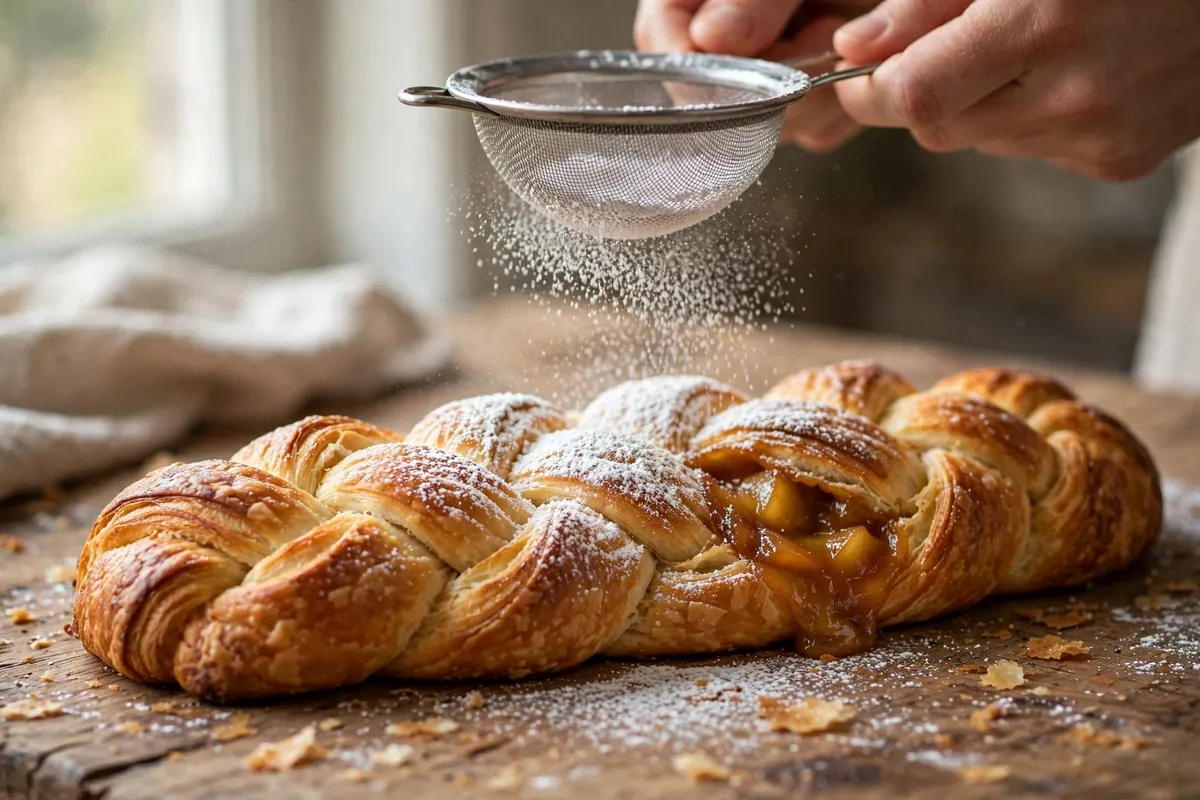
The filling can’t go back in, but the braid is rarely ruined. While warm, trim blackened, bitter bits with a knife or shears — scorched sugars taste acrid. Dust generously with powdered sugar: it hides a multitude of sins and looks intentional. Serve warm — a warm Danish with a little escaped filling reads as “rustic,” especially with coffee.
FAQ
Is it safe to eat a Danish braid that leaked?
Yes — leaked filling is just baked fruit and sugar. Trim any blackened, bitter bits; the rest is delicious.
Why did my Danish braid leak cream cheese filling?
The filling was too loose. Use full-fat block cream cheese (never tub spread), an egg yolk to set it, minimal sugar. If it pours rather than mounds, add another yolk or 1 tbsp flour.
Should Danish dough be cold going into the oven?
Yes — firm and cold after 20–30 minutes in the fridge. Cold laminated dough in a hot oven is the mechanism of flakiness; warm dough is the mechanism of leaks.
Can I use canned pie filling?
Yes — it’s pre-thickened, one of the safest options. If it’s loose in the can, simmer 5 minutes with 1 tbsp cornstarch per cup and cool before using.
Why did my braid unravel as well as leak?
Under-sealed seams plus no chill: strands weren’t glued with egg wash and warm dough relaxed open. Seal with egg wash, tuck ends under, chill before baking — the same fixes solve both. (See also cinnamon rolls and rugelach.)
How do I keep the bottom from getting soggy?
Bake on a preheated sheet or stone so the base sets fast, don’t overfill, and keep the filling thick — watery filling soaks the base. A dusting of flour or fine breadcrumbs under the filling absorbs stray moisture.
Related troubleshooting: Why Did My Croissants Come Out Dense? Lamination Fixes · Kouign-Amann Troubleshooting: Leaked Butter and Burnt Sugar, Fixed · Galette Troubleshooting: Soggy, Leaky, Cracked (Free-Form Pie Fixes)